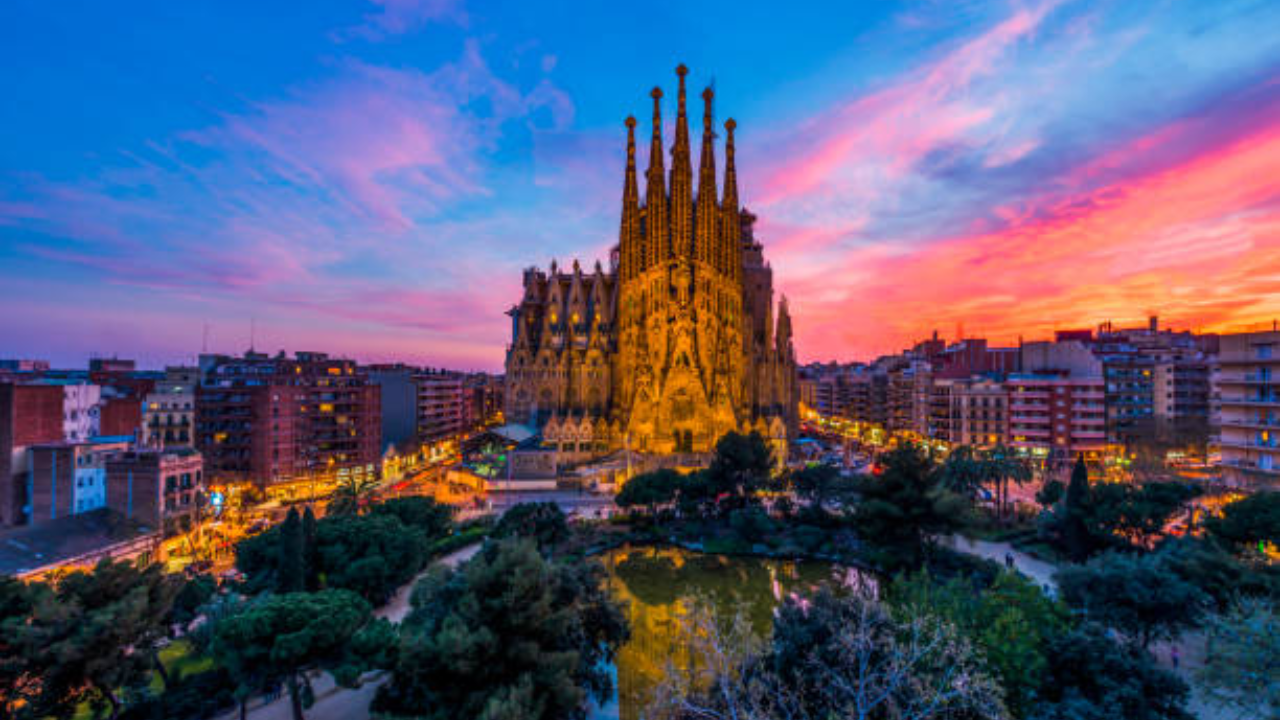
Achieving structural height milestones in masonry-dominated architecture is fundamentally an exercise in mass management, material efficiency, and load path optimization. The milestone of establishing the Sagrada Familia as the world's tallest church relies on a specific technological intervention: the incorporation of a 24-tonne high-performance adhesive and structural mortar composite system to secure prefabricated stone panels onto the central tower of Jesus Christ.
This intervention shifts the engineering paradigm from traditional compression-only unreinforced masonry to a hybrid post-tensioned and bonded stone system. By analyzing the mechanics of this operation, the logistics of prefabrication, and the long-term load distribution across Antoni Gaudí’s original geometry, we can deconstruct how modern material science enables the completion of a century-old architectural concept.
The Mechanical Cost Function of Height
As structural height increases, the dead load of the material grows non-linearly with respect to the load-bearing capacity of the base components. In traditional stone construction, every vertical meter added increases the compressive stress on the lower courses. Gaudí anticipated this limitation through his geometry, relying on catenary arches, inclined columns, and hyperbolic paraboloids to distribute weight outward rather than strictly downward.
However, modern regulatory frameworks and wind-load safety standards require structural tolerances that exceed historical empirical margins. The central tower, designed to reach 172.5 meters, demands a material system that can resist lateral wind shear without increasing the overall wall thickness, which would otherwise compromise interior spatial integrity and illumination.
The application of a high-performance bonding matrix—colloquially termed a "glue job"—serves three primary mechanical functions:
- Shear Transfer: It creates a continuous shear plane between independent stone modules, preventing relative slip under seismic or aerodynamic loading.
- Stress Redistribution: It eliminates local stress concentrations by filling microscopic irregularities in the stone interfaces, distributing uniform contact pressure.
- Tensile Enhancement: While stone possesses high compressive strength, its tensile and shear resistance are low. The polymer-modified adhesive composite introduces a localized tensile and bonding bridge across panel joints.
Prefabrication Logistics and Assembly Tolerances
The construction methodology relies on stone prefabrication off-site followed by chronological hoisting and assembly. This approach alters the traditional construction cost function by trading on-site masonry labor hours for precision digital modeling and computer numerical control (CNC) stone cutting.
Each granite and montjuïc stone panel is engineered with millimeter-level tolerances. When hoisted into position on the central tower, the margins for error are narrow. The 24-tonne adhesive application functions not merely as a sealant, but as a structural grout that accommodates thermal expansion differentials between the internal stainless-steel skeletal anchoring and the external stone cladding.
The installation sequence operates under strict environmental constraints:
- Temperature Windows: Polymerization rates of structural epoxies and mortars vary with ambient temperature, requiring controlled curing intervals.
- Load Application Timing: Temporary shoring must remain in place until the adhesive matrix achieves designated shear strength thresholds.
- Geodetic Monitoring: Laser interferometers track real-time deflection of the tower during panel placement to ensure symmetry and prevent eccentric loading.
Material Selection and Durability Variables
The choice of adhesive composite must balance immediate structural bonding with century-scale durability. Unlike organic sealants that degrade under ultraviolet radiation and thermal cycling, structural mortars used in monumental architecture must match the Young’s modulus of the surrounding stone as closely as possible.
If an adhesive is overly rigid, thermal expansion differences between the stone and the bonding agent will induce localized spalling. Conversely, if the adhesive is too flexible, cyclic wind loading will cause fatigue failure in the joints over decades.
The engineering team utilizes a specialized micro-silica-infused mortar and epoxy blend designed to achieve high early strength while maintaining long-term dimensional stability. This material choice mitigates the risk of moisture ingress, which is the primary catalyst for freeze-thaw degradation in exterior stone facades.
Strategic Outlook and Structural Monitoring
The completion of the central tower establishes a new benchmark for combining historical architectural geometry with modern high-performance materials. The integration of 24 tonnes of structural adhesive is a tactical solution to a systemic physical constraint: reaching record heights without violating the aesthetic proportions mandated by Gaudí's original scale models.
Future integrity relies entirely on continuous sensor feedback. Embedded fiber-optic strain gauges within the stone panels and adhesive joints provide real-time data on internal stress distribution, verifying whether the theoretical load models match empirical performance under actual wind and seismic conditions. The success of this vertical expansion validates the viability of hybridizing historical masonry design with advanced structural chemistry.