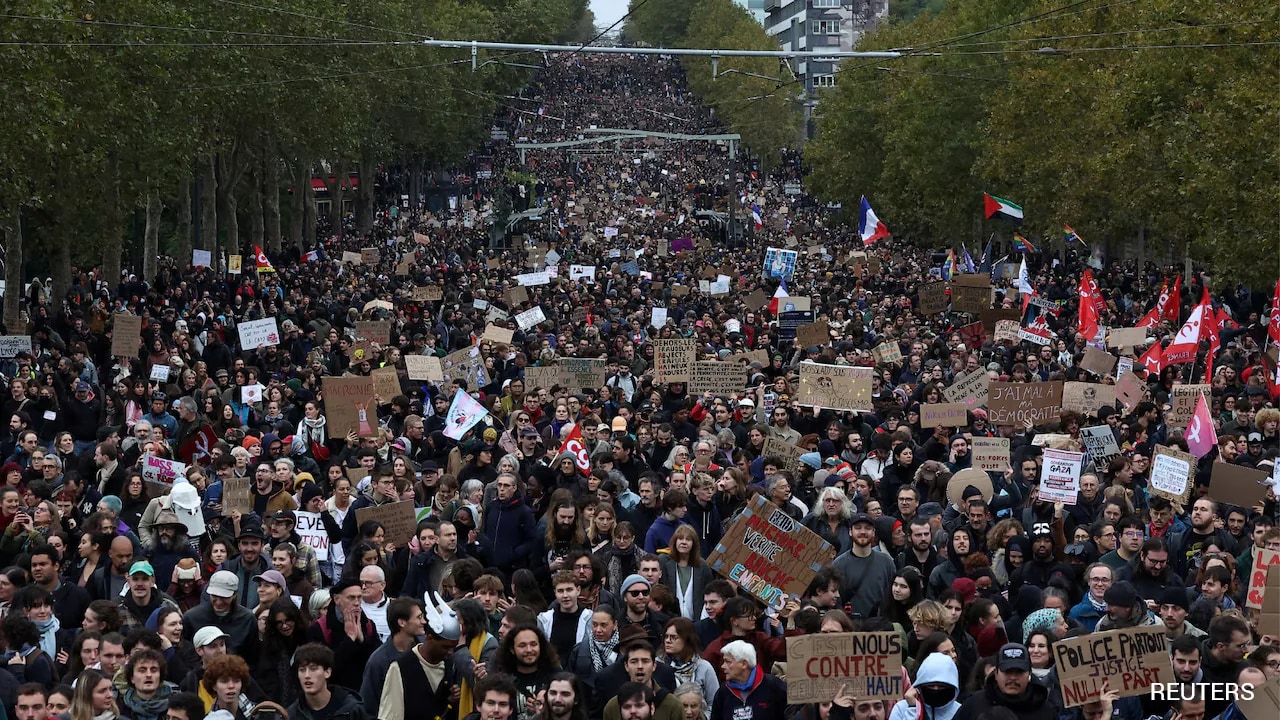
Mass civic mobilization functions through predictable equations of economic pressure, institutional friction, and spatial containment. When participation exceeds four hundred thousand individuals nationwide, as observed during the recent demonstrations across French urban centers, the phenomenon ceases to represent isolated labor grievances. It reflects a systemic misalignment between state administrative capacity and the economic security of the urban working and middle classes.
Understanding this dynamic requires deconstructing the mobilization into three core vectors: the economic cost function driving participation, the tactical spatial containment executed by the state, and the structural limits of presidential authority during periods of institutional deadlock. Meanwhile, you can find related developments here: When the Ashes Are Used Against You.
The Economic Cost Function of Mass Mobilization
Participation in protracted civil unrest is governed by an individual cost-benefit calculation. When inflation outpaces wage growth, and structural deficits in public services—such as the loss of millions of teaching hours due to unreplaced staff in secondary schools—transfer financial burdens directly to households, the opportunity cost of remaining passive rises.
Citizens face a dual economic squeeze: To see the bigger picture, we recommend the recent analysis by Al Jazeera.
- The Fixed-Cost Burden: Surging energy, fuel, and basic necessity prices compress disposable income, leaving zero margin for monetary shocks.
- The Human Capital Devaluation: Young adults holding advanced degrees encounter severe labor market friction, evidenced by high underemployment rates among recent graduates. This breaks the social contract wherein educational attainment guarantees economic mobility.
When these variables compound, the threshold for taking to the streets drops. The convergence of trade unions, high school students, and decentralized factions like the yellow vest movement illustrates a coalition of distinct economic casualties sharing a single grievance against state austerity and fiscal policy.
State Apparatus Response and Tactical Containment
Faced with recurring nationwide protests and the historical precedent of widespread property damage, the French Ministry of the Interior deploys a calculated operational doctrine. Rather than attempting to suppress demonstrations across entire metropolitan grids—a strategy prone to uncontrollable urban guerrilla tactics—authorities utilize a framework of spatial isolation and force concentration.
The state operationalizes this through three distinct defensive layers:
- Perimeter Quarantine: Restricting assembly points to peripheral zones, such as the outer edges of Paris near the Porte de Vincennes or Porte d'Italie, protects commercial cores and historic monuments from direct exposure.
- Massive Personnel Saturation: Deploying up to seventy thousand law enforcement officers, backed by specialized vehicles and mobile units, increases the probability of deterrence while enabling rapid compartmentalization when friction occurs.
- Preemptive Interdiction: Utilizing administrative checks, targeted arrests for weapon possession or group violence conspiracy before marches peak, and curfews in localized high-risk sectors.
While these measures successfully mitigate systemic commercial looting compared to previous unrest cycles, they inherently compress large crowds into restricted corridors. This spatial compression increases the kinetic friction between demonstrators and riot police, predictably triggering the deployment of tear gas and water cannons once projectiles are introduced.
Institutional Vulnerability and Political Deadlock
The political impact of sustained civil unrest depends on the temporal horizon of the executive branch. In the final months of a presidential term, the administration operates under acute vulnerability. Legislative concessions offered by the executive—such as promised overhauls of university admissions or minor policy adjustments—frequently fail to de-escalate the movement because trust in the institutional machinery has eroded.
Opposition parties on both the radical left and nationalist right exploit this vulnerability differently:
- The populist left leverages street mobilization to pressure the government into immediate distributive concessions and challenges police tactics directly.
- The nationalist right frames the public disorder as a failure of state security, channeling societal anxiety into electoral support for law-and-order platforms.
This dynamic traps the executive in a policy trap. Yielding entirely to street demands invites accusations of weakness and collapses fiscal discipline, whereas maintaining a rigid stance guarantees weekly recurrences of mobilization, draining state security resources and paralyzing public infrastructure.
Strategic Forecast
The recurrence of cyclical protests points toward chronic structural instability rather than a transient flashpoint. As long as structural labor market bottlenecks and educational deficits persist without fiscal remedies, urban centers will remain susceptible to rapid mobilization cycles. The state's reliance on high-density policing and geographic containment manages tactical property damage but leaves the underlying economic drivers unaddressed, ensuring that civil friction remains a permanent feature of the political landscape.


