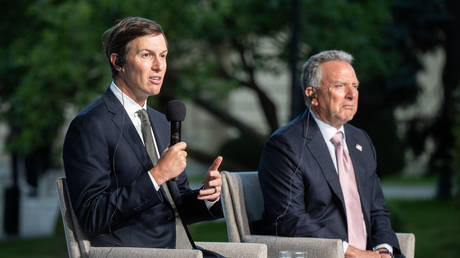
Diplomatic interventions in prolonged asymmetric conflicts fail when they rely on symmetrical concessions. The recent diplomatic push led by United States presidential envoys involving sequential talks in Miami, Abu Dhabi, and Moscow introduces a transactional framework attempting to break the current theater stalemate. By coupling territorial adjustments in the Donbas with prospective security architecture guarantees such as NATO accession, the initiative attempts to construct a grand bargain.
Evaluating the viability of this diplomatic mechanism requires stripping away political rhetoric to examine the underlying cost functions, red lines, and strategic constraints governing Kyiv, Moscow, and Washington. Meanwhile, you can explore related events here: Why Iran Boosting Arms Production 250 Percent is a Desperate Illusion.
The Operational Reality of the Strategic Stalemate
The conflict has settled into a grinding attrition dynamic characterized by high marginal costs for territorial gain and severe vulnerability of critical energy infrastructure on both sides. Secretary of State Marco Rubio’s characterization of the situation as a dangerous stalemate underscores the finite nature of military sustainability through upcoming winter cycles.
When military instruments reach diminishing marginal returns, belligerents typically turn to political and economic levers to alter the calculus. However, the structural divergence between the core security requirements of the participants creates a profound bargaining friction: To explore the full picture, check out the recent article by USA Today.
- Maximalist Territorial Objectives: Moscow maintains operational goals that incorporate the entirety of the administrative boundaries of the four annexed Ukrainian regions, regardless of immediate physical control.
- Inviolable Sovereignty Constraints: Kyiv operates under constitutional and domestic political mandates that prohibit the formal cession of sovereign territory or the codification of permanent neutrality.
- Domestic Electoral Timelines: External mediators face compressed political horizons, driving an urgent search for a durable ceasefire framework before subsequent legislative shifts alter domestic backing for mediation.
This asymmetry ensures that conventional diplomatic mediation—focused on minor adjustments at the contact line—cannot succeed. Any functional framework must alter the foundational security equations for the primary actors.
The Territorial-Security Trade-Off Mechanism
The core proposal floated by American intermediaries—exchanging a formal security guarantee, including potential NATO membership for Kyiv, for the effective relinquishment of the remainder of the Donbas region—represents a calculated attempt to trade spatial depth for structural permanence.
Analyzing this trade-off requires mapping the utility functions of both capitals.
[Territorial Concession (Donbas)] ---> Shifts Security Architecture ---> [Institutional Guarantee (NATO/West)]
For Ukraine, the primary risk of any territorial compromise is the erosion of deterrence. A ceasefire without robust, enforceable security guarantees merely establishes a low-cost staging ground for future offensive operations by the adversary. Conversely, securing a legally binding collective defense commitment addresses the primary existential threat, albeit at a catastrophic domestic and political cost regarding territorial integrity.
For Russia, the acquisition of the Donbas fulfills a symbolic and geopolitical objective, but it is counterbalanced by the primary strategic threat driving the original intervention: the eastward expansion of Western security structures. Allowing Ukraine to enter the NATO umbrella in exchange for territorial gains creates a contradictory outcome for Moscow unless paired with broader rollbacks of European security architecture, which the Kremlin has consistently demanded since 2021.
The European Security Variable and Alignment Friction
A critical dimension of the current diplomatic push involves expanding the negotiation table to include European representatives to address continent-wide security architecture. This creates structural friction between Washington’s desire for a rapid negotiated settlement and European capitals’ deep-seated anxieties regarding unilateral concessions to Moscow.
The inclusion of European security parameters introduces three distinct complications:
- The Representation Bottleneck: Moscow historically resists direct multilateral negotiations with European bodies, viewing them as secondary actors heavily aligned with the Ukrainian defense apparatus.
- Post-Ceasefire Enforcement: Proposals involving European military deployments to enforce a prospective ceasefire face immediate rejection from the Kremlin, which views foreign troops on Ukrainian soil as an unacceptable security threat.
- Sanctions and Energy Interdependence: Divergent economic policies—exemplified by intermittent tactical compromises on energy imports alongside ongoing sanctions enforcement—weaken the cohesive pressure required to compel long-term behavioral changes in Moscow.
Consequently, broadening the agenda to encompass European security risks diluting the immediate operational focus on a cessation of hostilities, transforming a bilateral territorial dispute into a comprehensive structural renegotiation of the post-Cold War security order.
Assessing the Structural Limitations
No diplomatic framework currently on the table constitutes a frictionless solution. The limitations of the current mediation strategy stem from mutually exclusive legal and political imperatives.
- Constitutional Rigidities: Kyiv cannot legally alter its alignment status or ratify territorial losses without risking domestic political collapse.
- Enforcement Deficits: Security guarantees that rely on external political will are subject to future electoral shifts in donor nations, rendering them inherently fragile from the perspective of front-line states.
- Escalation Dynamics: In the absence of a negotiated settlement, the alternative to stalemate remains escalation, with structural risks of geographic spillover across the broader European theater.
The immediate utility of the current diplomatic cycle lies not in the immediate realization of a comprehensive peace treaty, but in the delineation of precise boundary conditions for future negotiations. Progress on humanitarian vectors, such as large-scale prisoner exchanges, serves as a confidence-building mechanism to test administrative channels, while foundational disagreements over territorial sovereignty and alliance architectures remain deadlocked.
Strategic Forecast and Implementation Pathway
To transition from exploratory mediation to an enforceable settlement, intermediaries must abandon the expectation of a simultaneous, holistic resolution of both territorial and regional security architectures. The sequencing must follow strict operational logic:
Prioritize an unconditioned, monitored cessation of hostilities along current contact lines decoupled from final status determinations on sovereignty.
Establish independent, bilateral enforcement mechanisms backed by unambiguous material commitments from primary security providers rather than sweeping multilateral treaties that invite protracted diplomatic gridlock.
Defer structural modifications to European security architecture until a functioning ceasefire has endured across operational weather cycles, thereby decoupling the immediate survival of the Ukrainian state from broader geopolitical realignment negotiations.