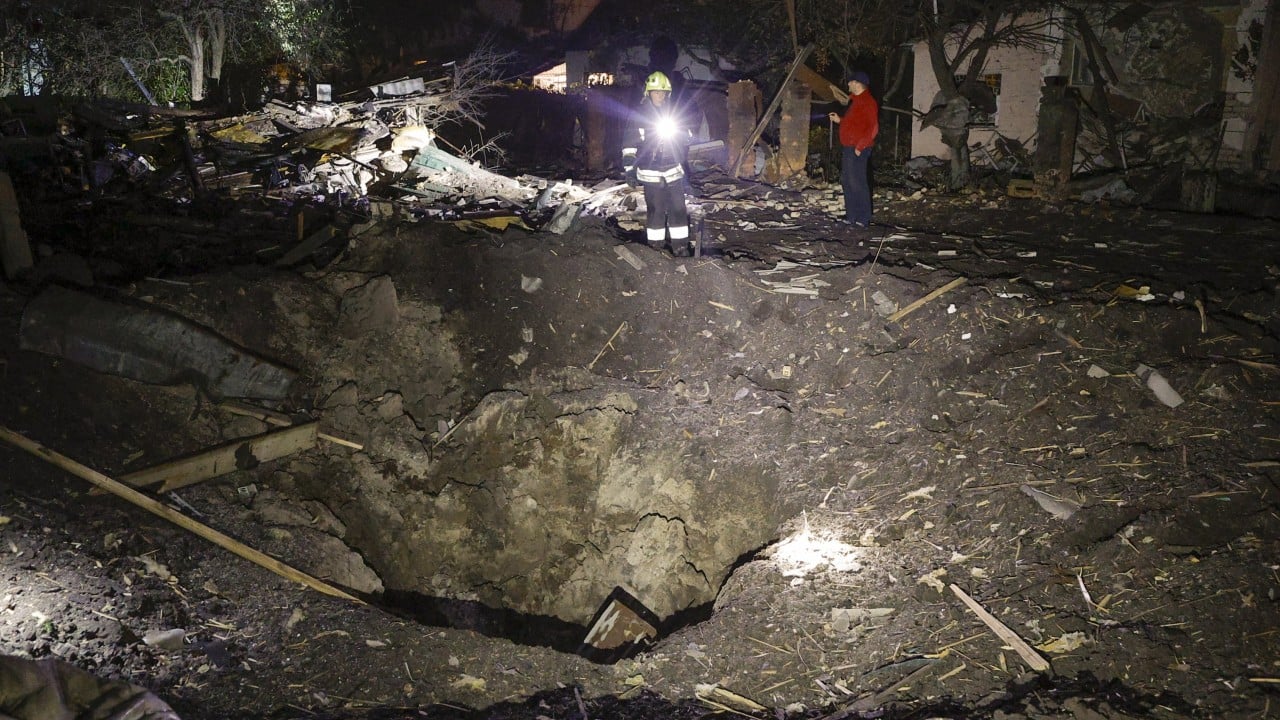
Strategic conflict analysis requires abandoning reactive journalism in favor of structural stress-testing. When state actors trade sustained high-intensity kinetic strikes while parallel diplomatic actors signal imminent mediation pressure, observers witness a dual-track dynamic: battlefield escalation driven by tactical windowing, paired with signaling campaigns designed to establish pre-negotiation baselines. Evaluating this environment demands an examination of supply-side constraints, military attrition metrics, and the incentive structures governing third-party mediation.
The Attrition Function of Long-Range Strikes
Military campaigns characterized by cross-border aerial bombardments operate on a strict cost-asymmetry principle. The deployment of long-range precision munitions serves three distinct operational objectives: degrading industrial capacity, depleting adversary air-defense interceptor inventories, and imposing sustained psychological overhead on civilian populations to fracture internal cohesion.
[Precision Munitions Input]
       │
       ├──► Target 1: Energy & Logistics Grid (Degrades Industrial Output)
       ├──► Target 2: Air Defense Radars & Launchers (Forces Interceptor Depletion)
       └──► Target 3: Urban Centers (Imposes Civil-Military Friction)
Targeting infrastructure is rarely about immediate territorial capture; it is an economic calculation. Every high-end ballistic or cruise missile expended forces the defender to fire multiple interceptors whose replacement cost and manufacturing lead times vastly exceed the offensive platform. This creates a widening inventory deficit over time.
The strategic utility of trade-off strikes relies on localized windows of operational weather, satellite reconnaissance availability, and electronic warfare suppression. When both combatants escalate simultaneous deep-strike campaigns, each side attempts to demonstrate resilience beyond the adversary's threshold of pain, signaling that continued attrition will yield diminishing marginal returns for the opponent.
Diplomatic Leverage and the Pre-Negotiation Window
External political actors attempting to broker or accelerate cessation frameworks introduce an entirely separate vector of pressure. High-level diplomatic signaling—particularly from dominant economic or military patrons—functions as a temporal constraint on commanders in the field.
When political leadership asserts that progress toward a settlement is occurring, military doctrine dictates an immediate intensification of operations. Combatants operate under the rational assumption that the territorial and strategic lines held at the precise moment of a ceasefire will form the de facto framework for any subsequent partition, demilitarized zone, or legal settlement.
This creates a high-stakes acceleration loop:
- Territorial Positioning: Units push past defensive lines to capture logistically advantageous high ground before talks formalize.
- Resource Conservation vs. Expenditure: Munition stockpiles are aggressively burned to secure maximum tactical advantage, balancing future scarcity against immediate leverage gains.
- Information Dominance: Public signaling is weaponized to frame the adversary as intransigent, justifying further escalation to domestic and international constituencies.
Resource Bottlenecks and Industrial Capacity
The long-term viability of high-intensity state-on-state conflict is strictly bounded by industrial capacity rather than tactical brilliance. Modern military operations consume raw materials, microelectronics, chemical propellants, and replacement barrels at rates that legacy peacetime manufacturing bases cannot sustain without systemic reallocation.
The primary friction points involve specialized supply chains:
- Solid Rocket Motors: The production bottleneck for tactical missiles and air-defense interceptors relies on specialized composite materials and skilled chemical engineering labor.
- Barrel Wear and Artillery Maintenance: Sustained high-volume barrel usage degrades accuracy, requiring industrial-scale heavy forging capabilities that exist in very few global jurisdictions.
- C4ISR Integration: Command, control, communications, computers, intelligence, surveillance, and reconnaissance systems depend on semiconductor supply chains vulnerable to geopolitical friction and trade restrictions.
When industrial replacement rates lag behind consumption rates, operational tempo becomes a zero-sum calculation. Commanders must ration capabilities, reserving precision assets for high-value targets while relying on mass-produced, lower-accuracy alternatives for general suppression tasks.
Strategic Forecast
The convergence of intensified kinetic exchanges and external political intervention points toward a narrowing window of maneuver. As both sides exhaust their immediate surge inventories, the friction of industrial replacement will force a transition from expansive offensive operations to stabilized attrition management.
Future developments will not be determined by sudden ideological shifts, but by quantitative thresholds: inventory depletion rates for air defense systems, the fiscal sustainability of domestic subsidy models under infrastructure strain, and the ability of mediating powers to align enforcement mechanisms with vital security interests. Stakeholders must monitor logistical output metrics rather than diplomatic rhetoric to gauge the true trajectory of the conflict.