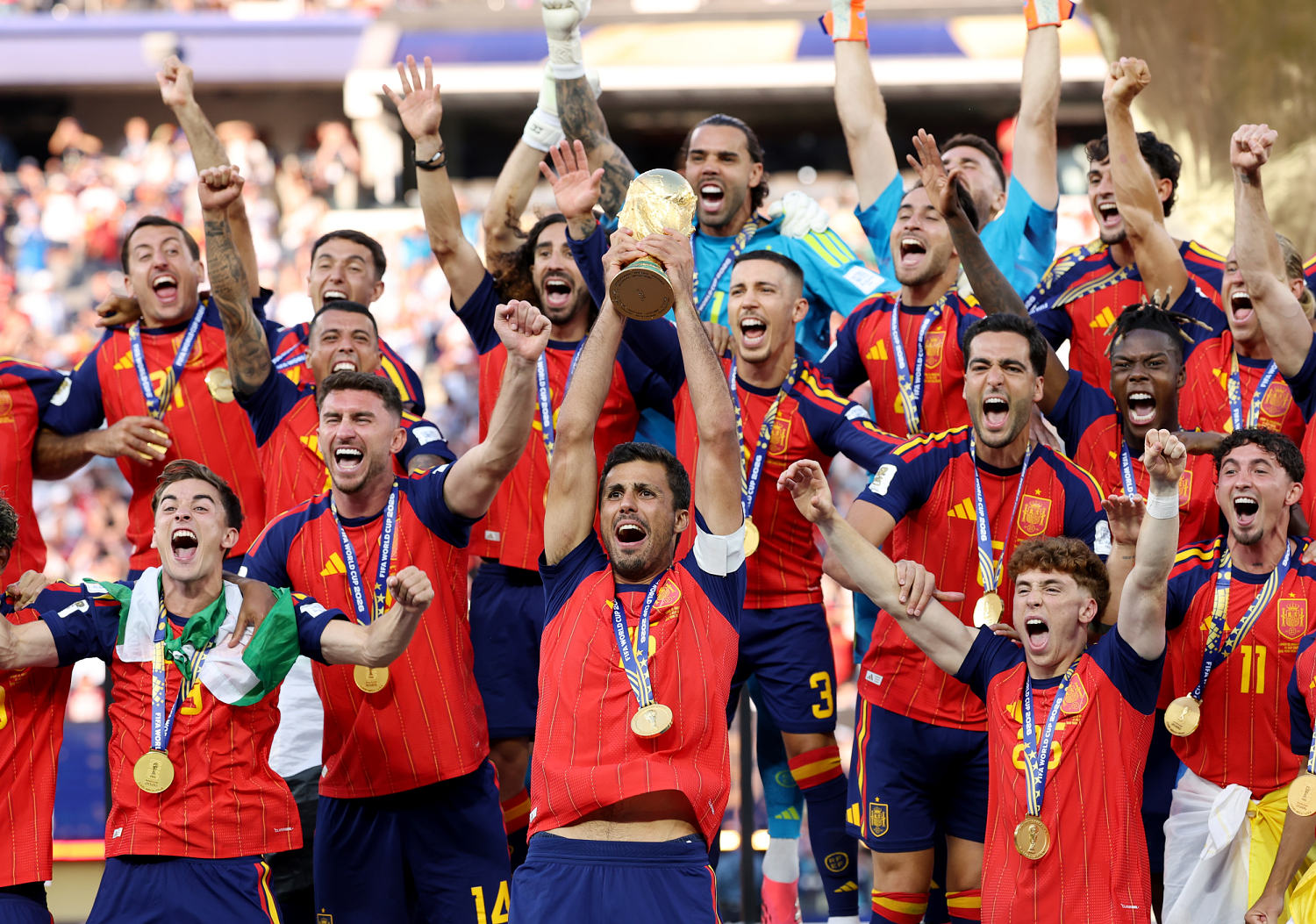
International football matches are won through structural efficiency rather than episodic brilliance. Spain’s 1–0 extra-time victory over Argentina at New York New Jersey Stadium in the 2026 FIFA World Cup final represents the logical outcome of a decade-long system overhaul. By combining high-volume positional control with direct vertical outlets, Spain neutralised Argentina’s attacking infrastructure, allowing zero shots on target through normal time and outshooting the defending champions 20 to 4 over 120 minutes.
Analyzing this victory requires stripping away narrative abstractions and evaluating the technical, tactical, and organizational frameworks that produced the outcome. Spain’s tournament performance—yielding just one goal conceded across eight matches and extending an international unbeaten streak to 38 games—functions as an engineering case study in elite performance optimization.
The Tactical Infrastructure of Deflationary Possession
Traditional Spanish positional play relied heavily on horizontal ball circulation to manipulate low blocks. While this framework generated sustained possession metrics above 70%, it frequently suffered from low conversion rates and vulnerability to direct counter-attacks. Under Luis de la Fuente, Spain refined this model into a dual-threat system: maintaining high possession volume while incorporating direct wide acceleration.
Spatial Control via Asymmetrical Directness
The tactical mechanics of Spain’s 2026 campaign rested on the structural interaction between the central midfield axis and wide wingers Lamine Yamal and Nico Williams.
- Central Overloads: The midfield triangle of Rodri, Fabian Ruiz, and Pedri maintained tight inter-unit distances, forcing opposition central midfielders into narrow defensive channels.
- Isolated Iso-play: By drawing the opponent’s defensive mid-block inside, Spain consistently isolated wide defenders against Yamal and Williams in one-on-one spatial scenarios.
- Verticality Metrics: Rather than recycling possession backward when pressed, Spain executed forward passes into the final third at a rate 24% higher than during their 2010 World Cup campaign.
In the final against Argentina, this structural asymmetry continuously shifted Argentina’s backline. The match-winning sequence in the 106th minute originated from Yamal initiating a right-side build-up, shifting defensive cover before switching play to the left flank where Williams headed Pedro Porro’s deep delivery back into the central box for Ferran Torres to finish.
[Opponent Low Block]
    ↓ (Drawn inward by central midfield overload)
[Isolated Wide Flanks] ───> [Vertical Penetration via Yamal / Williams]
    ↓
[High-Probability Chance Creation in Central Box]
Rest Defense and Neutralization of Transition Engines
Spain’s defensive record—one goal conceded in eight matches—was not built on reactive central defending, but on immediate counter-pressing and rest defense positioning.
Rest defense refers to the positioning of non-attacking players while their team possesses the ball. When Spain attacked in the final third, a minimum of five outfield players remained structured behind the ball line.
- The Central Anchor: Rodri occupied the primary central channel, suppressing opposition outlet passes before they cleared the center circle.
- Full-Back Inversion: One full-back regularly tucked inward alongside the central defenders, forming a three-man rest defense base.
- Target Neutralization: Argentina captain Lionel Messi was restricted to 54 total touches and zero chances created—the first time in his 34 World Cup appearances he failed to create a key opportunity. This was achieved by closing his receiving lanes before the first pass was made, leaving him isolated in non-threatening midfield zones.
By limiting Argentina to 433 completed passes compared to Spain's 845, Spain converted ball control into a defensive shield that prevented opposition counter-attacks from maturing into shot opportunities.
Defensive Efficiency as a Quantitative Anomaly
Spain’s 2026 defensive output established historical precedents. The team became the first world champion in FIFA history to concede only a single goal over the course of a full tournament while going 519 consecutive minutes without conceding a goal, breaking Walter Zenga's 1990 record.
Evaluating these defensive numbers requires looking at expected goals against ($xGA$) and press-resistance coefficients rather than surface-level clean sheets.
| Tournament Metric | Spain 2026 Baseline | Historical Tournament Average |
|---|---|---|
| Goals Conceded Per Game | 0.125 | 0.85 |
| Shots Allowed Per 90 Min | 3.8 | 10.2 |
| Opposition Shots on Target Rate | 18.2% | 33.5% |
| Possession Percentage | 65.4% | 50.0% |
Press Resistance as a Structural Shield
When an opposing team applies a high press, the build-up team faces two options: play long balls with low possession retention probability, or execute high-risk short passes to break the pressing lines.
Spain selected the second option consistently. Goalkeeper Unai Simón and center-back Pau Cubarsi functioned as deep playmakers, completing passes under pressure at a 91% rate. This eliminated opposition high-pressing strategies. When opponents attempted to press high, Spain bypassed the first line of press, creating numerical advantages in the middle third. When opponents dropped into a low block, Spain controlled tempo and territory, starving opposition forwards of service.
Macro Structural Mechanics of National Talent Pipelines
Spain’s success on the international stage across both men's and women's divisions—where both national teams simultaneously hold world number one rankings and World Cup titles—points to system-wide talent development frameworks within the Royal Spanish Football Federation (RFEF).
RFEF Academy Standardization and Positional Archetypes
Unlike national associations that rely on individual talent anomalies, Spanish football utilizes standardized tactical profiles from age-grade academies up to the senior national team.
- Cognitive Speed Training: Youth academies prioritize decision-making speed under tight spatial conditions over raw physical profile metrics.
- Universal Positional Archetypes: Every midfielder produced within the system understands the timing mechanisms of positional play, allowing substitute players like Ferran Torres and Mikel Merino to enter high-intensity matches without disrupting team cohesion.
- In-Game Adaptability: When tactical shifts are ordered, such as switching from a 4-3-3 build-up to a 3-2-5 attacking structure, players execute spatial adjustments without needing extensive sideline instruction.
Economic and Financial Compounding Effects
Winning the 2026 World Cup generated an immediate $50 million payout from FIFA’s $727 million overall prize pool. The economic distribution model amplifies long-term performance advantages:
[FIFA $50M Championship Payout]
    ↓
[Reinvestment in Youth Infrastructure & Coaching Analytics]
    ↓
[Higher Production Rate of Press-Resistant Talent]
    ↓
[Sustained Tournament Performance & Commercial Revenue]
This financial infusion compounding with existing academy infrastructure creates a recurring competitive advantage that national associations reliant on short-term tactical fixes cannot match.
Strategic Implementation Model for National Associations
To match Spain's systemic dominance, competing football federations must abandon short-term managerial turnarounds and execute a long-term structural restructuring across three primary operational areas.
First, transition youth development criteria away from physical metrics (height, acceleration, power) toward tactical perception indices (scanning frequency, pass completion under pressure, spatial awareness). Player identification protocols must prioritize technical execution in high-density areas.
Second, construct a unified tactical philosophy across all national team age levels ($U15$ through senior squad). This ensures tactical familiarity, allowing incoming players to execute defensive rest structures and build-up patterns without steep learning curves during short international break windows.
Third, replace low-block reactive defensive systems with ball-possession rest defense frameworks. Winning major international tournaments requires controlling spatial variables and minimizing total match variance. Relying on counter-attacking efficiency leaves national teams vulnerable to marginal refereeing decisions, individual mistakes, and late-game variance. Systemic spatial control remains the only scalable framework for sustainable tournament success.