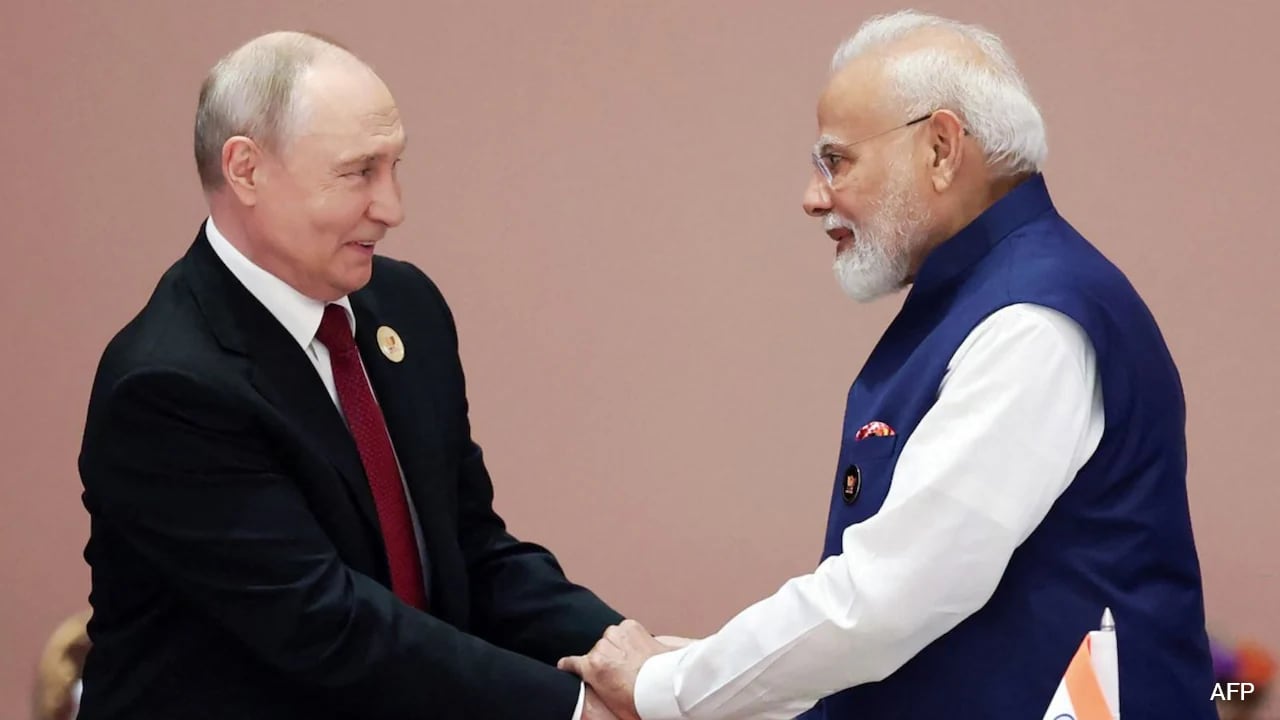
International diplomatic architecture remains anchored to the distribution of power established in 1945. The United Nations Security Council, designed as an executive committee for the victorious powers of the Second World War, exhibits structural rigidity that systematically fails to reflect contemporary geopolitical realities. Russia's explicit backing of India's bid for a permanent seat on the Security Council is frequently interpreted through the superficial lens of bilateral opportunism or rhetorical solidarity. A rigorous examination of the structural incentives, voting mechanics, and institutional friction points reveals a different reality. This development represents a calculated maneuver within a broader multi-polar balancing strategy designed to alter the governance equilibrium of international institutions.
Deconstructing the mechanics of United Nations reform requires isolating three distinct operational variables: the formal amendment process under Article 108 of the Charter, the veto threshold mandated by Article 27, and the regional coalition dynamics that dictate intergovernmental bargaining. Understanding how these variables interact clarifies why declarations of support from existing permanent members operate more as diplomatic signaling devices than as actionable pathways to institutional restructuring. If you enjoyed this article, you should check out: this related article.
The Institutional Bottleneck of Article 108
Any structural modification to the Security Council requires an amendment process governed by strict legal criteria. Article 108 mandates that amendments to the Charter must be adopted by a vote of two-thirds of the members of the General Assembly and ratified by two-thirds of the Members of the United Nations, including all five permanent members of the Security Council. This requirement introduces an absolute veto gate at the final stage of any reform trajectory.
When a permanent member like the Russian Federation publicly endorses a candidate state, analysts frequently miscalculate the legal weight of that endorsement. A declaration of support satisfies only one-fifth of the permanent member ratification requirement. It does not bypass the procedural friction within the General Assembly, nor does it resolve the regional opposition blocs that actively undermine expansion proposals. For another angle on this event, refer to the recent coverage from Al Jazeera.
The structural cost function for India's inclusion involves navigating the intersecting vetoes of rival regional actors. For instance, the Uniting for Consensus movement—informally known as the Coffee Club, comprising states such as Pakistan, Italy, Argentina, and South Korea—operates specifically to block proposals that would grant permanent seats to regional rivals without establishing a consensus on a broader, more equitable formula. Russia's endorsement alters the posture of one major power, but it leaves the systemic friction points of the General Assembly untouched.
The Multi-Polar Hedging Strategy
To understand why Moscow chooses to reinforce New Delhi's institutional ambitions, one must examine the broader shifts in global power distribution. Russian foreign policy operates under severe systemic constraints resulting from Western sanctions, economic redirection toward Asian markets, and a declining ability to project unilateral influence in traditional spheres. In this operational environment, cementing strategic alignment with rising global south economies is an economic and diplomatic imperative.
By supporting India's permanent membership bid, Moscow achieves three distinct objectives within its strategic calculus:
- Institutional Legitimation of Multi-Polarity: By advocating for the inclusion of a major developing economy in the apex body of international security, Russia aligns itself rhetorically with the broader Global South grievance against Western-dominated governance structures.
- Bilateral Leverage Preservation: Endorsements in international forums serve as low-cost, high-yield diplomatic capital. They reinforce existing bilateral trade corridors—particularly in energy and defense technology—without requiring immediate security commitments that could overextend Russian capabilities.
- Counter-Balancing Western Hegemony: The current configuration of the P5 features three Western states (the United States, the United Kingdom, and France) alongside Russia and China. Expanding the permanent membership to include a state that maintains strategic autonomy and multi-aligned foreign policy frameworks complicates the ability of the Western bloc to command consensus on critical security resolutions.
This dynamic exposes the underlying transactional nature of great power diplomacy. Support for institutional reform is rarely driven by abstract principles of equity; it is deployed as an instrument to alter the voting weights and coalition dynamics of international decision-making bodies.
Regional Counter-Frictions and the Cost of Expansion
A rigorous evaluation of Security Council reform cannot ignore the internal contradictions of expansion. Adding permanent members without addressing the dysfunctional nature of the existing veto power risks compounding organizational paralysis rather than resolving it.
If India, Brazil, Germany, and Japan—collectively known as the G4—were simultaneously granted permanent seats, the total number of permanent veto-wielding entities would expand from five to nine. From a game-theoretic perspective, increasing the number of veto players exponentially raises the transaction costs of achieving consensus. In situations involving international crises or humanitarian intervention, a larger Security Council with expanded veto capabilities would likely experience higher rates of institutional gridlock.
Furthermore, regional power dynamics create severe negative externalities for any unilateral endorsement. Pakistan's structural opposition to India's permanent seat is rooted in a security dilemma where institutional parity on the global stage translates directly into perceived regional vulnerability. Similarly, China's official posture toward India's bid remains ambiguous or conditionally restrictive, balancing competitive bilateral tensions against the desire to maintain solidarity within broader frameworks like BRICS and the Shanghai Cooperation Organisation.
When Moscow backs New Delhi, it implicitly accepts the friction this generates within its relationship with Beijing. That calculated risk demonstrates that Russia views the consolidation of a non-Western economic and political axis as a higher priority than appeasing Chinese regional sensitivities on this specific institutional question.
Strategic Trajectory and Institutional Futility
The pursuit of a permanent seat on the United Nations Security Council is an exercise in long-term positional bargaining. The probability of a formal amendment to the UN Charter occurring under the current international climate approaches zero, given the irreconcilable divergence of interests among the P5 and regional middle powers.
Consequently, declarations of support must be measured by their utility in shaping diplomatic narratives rather than their immediate legal outcomes. India continues to build comprehensive national power through economic growth, technological scaling, and strategic partnerships across both Western and non-Western blocs. The institutional architecture of 1945 will eventually face a point of structural rupture, not because of normative appeals to fairness, but because the distribution of global economic and military output will render the current governance model entirely disconnected from operational reality. When that systemic tipping point arrives, the prior diplomatic positioning established by endorsements from major powers will serve as the baseline for negotiating a new international equilibrium.