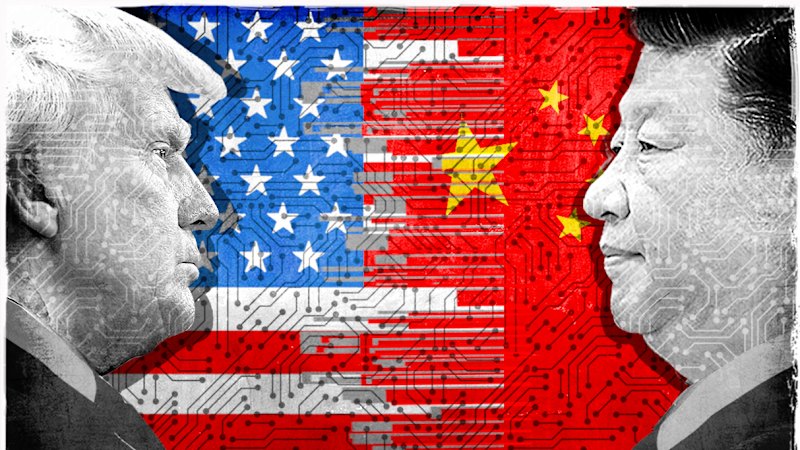
Public discourse regarding the geopolitical competition in artificial intelligence between the United States and China is dominated by binary narratives. Observers frequently swing between panic over putative Chinese supremacy and complacency regarding American institutional advantages. Both extremes obscure the underlying mechanics of the rivalry. The strategic balance between the two superpowers is not defined by a single metric of computational scale or a monolithic national triumph. Instead, it is governed by asymmetric capabilities, divergent resource constraints, and distinct structural dependencies across the entire technology stack.
Evaluating the competitive position requires dismantling the broad concept of artificial intelligence into its constituent layers: foundational compute hardware, algorithmic architecture, data pipelines, energy infrastructure, and commercial integration. When analyzed through this disaggregated lens, the narrative of an outright American lead evaporating overnight gives way to a complex picture of mutual vulnerabilities and narrow, hard-fought strategic moats.
The Compute Bottleneck and Hardware Asymmetry
The foundational layer of modern machine learning is physical computation, anchored primarily by advanced semiconductor fabrication and specialized accelerators. The United States maintains a decisive advantage at the frontier of semiconductor design and lithography. Through stringent export controls implemented by the Bureau of Industry and Security, Washington has sought to restrict Beijing's access to extreme ultraviolet lithography equipment and high-end graphics processing units required to train frontier models.
Yet, hardware restrictions alter optimization pathways rather than halting development entirely. The economic and engineering response to export controls dictates a shift in algorithmic efficiency and hardware utilization.
- Cluster-Level Scaling: American labs construct massive, centralized training clusters containing tens of thousands of accelerators communicating via ultra-low-latency interconnects. This brute-force scaling approach relies on uninterrupted access to bleeding-edge silicon.
- Distributed and Heterogeneous Computing: Constrained by hardware ceilings, Chinese engineering efforts have pivoted toward optimizing training workloads across fragmented, lower-tier domestic silicon and maximizing the efficiency of inter-node communication protocols.
This dynamic creates a divergent cost function. American firms absorb higher capital expenditure for raw computational power, whereas Chinese entities invest heavily in algorithmic efficiency to extract higher performance from constrained hardware envelopes. While brute-force scaling currently holds the crown for frontier capability, the long-term compounding effects of engineering efficiency under duress present a persistent competitive wildcard.
Data Ecosystems and Structural Divergence
Data availability and curation represent the second critical axis of competition. The common assumption that data volume dictates model quality is fundamentally incomplete. The utility of a dataset is a function of its structural diversity, annotation fidelity, and alignment with specific deployment environments.
The United States benefits from a globally distributed digital economy. American foundation models ingest broad multilingual corpuses, diverse codebases from open-source repositories, and rich user interaction data spanning multiple continents. This enables general-purpose capabilities designed for universal applicability across Western regulatory and cultural frameworks.
Conversely, China operates within a more walled, yet intensely optimized, domestic data ecosystem.
- Industrial and Manufacturing Telemetry: China's dominance in hardware manufacturing, supply chain logistics, and physical infrastructure generation yields proprietary streams of real-world operational data that are difficult to replicate in service-dominated Western economies.
- State-Backed Coordination: Public-private alignment facilitates large-scale data pooling for specific national priorities, such as autonomous transport grids, smart-city deployments, and specialized medical diagnostics.
The strategic trade-off is clear. The American data diet fosters broad, creative, and generalized intelligence suited for open markets. The Chinese data diet accelerates vertical integration, automation of physical processes, and optimization within controlled operational boundaries.
The Energy Constraint and Infrastructure Physics
Compute scale is ultimately bounded by thermodynamics. Training and deploying large language models demand immense electrical power and sophisticated cooling infrastructure. The geographic distribution of this energy footprint introduces a critical variable into national strategies.
The United States faces mounting grid constraints, particularly around major data center hubs in Northern Virginia and the Pacific Northwest. Meeting the exponential power demands of next-generation clusters requires integrating new baseload energy sources, including a resurgence of interest in nuclear power contracts, alongside aggressive grid modernization. Permitting bottlenecks and regulatory friction often slow the pace of physical infrastructure deployment in Western democracies.
China approaches the energy equation through state-directed infrastructural planning. The ability to mandate transmission line construction, subsidize heavy electrical generation, and rapidly site mega-scale data centers in regions with surplus renewable or coal-fired capacity provides a distinct velocity advantage in physical buildout. However, this infrastructure is increasingly pressured by national carbon reduction targets and the geographical mismatch between inland renewable generation and coastal demand centers.
Talent Pipelines and Research Mobility
Human capital remains the ultimate engine of technological iteration. The global AI talent market has historically been characterized by a unidirectional flow of top-tier researchers from international institutions into American academic labs and enterprise research groups.
Immigration policies and academic prestige have anchored the United States as the global magnet for foundational research talent. The concentration of capital, venture ecosystems, and computing resources in American tech hubs creates a self-reinforcing loop that attracts the world's most capable engineers.
Simultaneously, China has systematically expanded its domestic technical education pipelines, producing a high volume of engineering graduates specialized in applied mathematics, hardware-software co-design, and systems engineering. While historical barriers existed regarding basic research breakthroughs, domestic funding initiatives and localized research clusters have significantly narrowed the gap in publishing volume and architectural innovation at premier conferences.
The risk for the United States lies not in a lack of domestic brilliance, but in the fragility of its open immigration architecture. Restrictive visa policies risk severing the inflow of international expertise that has historically powered American technological dominance.
Commercial Integration and Deployment Velocity
Possessing a superior model is distinct from achieving systemic economic transformation. The ultimate test of national strategy is the speed and depth with which artificial intelligence is integrated into the broader industrial base and public sector.
The American commercial landscape excels at software-as-a-service distribution, venture-backed enterprise software integration, and consumer-facing application ecosystems. Market-driven incentives ensure rapid capital allocation toward high-margin use cases, though this can result in duplicated efforts and short-term commercial focus.
In contrast, China's strategic deployment model emphasizes deep vertical integration into state-owned enterprises, municipal administration, and heavy industry.
- State-Directed Adoption: Policy mandates compel state-owned industrial sectors to adopt domestic automation technologies, creating guaranteed baseline demand for enterprise AI solutions.
- Ecosystem Fusion: The integration of artificial intelligence with ubiquitous digital payment platforms, logistics networks, and surveillance apparatuses yields high systemic friction reduction in day-to-day economic transactions.
This structural approach allows for rapid scaling of proven applications across massive domestic populations, even if consumer preference models operate under tighter ideological and regulatory constraints.
Strategic Realignment
The premise that the United States has unequivocally lost its lead is analytically flawed, resting on a superficial reading of export headlines and isolated benchmark scores. Equally flawed is the assumption that traditional market dominance guarantees permanent security.
The competitive reality is a protracted contest of asymmetric advantages. The United States leads in foundational architectural innovation, capital depth, and global software distribution. China leads in manufacturing integration, targeted infrastructure velocity, and systems optimization under resource constraints.
Sustaining strategic competitiveness requires abandoning panic-driven resource dispersion in favor of targeted structural interventions. Policy must focus on shoring up domestic energy transmission, streamlining permitting for critical infrastructure, reforming high-skilled immigration pathways to retain global talent, and incentivizing resilient, hardware-agnostic algorithmic efficiency. The nation that wins the next phase of the artificial intelligence transition will not be the one with the largest single cluster or the most permissive regulatory environment, but the one that most effectively converts computational power into systemic economic and operational resilience.