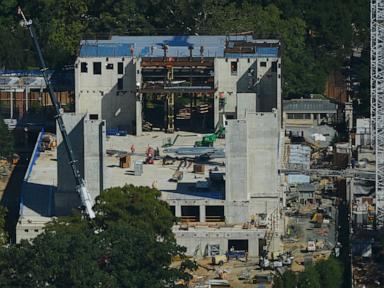
The convergence of architectural expansion and counter-unmanned aerial systems engineering within the executive complex presents a striking study in institutional redundancy. When proposals for structural additions intersect with pre-existing tactical capabilities, the resulting friction points reveal the complexities of institutional airspace management, jurisdictional overlap, and resource allocation at the highest levels of national security infrastructure.
To evaluate this dynamic, one must examine the operational mechanics governing the capital's restricted airspace. The executive complex occupies an intensely monitored 18-acre footprint nested inside Federal Aviation Administration Special Flight Rules Areas. Managing low-altitude aerial threats requires a multi-layered detection and interdiction apparatus. The operational reality of this environment is defined by three primary variables: sensor coverage density, response latency, and inter-agency command structures. For an alternative look, see: this related article.
Historically, low-altitude defense over the federal city relied on perimeter monitoring and reactive intercept protocols. The rapid proliferation of commercial and tactical unmanned aerial systems necessitated a structural shift toward proactive airspace denial. Counter-unmanned aerial systems networks integrate radio frequency detection, optical tracking, and active mitigation units. These systems require continuous line-of-sight and unobstructed electromagnetic horizons to achieve maximum detection range.
Within this operational framework, the establishment of localized drone hubs serves a distinct tactical function: reducing intercept latency. When a dynamic aerial anomaly breaches restricted zones, every second of transit time saved by positioning response units closer to the perimeter alters the probability of successful mitigation. However, spatial optimization dictates that proximity yields diminishing returns once a minimum operational radius is achieved. Similar reporting regarding this has been provided by BBC News.
This brings the structural analysis to the core paradox of dual-station deployment. The United States Secret Service maintains established aviation security infrastructure immediately adjacent to the executive grounds, utilizing dedicated docking units and surveillance arrays designed to screen the immediate perimeter. Introducing an additional, highly publicized aerial defense station atop newly planned architectural structures creates a condition of functional redundancy.
From an operational perspective, dual installations in such close proximity generate several systemic challenges:
First, electromagnetic and acoustic interference must be managed. Operating multiple counter-unmanned aerial systems nodes within hundreds of feet of each other risks sensor saturation, cross-talk, and signal degradation. Radio frequency jammers or interrogators deployed simultaneously from competing nodes can unintentionally blind adjacent friendly systems unless rigorously synchronized.
Second, command and control de-confliction introduces friction. Institutional authority over executive airspace belongs primarily to federal protection details and specialized military detachments. Superimposing an architectural asset that houses tactical hardware requires clear protocols to prevent ambiguous jurisdiction during a fast-moving security event. When multiple nodes possess overlapping fields of fire or monitoring capabilities, decision-making velocity can paradoxically decrease due to the necessity of inter-agency verification.
Third, the capital's airspace is among the most congested in the nation, bounded by civilian flight paths operating near major regional transport hubs. Introducing elevated launch and recovery platforms within the immediate urban core requires intricate coordination with national air traffic control frameworks. Every new localized launch point multiplies the variables that must be processed by automated de-confliction algorithms.
The strategic play moving forward depends on whether the proposed architectural asset functions as an active tactical node or a passive structural reinforcement. If integrated seamlessly into the existing technical architecture managed by protective details, the installation must operate as a synchronized extension rather than an independent garrison. True optimization in executive defense architecture is measured not by the accumulation of visible deterrents, but by the elimination of operational friction across overlapping security perimeters.
For more information on these developments, you can view this White House drone report coverage.