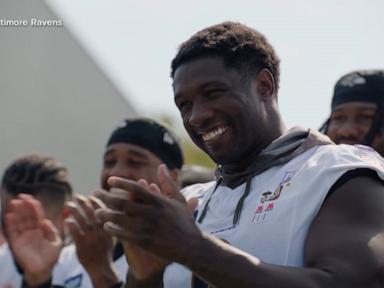
Professional sports franchises operate as high-visibility distribution networks capable of altering public awareness and capital mobilization channels overnight. When organizations such as the Baltimore Ravens integrate community initiatives with institutional health campaigns—specifically targeting pediatric oncology through vehicles like the V Foundation's Victory Challenge and league-wide Crucial Catch frameworks—the underlying mechanics extend far beyond superficial public relations. Understanding the efficacy of these programs requires examining the intersection of brand equity, localized engagement models, and targeted capital allocation.
The Attention Economy of Franchise-Led Philanthropy
Professional sports teams possess a scarce asset: concentrated, highly engaged audience attention. Traditional philanthropic entities often struggle with customer acquisition costs regarding public awareness. A professional franchise bypasses this barrier by embedding advocacy directly into the entertainment product.
When players engage with pediatric patients, or when athletic campaigns incorporate personalized design elements into equipment, two distinct structural effects occur:
- Audience Conversion: Passive sports consumers are introduced to complex health metrics, such as early detection markers or clinical trial funding deficits, within a trusted content environment.
- Amplification Velocity: Media ecosystems surrounding professional teams exponentially multiply the message distribution without incurring standard advertising overhead.
The economic efficiency of this model relies on alignment. The franchise lends its credibility and reach, while established medical research organizations provide the administrative infrastructure and clinical execution.
Capital Mobilization Frameworks
Campaigns targeting multi-million-dollar benchmarks—such as initiatives aiming to secure $10 million for pediatric cancer research by specific high-visibility milestones like Super Bowl Sunday—depend on tiered funding architectures.
- Institutional Anchoring: Large corporate partners and foundation matching grants establish a high baseline, reducing perceived risk for individual donors.
- Direct Consumer Integration: Merchandise sales, ticket add-ons, and direct-donation interfaces convert fan loyalty into micro-transactions at scale.
- High-Net-Worth Philanthropy: Gala events, private auctions, and direct outreach leverage the stadium demographic to secure substantial commitments from corporate sponsors.
This multi-layered revenue stack prevents over-reliance on a single funding source, stabilizing capital flow against macroeconomic fluctuations.
Operationalizing Empathy
Direct player participation serves a functional operational role rather than a purely symbolic one. Player endorsement shifts narrative control from corporate entities to trusted public figures. For instance, customized apparel campaigns driven by player-patient interactions create localized emotional resonance.
This direct interaction mechanism alters the donor journey. Abstract medical statistics regarding pediatric survival rates are juxtaposed with individual narratives. Cognitive science indicates that human decision-making regarding altruism is heavily weighted toward identifiable victims rather than statistical aggregates. Franchise-led campaigns leverage this psychological mechanism to drive sustained engagement.
Systemic Limitations and Evaluation Metrics
Philanthropic initiatives within professional sports face distinct structural boundaries. The primary limitation is temporal volatility; campaigns often cluster around specific awareness months or game weeks, risking a drop-off in public focus during the off-season.
To measure true institutional impact, evaluation must move beyond gross revenue generated to assess long-term outcomes:
- Research Milestone Acceleration: Tracking how injected capital reduces the timeline from laboratory discovery to clinical trial implementation for pediatric therapeutics.
- Sustained Donor Retention: Measuring whether fans acquired during high-visibility campaigns transition into multi-year recurring contributors to medical research foundations.
- Local Healthcare Access: Evaluating tangible improvements in regional pediatric oncology support structures, including patient family housing, transportation logistics, and psychological care integration.
By dismantling the mechanics of franchise-backed health initiatives, the value proposition shifts from ephemeral goodwill to measurable structural support. The integration of high-visibility athletic platforms with rigorous clinical research funding creates a scalable blueprint for addressing systemic healthcare gaps.


