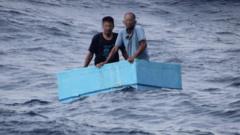
Every few months, the media unearths a survival story that turns basic physics on its head and treats sheer stubborn luck like an actionable strategy. The headlines love it. Fishermen get stranded at sea, cram themselves into an oversized plastic cooler, drift for five days, and emerge sunburned, dehydrated, and holding court on morning television. The lazy consensus from the commentariat is predictable: praise human resilience, marvel at the ingenuity of modern marine accessories, and quietly assume that sitting in a picnic box is a valid contingency plan when your hull goes down.
Stop romanticizing the miracle.
Survival isn't about finding a clever container to float in while you wait for a rescue helicopter to spot your neon orange lid. It is about systematically removing the variables that kill you before the Coast Guard even logs your missing person report. If your emergency plan relies on floating inside an insulated ice chest, you are not a rugged adventurer. You are a statistic waiting for a lucky break.
The Flawed Physics of the Floating Cooler
Let us dismantle the core myth right out of the gate. A standard marine cooler is designed to keep a case of beer cold for a Saturday afternoon tailgate, not to serve as an ocean-going life raft.
When you shove two grown adults into a heavy-duty ice box, you alter every structural dynamic the manufacturer intended.
- The Buoyancy Trap: Coolers are buoyant because of trapped air and closed-cell foam insulation. But they are top-heavy when unballasted, and adding hundreds of pounds of human weight above the waterline creates an aggressive center of gravity shift. One decent swell flips the box.
- The Thermal Paradox: Insulation works both ways. While it keeps heat out, a sealed polyethylene box in the baking sun turns into an anaerobic convection oven remarkably fast once the ice melts. You trade hypothermia in the water for heatstroke inside the plastic coffin.
- The Ventilation Void: Most coolers feature airtight gaskets designed to lock in cold air. Lock two panicked people inside a sealed plastic box in the middle of the Atlantic or Pacific, and you are racing a ticking clock of carbon dioxide accumulation.
The media treats these floating containers as makeshift arks. The engineering reality tells a different story. You survive in spite of the cooler, not because of it.
The Lazy Consensus on Marine Safety
Ask any casual boating enthusiast what to do in a sinking emergency, and you will hear a litany of comforting clichés. Grab the personal flotation devices. Activate the emergency position-indicating radio beacon. Cling to whatever debris is floating nearby.
This advice assumes a sterile, frictionless environment where rescue forces operate with omniscient precision. It ignores the brutal timeline of maritime mortality.
Hyperthermia and dehydration do not wait five days for a news crew to arrive. Within twenty-four hours of saltwater immersion and sun exposure, cognitive function degrades sharply. Panic sets in. Poor decision-making replaces protocol. By day three, the physical toll of drinking trace condensation off a plastic lid or, worse, giving in to the temptation of seawater, destroys renal function.
I have watched weekend skippers blow thousands on high-end electronics while neglecting the boring, unsexy mechanics of ditch bags and redundant communications. They treat safety gear as a bureaucratic tax rather than an active operational requirement. When the boat goes down, they grab the nearest floating object because they failed to pack a life raft rated for open water.
Unpacking the Real Metrics of Survival
Let us look at what actually keeps people alive on the open water. It is not improvisation. It is protocol, redundancy, and cold math.
Survival at sea is a game of mitigation, not miracles. Every hour you spend exposed to the elements degrades your probability of extraction exponentially.
Consider the data on maritime rescues. The vast majority of successful recoveries within the first seventy-two hours depend entirely on three factors:
- Active Transmit Capability: A registered personal locator beacon that sends coordinates directly to satellite networks within minutes of activation.
- Thermal Protection: Improvised immersion suits or dry rafts that keep core body temperatures stable, preventing the silent killer known as cold shock and subsequent incapacitation.
- Hydration Discipline: Carrying compact reverse-osmosis pumps or heavy-duty water rations rather than praying for rain or a passing shipping lane.
None of these items fit comfortably inside a beer cooler alongside your lunch.
The Uncomfortable Truth About Risk Management
Here is the part nobody wants to admit. When fishermen or sailors drift for days and make it back to land, we praise their grit while ignoring their catastrophic planning failures. If you require a miracle to fix your mistake, your system is broken.
Relying on a cooler is a symptom of a broader cultural disease in recreational navigation: the belief that common sense can override hostile environments. It cannot. The ocean does not grade on a curve because you had a positive attitude or a sturdy brand of ice chest.
If you are stepping onto a boat, ditch the romantic notions of improvising your way out of a disaster. Inspect your life rafts, service your emergency beacons, and stop pretending that a plastic picnic accessory is a valid substitute for professional marine safety equipment.
The next time a headline praises a miraculous rescue from a floating box, remember the dozens of others who tried the exact same trick and vanished without a trace. Stop waiting for the Coast Guard to reward your poor preparation.