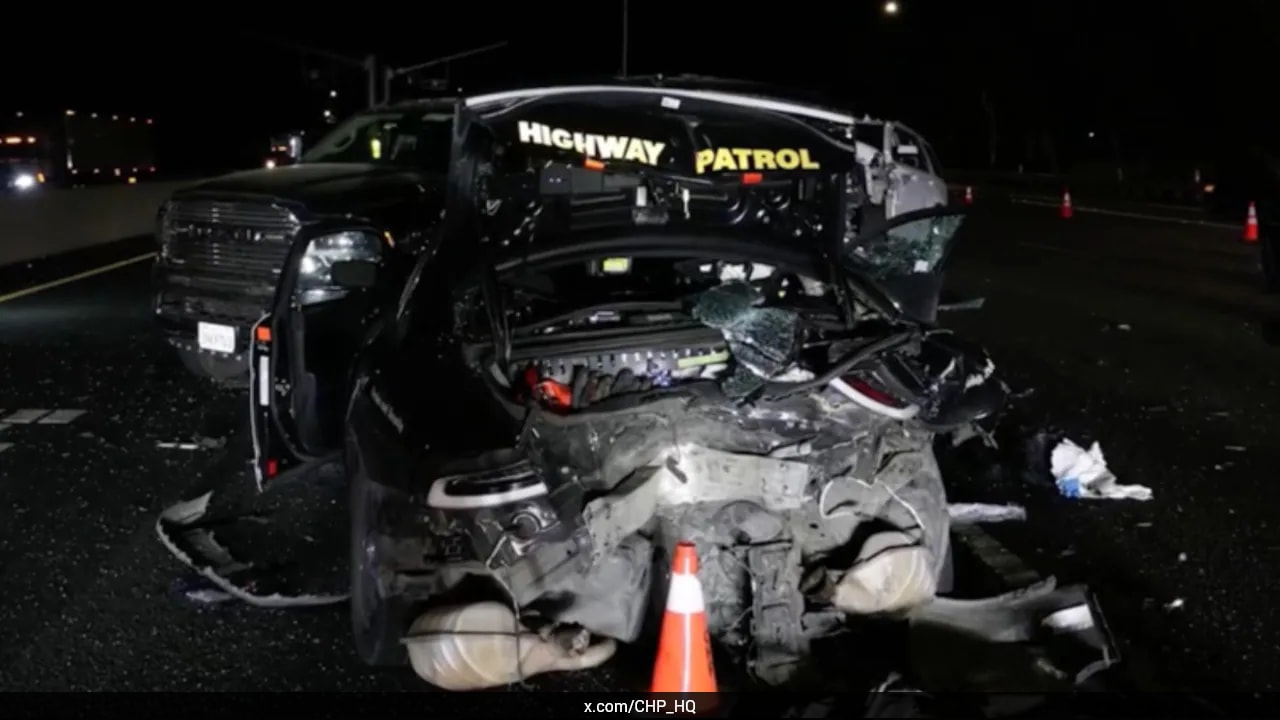
When a vehicle operating under semi-automated assistance collides with a stationary emergency cruiser while the driver is asleep, the incident is frequently misdiagnosed as an isolated malfunction or a simple failure of personal responsibility. This diagnostic framing is functionally useless for engineering safer systems or predicting future failure modes. Instead, such an event represents a predictable behavioral equilibrium resulting from the mismatch between human perceptual psychology and SAE Level 2 automation design.
To deconstruct this phenomenon, one must analyze the systemic architecture of driver monitoring, the cognitive economics of vigilance withdrawal, and the operational limitations of sensor fusion suites in edge-case environments.
The Automation Paradox and Vigilance Decay
Level 2 driver assistance systems require the human operator to maintain continuous supervisory control while the system executes longitudinal and lateral vehicle motion. This creates a severe structural contradiction known in human factors engineering as the automation paradox.
Human vigilance degrades rapidly during prolonged periods of passive monitoring. When a system performs correctly for extended intervals, operator attention shifts inward or toward secondary tasks because the perceived probability of failure approaches zero. The cognitive cost of maintaining active readiness for an unpredictable emergency outweighs the immediate utility of supervision.
Consequently, drivers engage in risk compensation. As they accumulate trust in the system's routine performance, they expand the operational envelope far beyond its engineered boundaries. Sleeping behind the wheel is an extreme manifestation of this degradation, but it sits on a continuous spectrum that includes texting, reading, and zoning out. The system design invites this drift because it relies on sporadic tactile or torque-based steering prompts rather than continuous cognitive state verification.
The Sensor Fusion and Edge-Case Bottleneck
From a technical perspective, collisions involving stationary objects highlight a fundamental vulnerability in radar-camera sensor fusion architectures. Radar systems excel at detecting motion and velocity vectors via Doppler processing, but they often struggle to classify stationary targets accurately against complex background radar clutter, such as overhead sign bridges, guardrails, and parked emergency vehicles with flashing lights.
Monocular or stereoscopic cameras provide the classification data necessary to identify stationary obstacles, but they are susceptible to environmental occlusion, lens contamination, and degraded lighting conditions. When fusion logic prioritizes moving traffic flow, stationary objects can be treated as ground clutter and filtered out to prevent phantom braking events.
When a semi-automated vehicle approaches a stationary police car on a highway, the software stack must correctly identify, classify, and assign a priority path to a target that has zero relative velocity compared to the road surface, yet represents an absolute obstruction. If the radar drops the return and the vision system fails to classify the silhouette under specific glare or nighttime conditions, the vehicle maintains its cruise trajectory straight into the hazard.
The Economic and Regulatory Incentive Structure
The proliferation of these incidents points to a misalignment between marketing nomenclature and functional capability. Using terms that imply autonomous operation creates a persistent illusion of safety. Consumers evaluate software capabilities based on colloquial descriptions rather than engineering specifications.
Manufacturers operate under an incentive structure that rewards rapid deployment of driver-assist features to capture market share and gather fleet-level telemetry. The liability shield is maintained through contractual disclaimers and rudimentary torque-based steering wheels sensors that can be easily defeated with aftermarket weights or casual hand placement.
Because the regulatory framework evaluates vehicles based on traditional crashworthiness rather than cognitive ergonomics and human-machine interface safety, companies face minimal financial penalties for deploying systems that encourage hazardous user behavior.
Strategic Mitigations for Operational Safety
Preventing future collisions of this nature requires shifting away from passive torque prompts toward active, biometric attention monitoring.
- Direct Driver State Tracking: Infrared eye-tracking and facial orientation cameras must be integrated as a hard interlock for Level 2 features. If the operator's gaze departs from the forward roadway for a specified duration, the system should not merely issue an acoustic chime; it must initiate a controlled deceleration and safe harbor maneuver to the shoulder.
- Operational Design Domain Constraints: Software geofencing must restrict advanced driver assistance features to mapped highway segments where lane markings, GPS accuracy, and infrastructure signaling reduce the probability of ambiguous stationary obstacle detection.
- Fail-Safe Deceleration on Disengagement: When a system detects an unresponsive driver or forces a disengagement due to lack of supervision, the vehicle must drop out of cruise control safely rather than transferring immediate, unassisted control back to an incapacitated operator.
The intersection of automation and human physiology leaves zero room for permissive design. Until safety architectures account for the absolute inevitability of driver distraction and fatigue, semi-automated systems will continue to exploit the psychological limits of human attention.