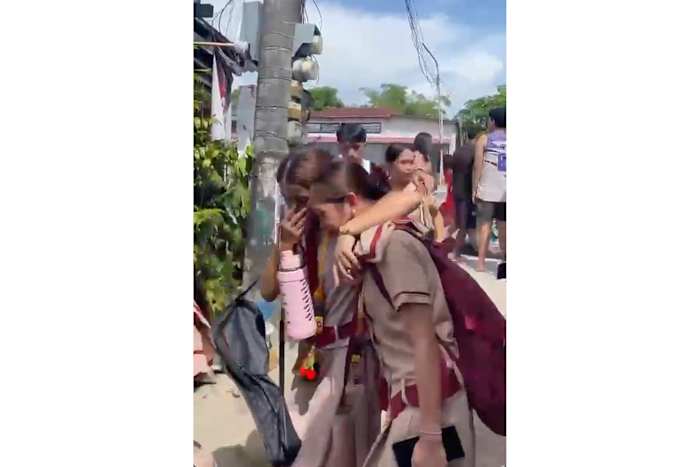
School shootings don't happen in the Philippines. That was the unwritten rule. Gun violence is a massive problem across the country, sure, but campuses have almost always remained a safe zone.
That reality broke on Monday morning at San Jose National High School in Tacloban City.
Two young teenagers, ages 14 and 15, walked onto a campus of 1,500 students carrying a Glock 9mm semi-automatic pistol and a .38 caliber revolver. By the time the smoke cleared, three students were dead, multiple others were hospitalized, and a community was left wondering how American-style school violence arrived on their shores.
The details coming out of the investigation show a mix of systemic security failures and a deeply troubling lapse in firearm custody.
Forty Shell Casings and a Single Security Guard
Around 9:20 a.m., classes were running normally. Minutes later, students were ducking under wooden desks, recording terrifying videos of screams punctuated by heavy gunfire.
The shooters didn't just fire a single warning shot. Police later recovered at least 40 empty cartridges and two spent magazines from the scene. The shooter wielding the Glock pistol actually reloaded during the attack, leaving just three rounds in his final magazine. The other suspect, holding the revolver, apparently only managed to fire one round.
The immediate question everyone in Tacloban is asking is simple: How did two kids walk past security with two deadly handguns?
Regional police chief Brig. Gen. Jason Capoy pointed directly to a massive vulnerability in the school's basic setup. The public school has more than 1,500 students and multiple entrances and exits, yet only a single security guard was on duty that morning. It wasn't hard for the shooters to slip inside undetected. Once the firing started in the first classroom, students panicked and ran, and the shooters chased them right into a second room.
The Identity of the Shooters and a Cop's Gun
Early reports stated that both shooters were students at the school. The Philippine National Police (PNP) has since clarified that only one of them actually went to San Jose National High School. His teacher described him as a quiet, socially withdrawn kid who was supposed to be in Grade 10 but had been held back because of poor grades. The other shooter was an outsider.
The motive appears to stem from a bitter personal grudge over alleged bullying.
Even more alarming than the motive is where the weapons came from. The Glock 9mm semi-automatic pistol belonged to a local policewoman who happens to be the aunt of one of the suspects. She is now facing a severe internal investigation for failing to secure her service weapon. The .38 caliber revolver was traced back to a private security agency in Cebu City, though investigators are still trying to figure out how a couple of kids in Tacloban managed to get their hands on it.
The Legal Loophole That Could Protect a Killer
The two boys are currently in custody at the Tacloban City Police Station 1, but the Philippine legal system faces a massive roadblock in prosecuting them.
Under a 2006 Philippine law called the Juvenile Justice and Welfare Act, the minimum age of criminal liability is 15.
- The 15-year-old suspect: He can face criminal charges, but only if prosecutors can prove he acted with full discernment—meaning he explicitly understood the illegality and horrific consequences of his actions.
- The 14-year-old suspect: He is completely exempt from criminal prosecution under the law. Instead, he will be handed over to local government welfare officers for rehabilitation programs.
This legal reality is already sparking intense public anger online, with many demanding accountability for an act that felt calculated and deliberate. Police noted that one of the suspects had previously posted videos online showcasing violent gun use, and they are checking whether the boys tried to mimic the outfits of infamous overseas school shooters.
President Ferdinand Marcos Jr. quickly responded to the tragedy by ordering a massive security sweep, demanding that law enforcement ramp up visible security measures in all public schools, workplaces, and high-traffic public areas across the country.
For parents in Tacloban, that directive feels like it's coming way too late. Dropping a kid off at a public school gate shouldn't require worrying about a 40-round shooting spree. School administrators nationwide are now forced to re-evaluate their bare-bones security budgets, because relying on one guard to secure thousands of kids is no longer an option.