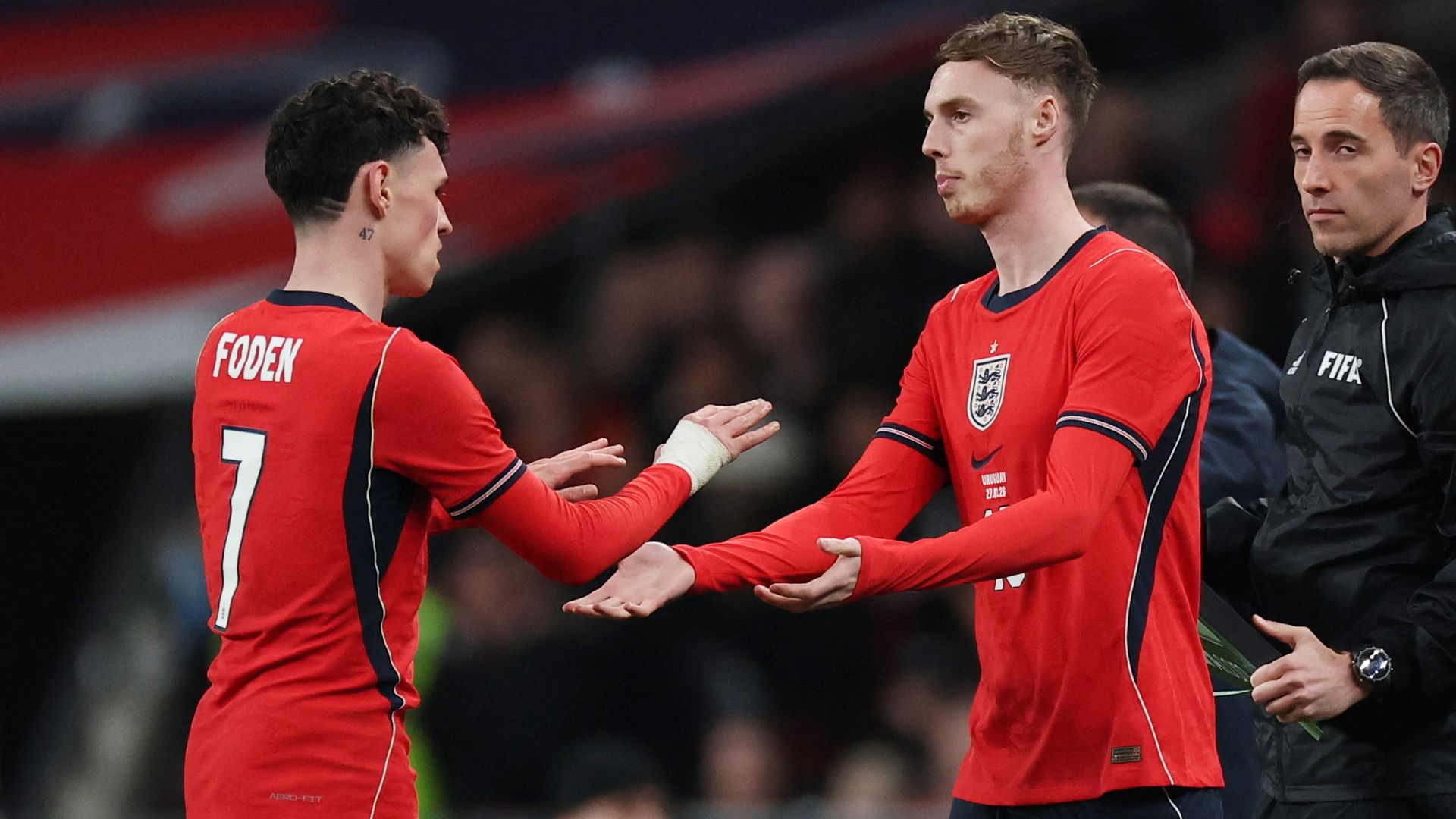
National team selection in elite football is fundamentally an optimization problem under acute resource constraints. When external media reports suggest players of the caliber of Phil Foden and Cole Palmer could miss out on a major tournament squad like the World Cup, the standard discourse revolves around form, character, or subjective managerial preference. The reality is dictated by a rigid structural framework: squad size limits, tactical compatibility matrices, and systemic defensive equilibrium. To understand why elite creative talent gets marginalized, one must analyze the squad selection process not as a talent aggregation exercise, but as a portfolio optimization problem.
The Structural Limits of the 26-Man Squad Portfolio
An international tournament squad operates under a hard cap, typically 26 players. This creates a zero-sum allocation environment. A manager cannot simply select the 26 best individual players; they must construct a functional ecosystem that mitigates risk across a short, high-intensity tournament format.
The portfolio construction breaks down into specific functional allocations:
- Fixed Baseline (9 positions): Three goalkeepers, alongside a minimum of two specialized players per fullback position to absorb physical attrition.
- Defensive Redundancy (4-5 positions): Central defenders selected based on complementary skill sets (aerial dominance versus progressive passing) and positional versatility.
- The Engine Room (5-6 positions): Central and defensive midfielders who dictate tempo, cover lateral space, and manage transitions.
- The Cutting Edge (6-8 positions): Modern wingers, traditional center-forwards, and specialized creators.
Foden and Palmer exist within the final category, competing not against the entire pool, but against a highly specific subset of players who offer distinct tactical profiles. The bottleneck occurs because both players operate optimally in similar zones of the pitch—specifically the right half-space—and demand high usage rates to maximize their efficiency.
The Half-Space Congestion Index and Positional Redundancy
The primary tactical barrier to integrating both Foden and Palmer into a starting eleven, or even a tight tournament squad, is spatial redundancy. Both players are "interior creators" who nominalize as wide players but naturally drift centrally into the right half-space to create passing angles or shooting opportunities on their left feet.
[Left Wing]     [Left Half-Space]     [Center]     [Right Half-Space]     [Right Wing]
                                                      (Foden / Palmer)
                                                      (Congestion Zone)
Simultaneously deploying two players who instinctively seek the exact same geographical coordinates on the pitch introduces severe structural inefficiencies:
1. Offensive Predictability and Spatial Compression
When multiple players occupy the same vertical lines, the attacking shape loses its horizontal stretching mechanism. Opposing low-block defenses can remain compact, shifting their defensive block laterally by fewer meters, effectively neutralizing the space available for creative pass execution.
2. The Loss of Dynamic Depth
A functional attacking unit requires verticality—players who run behind the opposition defensive line to drop their backline and create pockets of space in front of them. Neither Foden nor Palmer profile as pure touchline-hugging, vertical wingers who rely on raw isolation speed. Replacing a vertical outlet with a second interior creator removes the threat of depth, allowing opponents to press higher and squeeze the midfield.
3. Structural Vulnerability in Transition
Players who operate in the half-spaces frequently attempt high-risk, high-reward progressive passes. A turnover in these central, compressed zones leaves the team highly susceptible to counter-attacks. If the nominal wide players have drifted inside, the defensive transition requires the fullbacks to cover immense lateral distances, creating immediate structural fractures that elite opposition exploit.
The Defensive Equilibrium Function
International football is disproportionately defined by defensive stability. The shorter preparation time available to national coaches prevents the implementation of highly complex, synchronized pressing systems seen at the club level. Consequently, international managers rely on simpler, more rigid defensive structures.
A team’s defensive equilibrium can be modeled by evaluating the defensive work rate, recovery speed, and physical dueling metrics of the non-defensive players.
$$E_d = \sum_{i=1}^{n} (W_i \cdot S_i \cdot D_i)$$
Where:
- $E_d$ represents the total defensive equilibrium score of the midfield/forward units.
- $W_i$ is the individual player’s defensive work rate (pressing actions, blocks, interceptions).
- $S_i$ is the recovery sprint profile.
- $D_i$ is the ground duel success rate.
Introducing highly specialized creative assets like Foden or Palmer typically lowers the aggregate $E_d$ value. While both possess elite pressing triggers under specific club systems, their defensive profiles in a less-drilled national setup often require insulation. A manager cannot afford to carry more than one or two players with low defensive volume or compromised recovery speed against elite opposition. If the squad strategy demands a high-volume defensive winger on one flank to balance an aggressive fullback, the available slots for interior creators shrink to one.
The Substitution Utility Matrix
In a tournament setting, squad players are evaluated not just on their ability to start matches, but on their specific utility as substitutes under distinct game states. This is where the marginal differentiation between Foden and Palmer becomes critical, and where a manager might decide to omit one entirely in favor of a different profile.
| Game State | Tactical Requirement | Foden Profile | Palmer Profile | Alternative (Vertical Winger) |
|---|---|---|---|---|
| Leading (Low Block) | Retention, ball-hydration, tactical discipline | High efficiency in possession; excellent under pressure | High risk/reward passing; less suited to deep defensive shape | High recovery speed; outlet for counter-attacking relief |
| Chasing (Against Low Block) | Chaos creation, penalty box presence, variance | Subtle rotation; requires coordinated movement to unlock | Elite micro-space dribbling; high shot volume; elite penalty execution | Direct isolation dribbling; cross volume maximize |
| Transition-Heavy (End-to-End) | Transition speed, physical endurance | High physical output; tactical flexibility | Operates at a calmer, deliberate tempo; less effective in chaotic physical duels | Elite top-end speed to exploit spaces left by tired defenders |
The matrix demonstrates that while Foden and Palmer offer world-class execution in specific states, they do not offer the stark profile variance that a manager looks for on a bench. If a manager already has one starting, the bench slot is better utilized by a player who offers raw speed, aerial power, or defensive rigidity, rather than a secondary version of the starter.
Systemic Incompatibility with the Primary Talisman
The final, and often most decisive, variable is the optimization of the team's focal point. In any elite international setup, the tactical system is built to maximize the output of the primary goalscorer or talismanic playmaker (e.g., Harry Kane or Jude Bellingham).
When a center-forward consistently drops deep to link play, they naturally occupy the central spaces that an interior creator wants to exploit. If the center-forward occupies that space, and the attacking midfielder pushes into the box, the right half-space becomes overcrowded if Foden or Palmer are also drifting inside.
The selection mechanism therefore prioritizes wingers who run away from the ball—players who make diagonal runs into the penalty box from out-to-in, dragging defenders with them and creating the structural vacuums that the team's primary stars require to function. Selecting both Foden and Palmer creates a compounding effect of players wanting the ball played to their feet, completely stalling the team's offensive mechanics.
Strategic Forecast
The probability of both Phil Foden and Cole Palmer missing out on a major tournament squad entirely remains statistically low due to their sheer individual quality and match-winning capability. However, the probability of one being sacrificed to preserve squad equilibrium, defensive redundancy, and profile diversity is highly underestimated by public consensus.
The final decision will not be a reflection of their talent, but a mathematical consequence of tactical system design. If the managerial framework prioritizes defensive transition stability and vertical depth, the squad will naturally lean toward selecting direct, high-work-rate wingers. This structural reality renders one of the interior creators redundant, forcing an elite asset out of the 26-man portfolio to ensure the broader collective system does not collapse under its own weight.