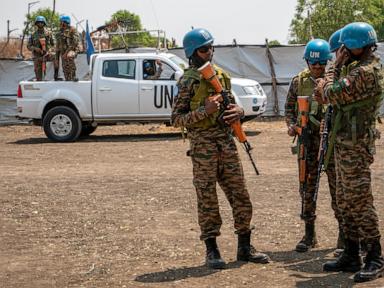
The assassination of a South Sudan county commissioner is not an isolated flashpoint of local ethnic friction. It is the predictable result of a fracturing national peace agreement. While initial reports frame the killing as a sudden escalation of localized violence, the reality is far more calculated. The assassination targets the very machinery of local governance, signaling a dangerous breakdown in the fragile power-sharing matrix that has kept a tenuous lid on full-scale civil war. This killing exposes the deep rot in the country’s delayed transitional security arrangements, proving that local administrative seats have become the primary battlegrounds for national political supremacy.
To understand why a local commissioner’s death carries such catastrophic weight, one must look at how power is distributed under the Revitalized Agreement on the Resolution of the Conflict in the Republic of South Sudan (R-ARCSS). You might also find this similar article insightful: The Real Reason Nigel Farage Resigned His Seat (And Why It Could Backfire).
The Deadly Math of Power Sharing
Local commissioners in South Sudan are not mere bureaucratic administrators. They are the frontline enforcers of political territory. Under the current peace framework, counties were split among competing factions—primarily the ruling Sudan People’s Liberation Movement (SPLM) under President Salva Kiir and the SPLM-In Opposition (SPLM-IO) led by First Vice President Riek Machar.
When a commissioner is killed, it is rarely a random act of cattle rustling or communal vengeance. It is a direct assault on a faction's territorial footprint. As extensively documented in recent articles by NPR, the effects are significant.
The security architecture of these counties is fundamentally broken. The unified forces, which were supposed to graduate and deploy to provide neutral security across the country, exist largely on paper or remain underfunded, undertrained, and loyal to their original factional commanders. This leaves local officials exposed. They sit on the fault lines of unresolved border disputes, competing resource claims, and the intense pressure of upcoming, repeatedly delayed national elections.
By eliminating a commissioner, opposition or rogue elements effectively decapitate the local state apparatus, clearing the path for rival militias to assert dominance over strategic trade routes and humanitarian corridors.
Weaponizing the Margins
Juba exists in a vacuum of political posturing, while the real war is fought in the provinces. The strategy is clear. National actors, hesitant to break the ceasefire directly in the capital, utilize local proxy forces to chip away at their opponents' territory.
- Territorial Encroachment: Capturing key rural junctions isolates larger pro-government or pro-opposition strongholds.
- Economic Suffocation: Localized conflicts frequently target markets and transport hubs, choking off the resource streams of rival factions.
- Electoral Engineering: With elections continuously pushed down the road, political actors are using violence to forcibly displace populations, effectively gerrymandering key districts ahead of any future vote.
This decentralized warfare offers national leaders plausible deniability. They can condemn the violence from the comfort of the capital, blaming "uncontrolled youth" or "inter-communal grievances," while their underlying political objectives are achieved on the ground.
The Illusion of the Unified Army
The cornerstone of South Sudan’s transition was supposed to be the integration of rival forces into a single, cohesive national army. It has failed.
The process has been plagued by deliberate delays. Factions are reluctant to send their best fighters to training centers, preferring to keep their core units intact as insurance policies for a conflict they assume will resume. The troops that have graduated face horrific conditions. Many lack basic rations, medical supplies, and ammunition, leading to widespread desertion.
When local violence erupts, these hollowed-out units are either incapable of intervening or actively take sides based on their ethnic or factional alignments.
"A peacekeeping force that cannot feed itself cannot enforce peace."
This security vacuum has allowed heavily armed civil militias to outgun the actual state authorities. The proliferation of small arms across the countryside is staggering. Decades of conflict have left communities trapped in a security dilemma where disarming means exposing oneself to annihilation by a neighboring group. The state cannot protect them, so they protect themselves, frequently co-opting or ignoring the authority of the appointed county commissioner.
The Electoral Powder Keg
The driving force behind this current wave of assassinations and targeted skirmishes is the looming specter of the ballot box.
South Sudan has never held a democratic election since its independence in 2011. The ruling elite are terrified of what a legitimate vote might do to their grip on power, yet they face immense international pressure to deliver a democratic transition. The result is a desperate scramble to secure geographic advantages before any electoral roadmap is solidified.
Controlling a county means controlling the local electoral machinery. The commissioner influences voter registration, dictates who can campaign safely within the region, and oversees the physical infrastructure where voting occurs.
Removing an opponent’s commissioner is the most direct way to compromise the integrity of a future election in that district before a single ballot is cast. It is preemptive rigging via political violence.
The international community's response remains frustratingly formulaic. Traditional diplomatic interventions rely on issuing strongly worded statements, demanding investigations that never materialize, and threatening sanctions that the ruling elite have long since learned to circumvent.
This approach treats the symptom rather than the disease. Imposing sanctions on individual local commanders does little when the structural incentives for violence remain profitable for the architects in Juba. The elite leverage the threat of renewed civil war to extract concessions from international donors, turning the peace process into a cyclical extortion racket.
Financing the Chaos
The political economy of South Sudan’s instability is tied directly to its natural resources.
While oil revenues fund the elite in the capital, local conflicts are often driven by the control of sub-surface minerals, fertile grazing lands, and charcoal production networks. Local commissioners frequently stand between warlords and these lucrative illicit economies. When an official refuses to facilitate the illegal extraction of resources or attempts to tax these informal networks to fund local government services, they become an immediate target.
The breakdown of law and order is profitable for those who command the militias. It allows for unchecked exploitation of resources without the burden of state oversight or environmental regulation.
This brings us to the core contradiction of the South Sudanese peace process. The individuals tasked with implementing the peace agreement are the very individuals who benefit most from the chaotic status quo. True stability requires a level of accountability that would dismantle the patronage networks keeping the political elite in power.
The killing of a government commissioner is a stark warning that the window for a peaceful, managed transition is slamming shut. It exposes the reality that local administrative boundaries are merely frontlines in a wider, unacknowledged conflict. If the international guarantors of the peace agreement continue to view these assassinations as isolated tribal clashes rather than deliberate political maneuvers, they will wake up to find the revitalized peace agreement completely hollowed out from the inside, leaving nothing behind but the framework for a renewed national catastrophe.
The trajectory cannot be changed by elite-level handshakes in Juba while the provinces burn. It requires a fundamental restructuring of the security sector, a genuine disarmament campaign that offers real economic alternatives to the youth, and an immediate end to the political manipulation of local administrative appointments. Without these radical shifts, the position of county commissioner will remain less an administrative office and more a death sentence.


