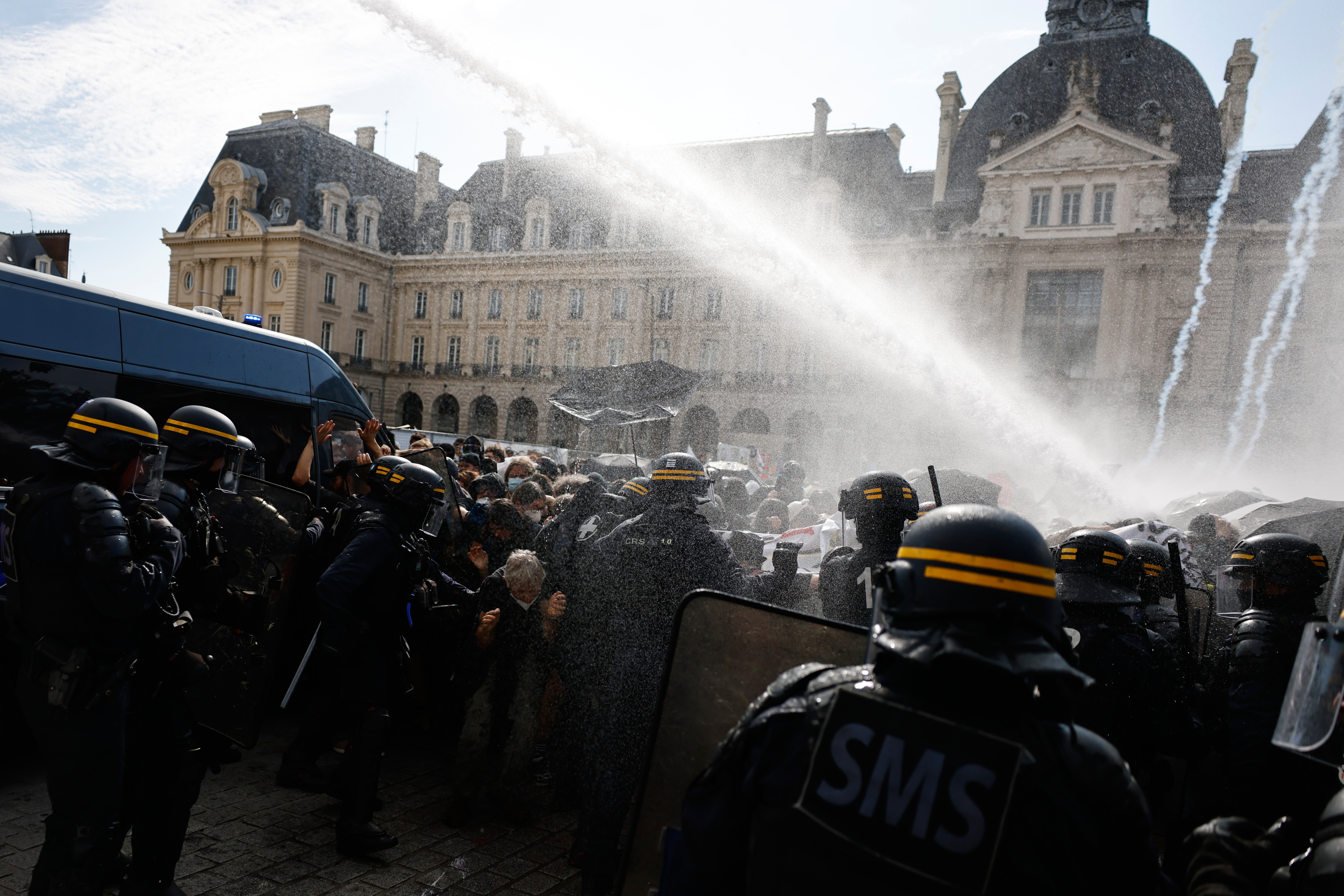
The metallic tang of tear gas hung thick in the air outside a suburban lycée in Lyon, mixing with the acrid scent of burning plastic from overturned waste bins. Police in full riot gear formed a moving wall, batons tapping rhythmically against polycarbonate shields, pushing back lines of teenagers whose faces were wrapped in scarves and ski goggles. Water cannons hissed, discharging high-pressure jets that soaked winter coats and sent adolescents scrambling over rusted iron fences.
This was not a pitched battle in the traditional industrial zones of Saint-Denis or the corporate districts of La Défense. It played out at the gates of an ordinary secondary school, a location where teenagers usually trade gossip about weekend plans rather than dodge projectile stun grenades.
When high school student protests sweep France, authorities in Paris tend to reach for familiar playbooks. They deploy the compagnies républicaines de sécurité, known universally as the CRS, establish containment perimeters, and wait for the teenage fury to exhaust itself against the state apparatus. Yet treating student mobilizations as a transient public order nuisance misreads the underlying structural fracture. The blockades of French lycées are not merely teenage tantrums or spontaneous riots. They function as a seismic indicator of deeper institutional malaise, an early warning system signaling that the social contract between the state and the next generation has ruptured.
To understand why thousands of teenagers regularly mobilize with pallets, padlocks, and smoke bombs, one must examine the specific architecture of French political culture. Direct action is woven into the curriculum. Long before they learn advanced calculus, French adolescents absorb the historical legacy of May 1968, the massive strikes of 1995, and the relentless tradition of street mobilization. Striking is viewed not as a disruption of civil society, but as its purest expression. When educational reforms are announced from the gilded rooms of the Ministry of National Education on the Rue de Grenelle, students across the country do not write polite letters to their parliamentary representatives. They chain shut the gates of their school courtyards at 7:30 in the morning.
The grievances driving these movements are rarely isolated to a single piece of legislation. While a specific reform—such as alterations to the baccalauréat examination, modifications to vocational training funding, or broader pension changes pushed by the executive branch—usually acts as the immediate spark, the dry timber has been accumulating for years.
Consider the daily reality inside many French secondary institutions. Overcrowded classrooms holding thirty-five or forty students are common in peripheral urban zones, known as the banlieues. Teaching staff face chronic burnout, compounded by budgetary constraints that leave laboratories underequipped and counseling services threadbare. For working-class youth, the promise of the republican meritocracy feels increasingly like a distant historical artifact. They look ahead at a job market marked by precarious short-term contracts, rising living costs, and a retirement age that stretches toward an impossible horizon. When the state modifies the educational ladder, students interpret it as an attempt to lock them into a descending escalator of economic insecurity.
The state’s response follows a predictable and counterproductive cycle. When blockades paralyze dozens of institutions, the Ministry dispatches police forces to clear the entrances. The optics are brutal: helmeted officers grappling with fifteen-year-olds, clouds of chemical irritants drifting past classroom windows, and viral videos circulating on TikTok and Snapchat within seconds.
This heavy-handed intervention transforms a local dispute over school budgets into a generalized struggle over civil liberties and police violence. Each canister of tear gas deployed outside a lycée radicalizes teenagers who might have been indifferent to the original policy debate an hour prior. The sight of a classmate bleeding from a rubber-bullet impact radicalizes entire friendship groups, drawing parents, local trade unionists, and neighborhood residents into the fray. The government achieves temporary order through chemical dispersal, but at the cost of deepening the profound alienation of the youth demographic.
The Mechanics of Student Mobilization
Organizing a national high school blockade requires a complex logistical network that operates almost entirely outside traditional political structures. Modern student movements do not rely on formal bureaucratic hierarchies. Instead, they leverage decentralized communication channels on encrypted messaging apps and social media platforms to coordinate simultaneous actions across different regions.
A successful blockade begins days before the physical disruption. Core organizing committees form within school courtyards during lunch breaks or outside the school gates after hours. These groups draft manifestos outlining their demands, ranging from specific infrastructural investments to broad denunciations of national policy. They print flyers using school copy machines when possible, or distribute digital graphics designed specifically for vertical phone screens.
On the morning of the action, mobilization begins before dawn. Students arrive carrying heavy chains, bicycle U-locks, wooden pallets scavenged from nearby construction sites, and trash bins. They barricade the main entrances, effectively trapping administrators and non-striking students inside or locking them out entirely. The goal is complete operational paralysis. A school that cannot open its doors cannot hold classes, and a school that cannot hold classes represents a successful political statement on the evening news broadcasts.
Management of these sites requires constant vigilance. Police intervention is anticipated, and contingency plans are discussed openly. Students establish spotters down adjacent streets to sound the alarm when vans approach. They set up makeshift medical stations with saline solution to wash out eyes stinging from tear gas.
This level of tactical coordination highlights a paradox at the heart of French youth activism. While critics often dismiss adolescents as politically apathetic or distracted by digital media, thousands of teenagers display acute organizational discipline when motivated by a collective sense of injustice. They run horizontal assemblies, vote on tactical decisions, and negotiate directly with school principals who find themselves caught between ministerial directives from Paris and mutinous teenagers in their courtyards.
Economic Anxiety and the Generation Gap
Underpinning these flare-ups is an acute generational anxiety that distinguishes contemporary student protests from those of previous decades. Earlier generations marched with the confidence that economic growth would eventually absorb them into stable careers with pensions and upward mobility. Today's youth look at the economic landscape through a lens of profound uncertainty.
Inflation has eroded purchasing power, housing costs in major metropolitan areas have shut young workers out of the rental market, and entry-level positions often demand unrealistic years of experience coupled with precarious pay structures. When politicians in Paris debate reforms that alter the trajectory of public education or professional training, students perceive a direct threat to their already narrow margins of survival.
This economic despair manifests as a deep distrust of institutional politics. Traditional political parties struggle to maintain youth wings with any real mass appeal. Elected officials are viewed not as representatives, but as a detached technocratic elite operating in a parallel universe, insulated from the daily grind of suburban life and underfunded public services.
When students chant slogans against the government in the streets, their anger is targeted at a system that feels unresponsive to their needs. The barricades are physical manifestations of this breakdown in communication. If the state refuses to listen through parliamentary channels, it will be forced to listen when national traffic grinds to a halt and schools close their doors.
The Broader Repercussions for Governance
The persistence of these high school rebellions exposes a fundamental vulnerability in the French model of governance. The Fifth Republic was designed to concentrate authority in the executive branch, allowing leaders to push through structural reforms even in the face of public resistance. This top-down approach has historically generated immense friction, pitting an inflexible state apparatus against a fiercely autonomous civil society.
When the state doubles down on enforcement, treating social unrest as a matter for law enforcement rather than political dialogue, it accelerates the cycle of confrontation. Each wave of protests leaves behind a generation of citizens whose primary interaction with the republic's security forces involved tear gas and batons.
The smoke eventually clears from the streets outside the lycées. The debris is swept away by municipal workers, the broken fences are welded shut, and students return to their desks to prepare for exams. Yet the underlying tensions remain entirely unresolved, simmering quietly until the next ministerial decree sparks the next cycle of defiance at the school gates.


