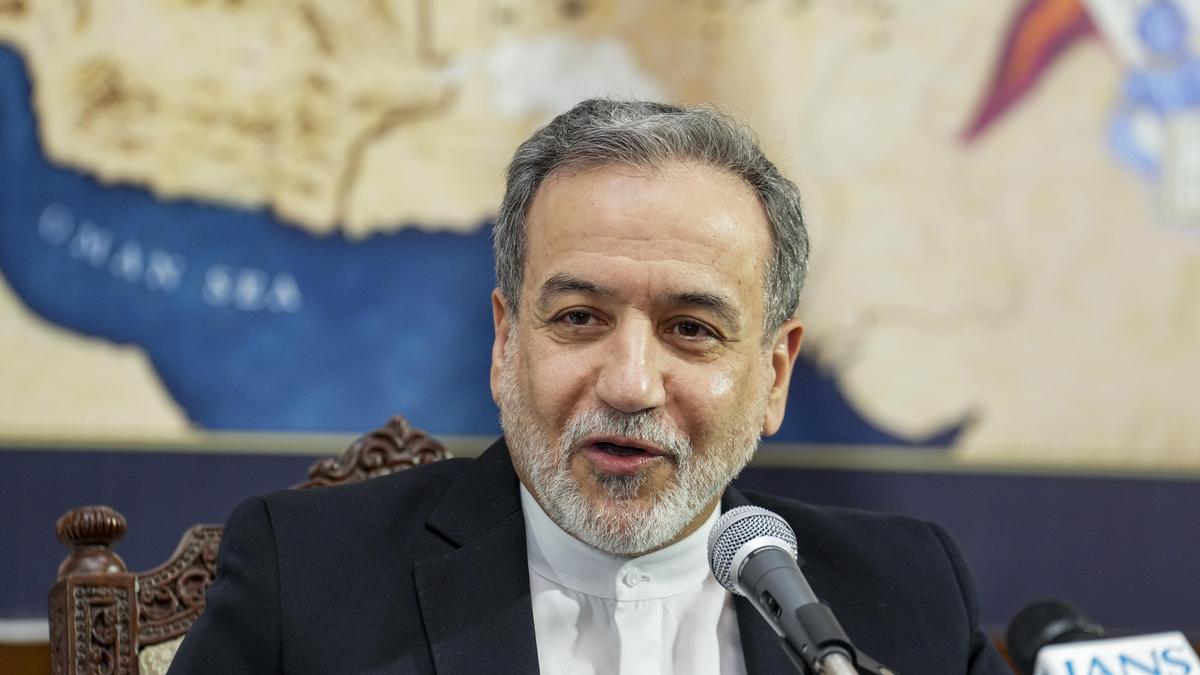
The Strait of Hormuz is not a highway. It is a choke point. When Iranian Foreign Minister Abbas Araghchi declares the waterway open to all except those "at war" with Iran, he isn’t offering a diplomatic olive branch. He is issuing a strategic ultimatum that resets the risk profile for every oil tanker currently in the Persian Gulf. By narrowing the definition of "safe passage" to a subjective political litmus test, Tehran has effectively weaponized the world’s most sensitive maritime corridor.
For the global economy, this is the nightmare scenario. Approximately 21 million barrels of oil flow through this narrow strip of water every single day. That represents roughly 20 percent of global liquid petroleum consumption. If the "at war" label is applied to any nation providing logistical support to Iran’s adversaries, the insurance premiums alone could paralyze regional shipping before a single shot is even fired.
The Illusion of Free Navigation
International law, specifically the United Nations Convention on the Law of the Sea (UNCLOS), provides for "transit passage" through straits used for international navigation. Iran, however, has never ratified UNCLOS. Tehran relies instead on the 1958 Convention on the Territorial Sea, which offers a much more restrictive "innocent passage" standard.
The distinction is vital. Under innocent passage, a coastal state can temporarily suspend navigation if it deems such movement prejudicial to its peace, good order, or security. Araghchi’s recent comments signal that Iran is moving toward a functional blockade by another name. They are shifting the burden of proof onto the shipping industry. If your flag state is perceived as a belligerent, your "innocent" status vanishes.
The Definition of Belligerence
What does it mean to be "at war" in 2026? Modern conflict is rarely a formal declaration. It is a mosaic of sanctions, cyber operations, and intelligence sharing. By leaving the term undefined, Araghchi grants the Islamic Revolutionary Guard Corps (IRGC) Navy the authority to intercept vessels based on fluid political triggers.
This isn't about traditional naval battles. It is about asymmetric leverage. Iran knows it cannot win a sustained conventional war against a superpower navy. However, it doesn't need to. It only needs to make the cost of transit high enough that the global market panics.
The Arithmetic of an Energy Shock
Market analysts often underestimate the speed of a Hormuz-induced price spike. Unlike a slow-moving supply glut, a disruption in the Strait creates an immediate physical deficit that cannot be easily mitigated by US shale or SPR releases.
- Fixed Geography: The Strait is only 21 miles wide at its narrowest point. The shipping lanes are even narrower, consisting of two two-mile-wide channels separated by a two-mile buffer zone.
- Lack of Alternatives: While Saudi Arabia and the UAE have pipelines that bypass the Strait, their total capacity is less than 40 percent of the daily volume currently flowing through the water.
- The Insurance Factor: War Risk Insurance premiums can jump 500 percent in a matter of hours following a "security incident" or a credible threat from a sovereign official.
If a major carrier is seized or struck, the "Hormuz Premium" could easily add $30 to $50 to the price of a barrel of Brent crude overnight. This would ripple through the supply chain, hitting everything from the cost of plastic manufacturing to the price of a gallon of gasoline in rural Nebraska.
The IRGC Role in Enforcement
While Araghchi speaks the language of diplomacy, the IRGC Navy (IRGCN) handles the hardware. The IRGCN operates differently than the regular Iranian Navy. They favor fast-attack craft, naval mines, and shore-based anti-ship cruise missiles.
Their doctrine is built on saturation tactics. They aim to overwhelm the sophisticated defense systems of modern destroyers with sheer volume. A swarm of fifty armed speedboats is a nightmare for a multi-billion dollar vessel to track and engage simultaneously. By claiming the Strait is closed to "enemies," Iran is giving these units the green light to increase their "inspection" regime, which frequently involves the forced boarding and diversion of commercial tankers to Iranian ports like Bandar Abbas.
The Shadow War on Logistics
We are seeing a transition from kinetic strikes to logistical strangulation. By targeting the crews and the companies rather than just the hulls, Iran creates a psychological barrier. Shipping companies are risk-averse. If a captain believes their vessel will be diverted and their crew detained for "investigation" because of a political dispute, they will refuse the charter.
The Geopolitical Chessboard
This rhetoric also serves a domestic purpose. Iran is currently navigating a period of intense internal pressure and regional isolation. Projecting power over the Strait of Hormuz is the ultimate "equalizer" in Tehran's eyes. It reminds the West, and particularly the energy-hungry markets of East Asia, that Iran holds the keys to the global engine.
China, the largest buyer of Iranian oil, finds itself in a precarious position. While Beijing benefits from discounted Iranian barrels, it relies on the stability of the Strait for the rest of its Middle Eastern imports. Iran is betting that the international community's fear of a global recession will prevent any decisive military response to their "conditional" closure of the waterway.
The Limits of Deterrence
The presence of the U.S. Fifth Fleet in Bahrain and the various multinational maritime coalitions are designed to prevent exactly what Araghchi is threatening. However, deterrence only works if the cost of the action outweighs the benefit. For a regime that feels its survival is at stake, the "Hormuz Card" is the only one left to play.
Reevaluating Global Energy Security
The era of taking the Strait of Hormuz for granted is over. Araghchi’s statement is a formal notification that the rules of engagement have changed. We are entering a period where the nationality of a ship's owner, the destination of its cargo, and the political alliances of its flag state are as important as the depth of its hull.
Companies must now diversify. The reliance on this single, 21-mile-wide artery is a systemic vulnerability that can no longer be ignored. Governments and private entities need to accelerate the development of trans-peninsular pipelines and increase localized storage capacity to buffer against the inevitable day when the "at war" definition is finally triggered.
The threat is no longer a "what if." It is a stated policy. When a sovereign state declares its intent to filter global commerce through the lens of its own military conflicts, the market must listen. The Strait is not just a waterway; it is a fuse. And the sparks are flying closer to the powder keg than they have in decades.