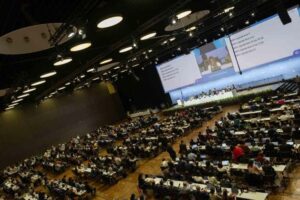
The air inside the World Conference Center in Bonn does not feel like the rest of the planet. It is chilled by industrial air conditioning to a precise, sterile coolness. Outside, the Rhine flows quietly past, but inside, a different kind of current stalls completely. For two weeks, human beings in sharp suits and traditional dress sat across from one another, surrounded by half-empty coffee cups and towers of printed text, trying to agree on the price of survival.
They couldn't.
When the mid-year United Nations climate talks collapsed into acrimony, the official reports used words like "procedural gridlock" and "methodological disagreements." Those words are shields. They are designed to obscure a simpler, more terrifying reality: the machinery we built to save ourselves is choking on its own paperwork.
To understand why Bonn failed, you have to look past the press releases and see the human architecture of a global negotiation. Consider a hypothetical negotiator named Amina. She has flown thousands of miles from a coastal district where the sea is no longer a neighbor but an intruder. She spent her days in Bonn arguing over a single bracketed word in a draft text. If the word is "shall," wealthy nations are legally bound to provide financial aid. If the word is "should," that aid becomes a polite suggestion.
Amina knows that back home, a bridge washed away last month. The money to rebuild it does not exist. Yet, she spent three hours on a Tuesday afternoon debating whether a footnote on page twelve should include the phrase "particularly vulnerable."
This is the psychological theater of the modern climate summit. The stakes are existential, but the daily work is mind-numbing bureaucracy. It is a disconnect that breaks people. By night ten, the hallways of the conference center smelled of stale adrenaline and cheap cafeteria pizza. Negotiators fell asleep on couches beneath banners proclaiming a sustainable future.
The core of the failure in Bonn is not a mystery. It belongs to an ongoing argument about money—specifically, the New Collective Quantified Goal, or NCQG. For years, developed countries promised to mobilize 100 billion dollars annually to help poorer nations transition away from fossil fuels and withstand extreme weather. They routinely missed the target, and even when they hit it, the money often arrived as loans rather than grants, trapping developing economies in a cycle of debt.
In Bonn, the bill came due. Developing countries argued that the actual need is now closer to one trillion dollars a year. Wealthy nations balked. They refused to name a specific number, insisting instead on discussing who else should pay—pointing fingers at emerging economic powerhouses like China.
The result was an icy stalemate. The rich nations refused to commit to numbers without structural reforms; the poorer nations refused to discuss structural reforms without seeing the money.
But the real problem lies elsewhere. It rests in a foundational design flaw of the UN framework: the requirement of total consensus. Every single country, from superpowers to tiny island states, must agree on every piece of punctuation. Consensus sounds democratic. In practice, it gives a single stubborn nation the power to hold the entire world hostage. It means the final text is never the boldest action plan; it is the lowest common denominator. It is the only thing left that nobody is willing to veto.
This structural paralysis is not just frustrating; it is dangerous. While negotiators debated the definition of "transparency frameworks," a real-world experiment was running outside the windows. The world had just experienced twelve consecutive months of record-breaking global temperatures. The oceans were warmer than at any point in recorded history.
Imagine trying to negotiate an insurance policy while your kitchen is actively on fire. You do not argue about the deductible while the curtains are melting. Yet that is exactly what happened along the Rhine.
The failure at Bonn sets a disastrous trajectory for the upcoming main summit. The mid-year talks are meant to do the heavy lifting, clearing away the technical clutter so that world leaders can make big, systemic announcements later in the year. Because Bonn produced nothing but anger, the next major conference will begin in a state of administrative chaos. We are running out of calendar pages, and we are wasting the ones we have left on arguments about administrative symmetry.
The trust has evaporated. When wealthy nations treat climate finance as charity rather than an obligation, it breaks the unwritten contract of global diplomacy. Poor nations did not burn the coal that fueled the industrial revolution, but they are paying the immediate price for it. When they are told to wait, to compromise, to understand the domestic political constraints of the West, they hear something else entirely. They hear that their survival is a line item that can be cut during budget negotiations.
Let us be completely honest about what happened in Germany. Bonn did not fail because the science is unclear. It did not fail because technologies like solar and wind are unviable. It failed because human institutions are poorly equipped to handle slow-motion catastrophes. Our political systems are built for the short term—the next election cycle, the next quarterly earnings report, the next news cycle. A crisis that unfolds across decades, requiring trillions of dollars in upfront investments for benefits that will be reaped by generations unborn, breaks the logic of modern governance.
On the final night, when the closing plenary was pushed back hour after hour, the fatigue in the building was heavy enough to feel physical. People stopped talking in the grand diplomatic phrases used during the opening ceremonies. They spoke in whispers.
When the gavel finally fell, signaling an end to the session without an agreement, there was no dramatic uproar. There were no tears. There was only the collective rustle of papers being stuffed into briefcases and the sound of laptops closing.
The negotiators walked out into the cool German night, looking for taxis to take them to the airport. They returned to a world that is growing steadily warmer, carrying briefcases full of bracketed text and unmade promises, leaving behind a locked room that had stayed perfectly, artificially cold.