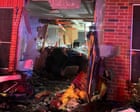
A quiet Friday evening in a Katy, Texas suburb ended in absolute disaster when a Tesla Model 3 careened off a residential road, jumped a curb, and tore straight through the brick facade of a two-story family home. Inside the front room, 76-year-old grandmother Martha Avila Mantilla was standing in what her family used as a children's playroom. She was pinned under the wreckage, airlifted to a hospital, and later died from her injuries.
The 44-year-old driver, Michael Butler, was sober and cooperative. His immediate statement to the Harris County Sheriff’s Office set off a massive federal chain reaction. He claimed his vehicle was operating on Tesla’s automated driving assistance system at the moment of impact. For another view, read: this related article.
By Monday, the National Highway Traffic Safety Administration (NHTSA) stepped in, launching a formal Special Crash Investigation. It is a nightmare scenario for automated driving tech. It turns a living room into a fatal highway zone for someone who never even bought into the autonomous future.
The Brutal Disconnect Between Drivers and Data
Surveillance footage from the neighborhood tells a terrifying story. The Model 3 did not just drift off the road. It rocketed down Rose Hollow Lane at speeds witnesses and data logs put between 60 and 73 mph before failing to make a turn and striking the home. Further analysis on the subject has been published by The Next Web.
Tesla executives immediately went into damage control on social media, aggressively shifting the blame entirely onto the human behind the wheel. Elon Musk fired back at critics, arguing that a high-speed crash makes no sense for the software because Full Self-Driving (FSD) naturally travels slowly through neighborhood streets.
Ashok Elluswamy, Tesla's head of AI, went a step further by posting specific telemetry claims on X. He stated that the driver manually overrode the autonomous system by pressing the accelerator pedal all the way to 100% in the residential area. According to Elluswamy, the car hit 73 mph and the driver kept the pedal pinned down even after the crash occurred.
This response highlights the massive, recurring gray area in modern semi-autonomous driving. If a car is on Autopilot or FSD and suddenly misjudges a corner, a panicked driver's natural reflex is to stomp a pedal. If they hit the gas instead of the brake, a phenomenon known as pedal misapplication, who bears the blame?
Tesla argues its tech is blameless the second a human overrides it. But safety experts argue that the marketing, naming conventions, and easily cheated driver-monitoring systems create a dangerous illusion of safety. They lull drivers into a state of complacency where rapid, flawless emergency takeover becomes physically impossible.
A Federal Collision Course Long in the Making
The federal investigation by NHTSA is not an isolated incident. It drops right into a raging regulatory battle over how much leeway tech companies should get on public roads.
Just months ago, NHTSA upgraded its existing investigation into Tesla’s FSD system to an Engineering Analysis. That is the final procedural milestone before the government can legally demand a physical or over-the-air safety recall. The active probe covers roughly 3.2 million vehicles, specifically targeting Model 3 sedans built from 2017 through 2026—the exact vehicle type involved in the Katy fatality.
Over the past decade, federal regulators have opened 46 special crash investigations into Teslas suspected of using advanced driver assistance systems. More than a dozen of those crashes resulted in fatalities. The scrutiny expands far beyond simple lane-keeping errors. Regulators are actively analyzing:
- How the vision-only system behaves in low-visibility environments like heavy fog, blinding sun glare, or sudden dust storms.
- A history of 58 documented incidents where vehicles running autonomous software allegedly blew through red lights or veered directly into oncoming traffic.
- Accusations from European traffic safety authorities that the company used highly misleading data to exaggerate its real-world safety records to regulators in the Netherlands and Switzerland.
The Flaw of a Vision Only Approach
Many autonomous vehicle developers use a mix of cameras, radar, and LiDAR (laser-based radar) to map out surroundings. Tesla famously abandoned radar and ultrasonic sensors entirely, relying purely on a suite of optical cameras and neural networks.
It is a cheaper strategy to manufacture, but it leaves the vehicle entirely dependent on visual data. Missy Cummings, director of the Mason Autonomy and Robotics Center and a former advisor to NHTSA, points out that a camera-only system lacks the depth perception and redundancy needed for true autonomy. If a system cannot reliably interpret a sudden obstacle, a changing lane configuration, or a sharp curve on a neighborhood street, the human driver becomes the ultimate safety net.
When that human driver is startled by a sudden vehicle movement, panic takes over. The federal data recorder pull from Butler's Model 3 will eventually prove exactly when the software was active, what it saw, and the millisecond-by-millisecond inputs the driver made.
If you own a semi-autonomous vehicle or share the road with them, relying blindly on the tech is a gamble. Keep your eyes on the road, your hands firmly on the wheel, and never assume the car sees the turn ahead. Treat driver-assist programs as basic cruise control, not an invisible chauffeur.