Silence.
That is the rarest currency in a packed stadium when the number one team in the country comes to town, wearing silver helmets and carrying the heavy, unblinking expectation that they are supposed to win before the opening whistle even echoes off the upper deck. For an alternative view, check out: this related article.
When you stand on a sideline during a game like Auburn against Georgia, you stop hearing music. You start hearing pressure. You feel it in the soles of your shoes as eighty thousand people stomp in unison. You smell the damp turf, the warm grease from concession stands, the sharp tang of cold sweat and autumn air. And beneath all of it, humming like a live wire inside a frayed cable, is the quiet terror of a program trying to remember what it feels like to stand toe-to-toe with a juggernaut and refuse to blink.
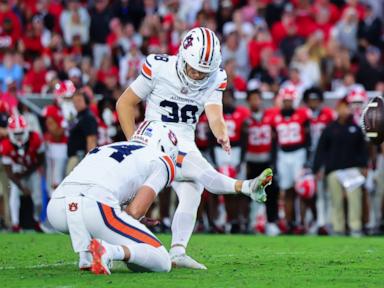
A box score will tell you the bare skeleton of what happened: Auburn beat No. 1 Georgia 27-24 on Alex McPherson's last-second 34-yard field goal. Clean. Neat. Tidy. A three-point margin on a piece of digital paper. Further reporting on this matter has been published by CBS Sports.
Box scores are liars by omission. They record the kick, not the tremor in a kicker's left calf after four quarters of pacing the sideline while every snap threatens to end the afternoon. They list 27 and 24 like two grocery totals, stripping away the bruised ribs, the blown coverages, the sudden bursts of hope that feel almost dangerous when you are playing a team built on depth and dominance.
Let's be honest about what happens when an underdog gets close to a top-ranked giant late in the fourth quarter. It is confusing, and it is scary. For three quarters, your brain tells you the script is already written. You watch the favored offense grind out first downs. You watch the top-ranked defense tighten the screws. You brace for the inevitable moment when the machine shifts gears and pulls away.
When that moment doesn't come—when the scoreboard stays knotted at 24-24 and the clock starts ticking down toward zero—the air changes. Hope arrives, but it doesn't feel like celebration. It feels like holding a glass ornament over concrete.
The Weight of a Thirty-Four-Yard Line
To understand a 34-yard field goal at the end of a tie game, you have to strip away the highlight reel and look at the geometry of panic.
Thirty-four yards sounds short on a sunny Tuesday at practice. At that distance, kickers hit balls into nets with relaxed shoulders, laughing with holders, comparing notes on wind gusts. Nothing is on the line except pride and muscle memory.
Now put eighty thousand screaming voices inside a bowl. Put the No. 1 team in college football across the line, waiting for a mistake, a bad snap, a fraction of a second of hesitation. Put the clock under ten seconds—or ticking down to the final snap—where there is no tomorrow to fix a push to the right or a low trajectory into the line.
Let's use a metaphor here to make the mechanics plain: imagine threading a needle while standing on a moving train. The needle hasn't changed size. The thread hasn't changed thickness. Nothing about the physical task became more complex in a vacuum. Yet everything changed because the ground beneath your feet refuses to stay still.
That is what kicking a late-game winner feels like. Your body knows the swing. Your hips know the rotation. Your plant foot knows where to land inches behind the ball. Your mind, however, is trying to process a thousand conflicting signals at once: Don't over-swing. Stay behind the ball. Watch the laces. Don't listen to the crowd. Don't think about the miss that could haunt a whole season.
A kicker is a specialist trapped inside a collision sport. For fifty-nine minutes and fifty-something seconds, he is a spectator to violence—watching helmets crack, linemen wheeze, and coaches age ten years per possession. Then, for roughly two seconds, the entire weight of four hours of grit lands on the instep of one shoe.
Two Characters in the Same Storm
To feel how fragile a 27-24 finish truly is, let's introduce two hypothetical fans sitting three rows apart in the lower bowl—one wearing orange and blue, one wearing red and black. Neither of them is on the field. Neither of them will ever take a snap. Yet both of them live every yard of that final drive as if their own pulse controls the play clock.
Marcus, a hypothetical Auburn season-ticket holder whose hands have been cold since the second quarter, hasn't sat down since the two-minute warning. Every time Georgia's offense lines up or Auburn's offense creeps closer to field-goal range, Marcus grips the metal edge of the seat in front of him so hard his knuckles turn white. He has seen too many close ones slip away against top-ranked teams. He knows the heartbreak math by heart: how a single penalty pushes you back five yards, how a sack turns a chip shot into a prayer, how quickly joy can curdle into silence.
Three rows over sits Elena, a hypothetical Georgia supporter who arrived expecting a hard-fought test, maybe even a scare, but still quietly trusting the badge on the helmet. By the fourth quarter, that quiet trust has curdled into disbelief. She watches the score stay locked at 24-24. She sees the seconds bleed away. Her stomach knots every time the ball is spotted a yard closer, realizing that against a ranked opponent in a hostile environment, you don't need a miracle to lose—you only need one clean snap and one true strike.
Notice how neither Marcus nor Elena is watching a simple game of football anymore. They are watching a high-wire act without a net. One side is begging for catharsis after years of frustration against a dominant rival; the other is fighting to protect a No. 1 ranking and an undefeated standard that leaves zero room for error.
When you look at a rivalry game through Marcus and Elena's eyes, the 27-24 scoreline stops looking like a statistic. It looks like a fault line.
Why Top-Ranked Teams Bleed in Road Environments
There is a recognized pattern in college football that casual observers often miss until it smacks them in the face: being No. 1 puts a target on your back that grows heavier with every week of the season.
When you are ranked first in the country, every opponent plays you with extra urgency. Every scheme is saved for you. Every third-and-long feels like a championship snap for the underdog. Meanwhile, the team at the top carries a different burden—the burden of not losing what they already have.
Consider what happens next in a tight fourth quarter:
The underdog plays with house money once they prove they belong on the field. Every stop feels like a triumph. Every first down draws a roar that shakes the press box. The favorite, by contrast, often tightens up. Play-calling can become cautious. Margin for error shrinks to nothing. When the game is tied at 24-24 late, the pressure isn't split evenly. Sometimes the team with everything to lose feels the squeeze hardest.
Auburn didn't stumble into a 27-24 win by accident on a fluke bounce. To beat a No. 1 team on a last-second 34-yard field goal, you have to survive four quarters of physical punishment, answer punches without folding, keep turnovers from snowballing, and put yourself in position where a single kick can settle the argument.
Even then, putting yourself in position is only half the battle. Execution under maximum stress is where seasons are forged or fractured.
The Anatomy of the Final Kick
Think about the seconds right before a game-winning field goal.
Time stretches. A single breath feels like a minute.
The snapper bends over the football, fingers locked on the leather, eyes focused between his own legs toward the holder seven or eight yards back. The holder kneels, hands ready, waiting to catch a spiraling ball traveling forty miles an hour and set it upright on the grass—laces facing away, tilt just right—in a fraction of a second.
And behind them stands Alex McPherson.
There is no hiding place for a kicker on a 34-yard attempt with the game tied at 24-24 and time expiring. Wide receivers can run a bad route and blame timing. Quarterbacks can throw into coverage and point to a blitz. Linemen can miss a block and argue leverage.
When the ball is snapped for a field goal, everyone in the stadium knows what is happening. The defense knows it. The offense knows it. The kicker knows it most of all.
You take your steps—measured, practiced thousands of times in empty stadiums and quiet mornings until your feet could walk the pattern blindfolded. You swing your leg through the strike zone. You listen for the thud of leather meeting rubber and sole.
Then comes the worst part of the job: watching.
You don't control the ball once it leaves your foot. You stand there, body angled slightly from the follow-through, eyes tracking a spinning oblong shape rising against a backdrop of jerseys, lights, and roaring humanity. A 34-yard kick is long enough to drift if you guide it, short enough that a flat trajectory gets batted down at the line if you rush your plant.
When it clears the crossbar—when the uprights frame a 27-24 lead with no time left—the release isn't just loud. It is explosive.
What a Three-Point Win Really Means
If you only care about who won, 27-24 tells you everything you need in half a second. Auburn won. No. 1 Georgia lost. Alex McPherson hit a 34-yard field goal at the buzzer.
If you care about why sports matter, that score is only the doorway.
Wins like this linger because they disrupt certainty. In an era where rankings, recruiting stars, and preseason projections often make outcomes feel predetermined before kickoff, a last-second 34-yard field goal against the No. 1 team reminds everyone why we bother watching. Giants can bleed. Underdogs can finish. One swing of a leg can turn an entire season's narrative upside down.
There is also something deeply human about watching a specialist step forward when everything is on the line. Most of us will never play in front of eighty thousand people or kick a ball to beat a top-ranked opponent. Yet almost all of us know what it feels like to have a moment where preparation meets nerve—where your hands are shaking a little, the room feels too loud, and you still have to step up and do your job cleanly.
That is why you can't reduce a 27-24 thriller to cold numbers. Numbers measure outcomes. Stories measure what it cost to get there.
Long after the final whistle fades and the postgame shows chop up the highlights into ten-second clips, the memory stays with the people who lived it—the kicker who trusted his swing, the teammates who held the line, and the crowd that watched a 34-yard sliver of turf turn into history.
The ball went up. The uprights held. And in the roar that followed, nobody in the stadium needed a box score to tell them how loud victory sounds.