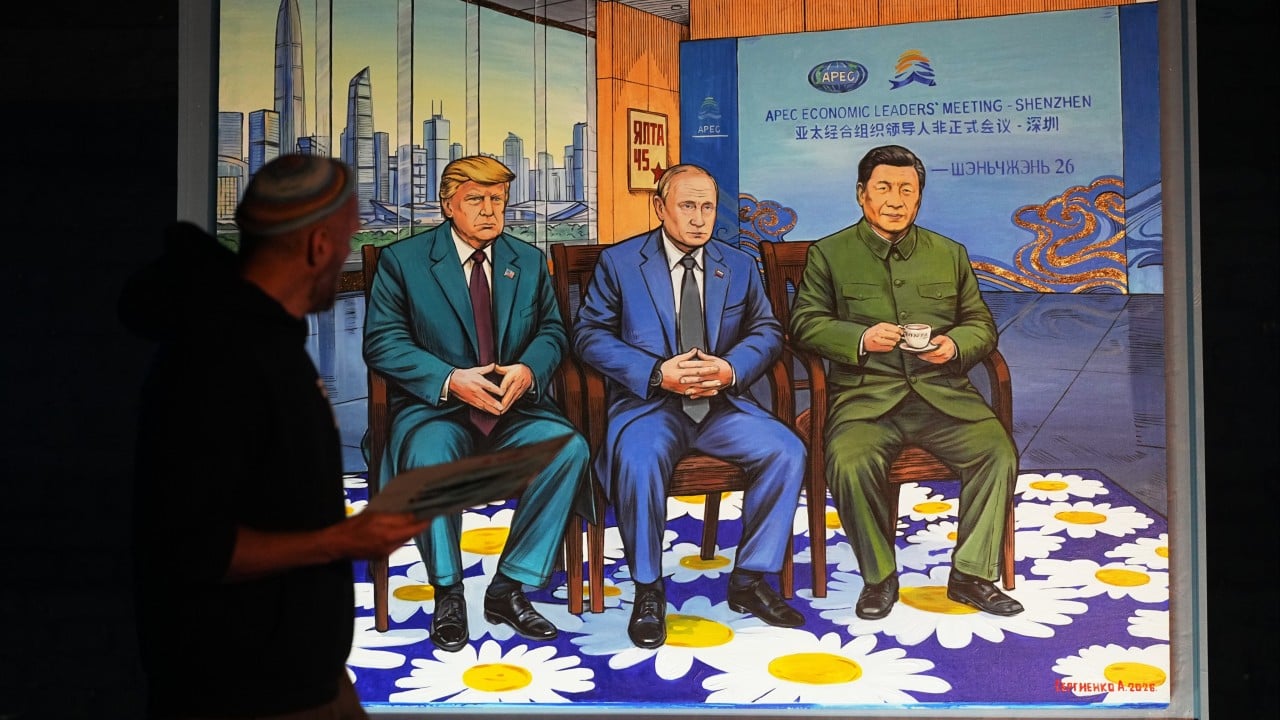
The carpet in a diplomatic holding room always smells faintly of stale espresso and dry-cleaning fluid.
I remember standing in a hallway outside a bilateral summit in Vienna a decade ago, watching a junior attaché drop a stack of briefing binders onto the marble floor. Nobody bent down to help him. The security detail stared straight ahead, earpieces coiled like plastic snakes behind their ears, while aides with laminated badges stepped carefully over the scattered pages of nuclear non-proliferation treaties. In those rooms, gravity works differently. Human warmth is treated as a security breach, and the fate of millions of people who will never own a tailored suit is reduced to bullet points on heavy bond paper.
Now, picture a different room. A bigger room.
Across a polished mahogany table sit Donald Trump, Xi Jinping, and Vladimir Putin. Cameras flash for ninety seconds—just long enough for the network chyrons to scream about history in the making—before the heavy oak doors swing shut and the press pool is herded back behind velvet ropes.
The pundits have already dusted off their favorite historical cliché for this moment. They are calling it Yalta 2.0.
They are wrong. And misunderstanding why they are wrong could cost us everything.
The Myth of the Mapmakers
To understand the seductive danger of the Yalta comparison, you have to strip away the black-and-white newsreel nostalgia and look at what actually happened in February 1945.
Picture a seaside palace in Crimea, the plaster peeling from artillery vibrations, where a dying Franklin D. Roosevelt, a pugnacious Winston Churchill, and a calculating Joseph Stalin sat down to carve up the rubble of a defeated empire. Germany was weeks from collapse. Japan was burning. The three men at Yalta were not negotiating a delicate peace between equals; they were dividing the spoils of a war they had nearly won. They had pencils, they had maps of Eastern Europe, and they had millions of exhausted soldiers standing on the exact territory they were trading away like poker chips.
If you want a metaphor for Yalta, think of three landlords splitting up an empty apartment building after the previous tenants have been evicted.
What happens when Xi, Putin, and Trump sit across from one another is the exact opposite. Nobody has been evicted. Nobody has surrendered. Instead of three victors dividing a ruined continent, imagine three rival captains standing on the decks of heavily armed ships in the middle of a storm, shouting through megaphones while their crews quietly aim torpedoes beneath the waterline.
History does not repeat itself; it rhymes poorly, usually when commentators get lazy. Calling a modern trilateral summit a new Yalta implies that the world is still neat enough to be carved into spheres of influence with a fountain pen. It suggests that if three strongmen simply shake hands over mineral rights, shipping lanes, and border provinces, the rest of the planet will obediently fall into line.
That world died forty years ago.
The Invisible Table
Consider a hypothetical character—let us call her Lin—who runs a mid-sized precision-manufacturing plant outside Shenzhen.
Lin does not care about nineteenth-century geopolitics or the historical parallels of Crimean resorts. She cares about the forty-two thousand micro-capacitors sitting in customs in Long Beach, California, and the German-engineered lithography parts currently stalled in Rotterdam. When Washington slaps a sixty percent tariff on Chinese green tech, Lin does not receive a diplomatic cable. She receives a frantic phone call from her floor manager at three in the morning telling her to cancel the second shift.
Now consider Marek, a fictional logistics coordinator working the night shift at a rail hub in eastern Poland, thirty miles from the Ukrainian border. Marek spends his nights watching flatbed cars loaded with artillery shells and winter generators roll east under floodlights. For Marek, a handshake between Washington and Moscow is not an abstract triumph of statecraft. It is the difference between whether his younger brother gets drafted next spring or whether the air-raid sirens across the river finally go quiet.
Lin and Marek are not in the room. Neither is the Taiwanese semiconductor engineer in Hsinchu, nor the Kazakhstani uranium miner, nor the European central banker watching energy futures spike every time a pipeline valve is turned in Siberia.
Yet they are all sitting at the table.
At Yalta in 1945, the global economy was shattered, supply chains barely existed outside military convoys, and power was measured almost exclusively in tank divisions and bomber wings. Today, the three men in that room are tethered to each other by trillions of dollars of tangled debt, fragile undersea fiber-optic cables, and rare-earth supply chains so intricate that a single factory fire in Asia can halt assembly lines in Detroit within three weeks.
You cannot draw a clean line down the middle of a spiderweb without tearing the whole thing apart.
Three Men, Three Clocks
If this summit is not a grand division of the globe, what is it actually? Strip away the pageantry, and you are left with three leaders operating on radically different internal clocks, each desperate for something the others can only partially give.
Start with Vladimir Putin. His clock is measured in territory and survival. Over a decade of grinding conflict in Ukraine has hollowed out Russia’s demographic future and turned its economy into a wartime furnace that cannot easily be cooled down without triggering domestic shockwaves. Putin walks into that room wanting one thing above all else: recognition. He wants the sanctions lifted, the frozen central bank reserves unlocked, and a permanent, internationally ratified acknowledgment that Russia cannot be isolated from the European security architecture. He is playing for permanence.
Now look across the table at Donald Trump. His clock is measured in election cycles, market tickers, and immediate, visible wins. Trump despises multilateral treaties that take ten years to ratify and twenty years to show results. He views diplomacy through the lens of transactional real estate—every alliance is a lease up for renegotiation, every tariff is leverage, and every summit is a stage where the value of the deal is measured by how dramatically it breaks from his predecessors. He wants the wars stopped so the money stops flowing outward, and he wants trade numbers that look triumphant on a broadcast graphic by Tuesday morning.
Then look at Xi Jinping. His clock is measured in decades.
Xi is presiding over a China that is simultaneously more powerful and more vulnerable than at any point in the last thirty years. A collapsing property sector, a shrinking workforce, and a stubbornly sluggish consumer economy have squeezed Beijing’s margins for error. Xi does not want a chaotic global war that chokes off the maritime trade routes keeping Chinese factories alive. Nor does he want to be dragged down by Moscow’s endless confrontation with the West. What Xi wants from a three-way summit is breathing room—a tactical pause in the American tech blockade and a quiet confirmation that Beijing, not Moscow, is the indispensable superpower sitting across from Washington.
Notice the friction here.
One man wants historical permanence. One man wants immediate transactional victory. One man wants strategic patience.
When three people enter a room wanting fundamentally incompatible versions of time, they do not walk out with a new world order. They walk out with a series of temporary, fragile bargains disguised as historic breakthroughs.
The Anatomy of a Mirage
I used to believe, early in my career covering international trade disputes, that closed-door summits failed because leaders hated each other. Years of watching diplomatic transcripts leak into the daylight taught me the exact opposite. Summits fail because leaders convince themselves that personal chemistry can override structural reality.
Think of the famous moments of summit theater over the last half-century. Nixon raising a glass of maotai with Zhou Enlai in 1972. Reagan and Gorbachev walking out to the cold ocean air in Reykjavik in 1986, coming within a hair’s breadth of abolishing nuclear weapons before stumbling over a single stubborn disagreement about space-based missile defense. Trump stepping across the concrete curb into North Korea in 2019, cameras clicking wildly while the actual centrifuges kept spinning underground fifty miles away.
The photograph always outlives the communiqué.
When Xi, Putin, and Trump finally emerge from behind those doors, the press release will be masterclass in constructive ambiguity. Words like framework, stability, and mutual respect will do heavy lifting to disguise the fact that none of the core collision points have been resolved.
Ukraine will not suddenly become a settled question because two leaders agree to freeze a frontline that neither side trusts the other to respect. Taiwan will not vanish from Beijing’s strategic calculus because Washington agrees to lower tariffs on electric vehicles or soybeans. And the deep, structural divorce between American and Chinese technology ecosystems—from artificial intelligence chips to quantum computing—will continue accelerating quietly in laboratories from California to Shenzhen long after the motorcades have left the tarmac.
This is the part that unsettles even seasoned diplomats when you catch them off the record, nursing a drink in a hotel lobby after midnight. The danger of a high-stakes trilateral summit is not that it triggers World War III. The danger is that it creates a seductive illusion of stability while the underlying tectonic plates keep grinding toward an earthquake.
What Actually Changes When the Doors Open
Does that mean the meeting is theater? No. That would be an equally dangerous misreading.
Even without a grand Yalta-style division of the world, putting these three men in the same room changes the atmospheric pressure of global politics overnight.
First, it shatters the post-Cold War taboo against great-power triangulations. For thirty years, Washington’s foreign policy establishment operated on the assumption that alliances were permanent, rules-based clubs, and that authoritarian rivals should be contained rather than bargained with directly as peers. By sitting down in a three-way format, the United States implicitly concedes what Beijing and Moscow have argued for twenty years: that we live in a multipolar world where three capitals hold the primary keys to global security, and everyone else—from Brussels to Tokyo to New Delhi—is sitting in the waiting room.
Look at how quickly the tremors spread outward from that single fact.
In Berlin and Paris, defense ministers quietly accelerate plans for European strategic autonomy, realizing that a bilateral bargain over Eastern Europe could leave them footing the bill for a security perimeter they had no hand in negotiating. In Tokyo and Seoul, quiet conversations begin about nuclear deterrence and whether the American security umbrella still covers every rainy day. In capitals across the Global South—from Brasília to Riyadh—leaders watch the three giants haggle and immediately raise their own asking prices for oil, lithium, and diplomatic backing.
Second, a trilateral summit creates a transactional marketplace where crises become linked in ways they never were before.
Imagine a simple, realistic scenario behind those closed doors. Washington hints at easing certain semiconductor restrictions or tariff schedules on Chinese goods. In exchange, Beijing quietly uses its economic lifeline to Moscow—buying discounted Russian crude, supplying dual-use machine tools—to nudge the Kremlin toward a ceasefire in Ukraine. Meanwhile, Moscow offers to withhold advanced submarine or missile technology from Iran or North Korea in exchange for Western sanctions relief.
None of that requires trust. None of it requires friendship. It is pure, cold-blooded horse-trading.
And yet, for millions of ordinary people—for Lin watching her shipping manifests in Shenzhen, for Marek listening to the night trains in Poland—that cold-blooded horse-trading could mean the difference between a slow-motion economic depression and a fragile, uneasy calm.
The Weight of the Unspoken
We have a habit of watching leaders on television and projecting onto them the clarity of chess grandmasters, moving pieces across a board with total foresight. Up close, power looks much messier. It looks like tired men reading briefing cards in terrible lighting, surrounded by advisors whispering conflicting warnings into their ears, trying to guess whether the person sitting across the table is bluffing or genuinely prepared to burn the house down.
The ghost of 1945 haunts this meeting not because Xi, Putin, and Trump are about to redraw the map of the world, but because we are still trapped in the mindset that three men in a room can simply decide the future by fiat.
They cannot. The world has grown too loud, too wired, too stubbornly interconnected to be carved up with a fountain pen over brandy and cigars. A single software patch, a drought in a grain belt, a protest in a provincial factory town, or a rogue drone over a contested strait can unravel a summit agreement before the ink has dried on the translation.
When the doors finally swing open and the three leaders walk out to the microphones, watch their hands, not their faces. Watch how quickly they step away from the podium once the scripted remarks are finished.
Somewhere outside the security perimeter, beyond the motorcades and the satellite trucks, the cargo ships will still be idling in the harbor, waiting to see which way the wind blows.