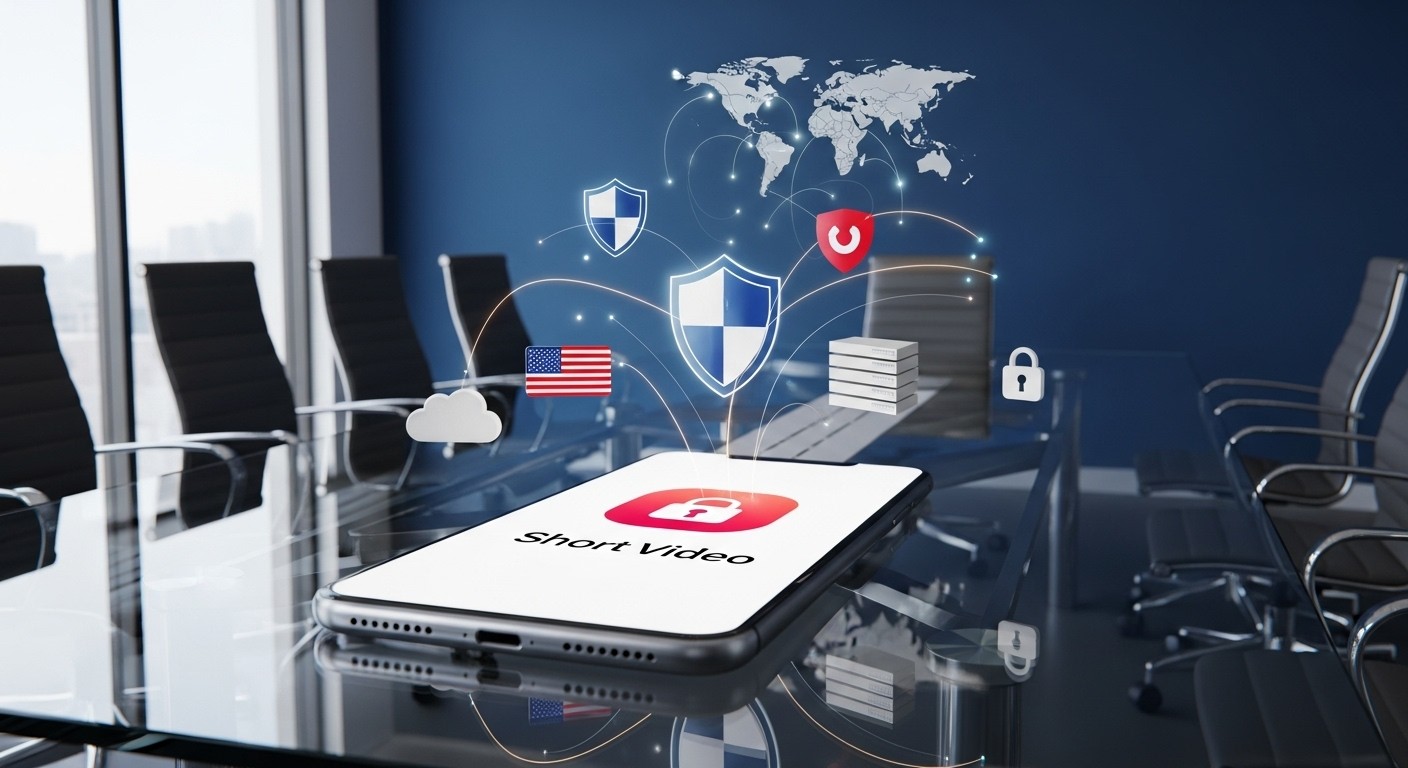
The press release reads like a victory lap. TikTok stays. Oracle gets a slice. The U.S. government gets a "win." The public is told that a joint venture—this shiny new entity—finally solves the data security puzzle that has haunted the app for years.
It is a lie.
The consensus view is that this agreement "secures" TikTok’s future. In reality, it formalizes a new type of corporate-state hostage-taking that will fundamentally break how the internet works. This isn't a peace treaty; it is a blueprint for the balkanization of the global web, dressed up in the language of compliance and national security.
The Myth of the "Clean" Cloud
The core argument for the joint venture is "Project Texas"—the idea that by moving U.S. user data to Oracle-controlled servers, the risk of foreign influence vanishes. This assumes that data is a static pile of gold sitting in a vault.
It isn't. Data is a river.
If the algorithm—the actual engine of the app—is still being refined, trained, and updated by engineers in Beijing, the location of the server is irrelevant. I have watched companies spend $50 million on "data residency" projects only to realize that their developers still need remote access to fix a bug at 3:00 AM. When that access happens, the "secure perimeter" becomes a sieve.
By focusing on where the data sits rather than how the logic is governed, the U.S. government has accepted a cosmetic fix for a structural problem. Oracle isn't a security guard here; they are a landlord collecting rent on a building they don't have the keys to.
Oracle’s Regulatory Capture
Let’s be honest about the players. Oracle didn't enter this deal because they care about your privacy. They entered it because they are a legacy hardware and software giant that has been losing the cloud wars to AWS and Azure for a decade.
This joint venture is the ultimate act of regulatory capture. Oracle is using federal mandates to force a massive, high-growth client onto its infrastructure. This isn't innovation; it’s a government-mandated subscription model.
- Monopoly by Decree: If every "sensitive" foreign app is eventually forced into a similar joint venture, we aren't creating a more secure internet. We are creating a protected class of domestic infrastructure providers who no longer have to compete on price or performance.
- The Compliance Tax: Every dollar TikTok spends on this redundant, hyper-localized infrastructure is a dollar not spent on improving the user experience. Eventually, that cost is passed down to creators and advertisers.
The "Algorithm Transparency" Scam
The competitor article suggests that allowing U.S. officials or third-party auditors to "review" the source code will prevent the manipulation of public opinion.
This reveals a staggering ignorance of how modern machine learning works. You cannot "audit" a recommendation engine by reading lines of code. The code is often simple; the complexity lies in the weights—the trillions of variables calculated by the model during training.
Asking a regulator to audit the TikTok algorithm is like asking a librarian to explain the consciousness of a human being by looking at an MRI. They can see the structure, but they have no idea why a specific thought (or a specific video) occurred at that exact moment.
To truly control the "influence" of the app, the U.S. would need to take over the training of the model itself. This joint venture doesn't do that. It just lets a few guys in suits look at a screen they don't understand.
The Dangerous Precedent of Forced Marriage
We are ignoring the most volatile part of this deal: it gives every other nation on earth the green light to do the exact same thing to U.S. companies.
If the U.S. can force TikTok into a joint venture to operate on its soil, why shouldn't India, Brazil, or the EU force Meta and Google into local joint ventures with their politically connected tech giants?
- Fragmentation: We are moving toward a world where every country has its own "local" version of the global internet, managed by a government-approved middleman.
- The Death of Scale: The reason tech companies grew so fast was the ability to deploy one codebase to 4 billion people. If you have to build a "Project Texas" for 190 different countries, the cost of entry for new startups becomes infinite.
We are killing the open web to save a political narrative.
The Privacy Red Herring
The irony of the "national security" panic is that TikTok’s data collection is largely indistinguishable from that of any American data broker.
If you are worried about a foreign power knowing your location or your interests, you should be terrified of the unregulated $200 billion data brokerage industry. Foreign intelligence agencies don't need to own TikTok to get your data; they can buy it legally, in bulk, from third-party aggregators based in Virginia and California.
This joint venture solves a branding problem, not a privacy problem. It allows politicians to look "tough on China" while doing absolutely nothing to pass a comprehensive federal privacy law that would actually protect citizens from all predatory data collection, foreign and domestic.
The Creator’s False Sense of Security
Creators are celebrating because the "ban" is off the table. They should be worried.
A joint venture controlled by a U.S. board and monitored by the government is an entity that is far more likely to engage in "shadow-banning" at the request of domestic agencies. We’ve seen the "Twitter Files." We know how the sausage is made.
By pulling TikTok into a domestic joint venture, the app becomes part of the domestic surveillance and content moderation apparatus. It’s no longer a rogue platform; it’s a deputy. If you thought the algorithm was opaque before, wait until it’s being tweaked to satisfy a "Compliance and Oversight Committee" made up of former intelligence officials.
Why the "Solution" is the Problem
The joint venture is a messy, expensive compromise that satisfies no one but the lawyers and the cloud providers.
It fails to address the underlying issue: we live in an era where software is a weapon. You don't fix a weapon by changing the box it’s shipped in. You either accept that the global internet is inherently risky, or you shut it down. This middle ground is a theatrical performance designed to keep the ad dollars flowing while pretending the risk has been mitigated.
The true "counter-intuitive" reality is that a total ban would have been more honest. A ban would have been a clear statement that the U.S. no longer believes in an open, global internet. This joint venture is the same statement, just whispered through a 500-page legal contract.
If you are a business leader, stop looking at this as a "resolution." Look at it as the starting gun for a new era of digital protectionism.
Start building your "Project Germany," your "Project Tokyo," and your "Project Mumbai" now. Because the joint venture isn't the exception—it’s the new, expensive, fragmented rule.
Stop asking if TikTok is safe. Start asking who benefits from the "safety" we just bought. It’s not the user. It’s the gatekeeper.
The internet isn't being saved. It's being subdivided.
Burn the white flag and stop calling this a win.