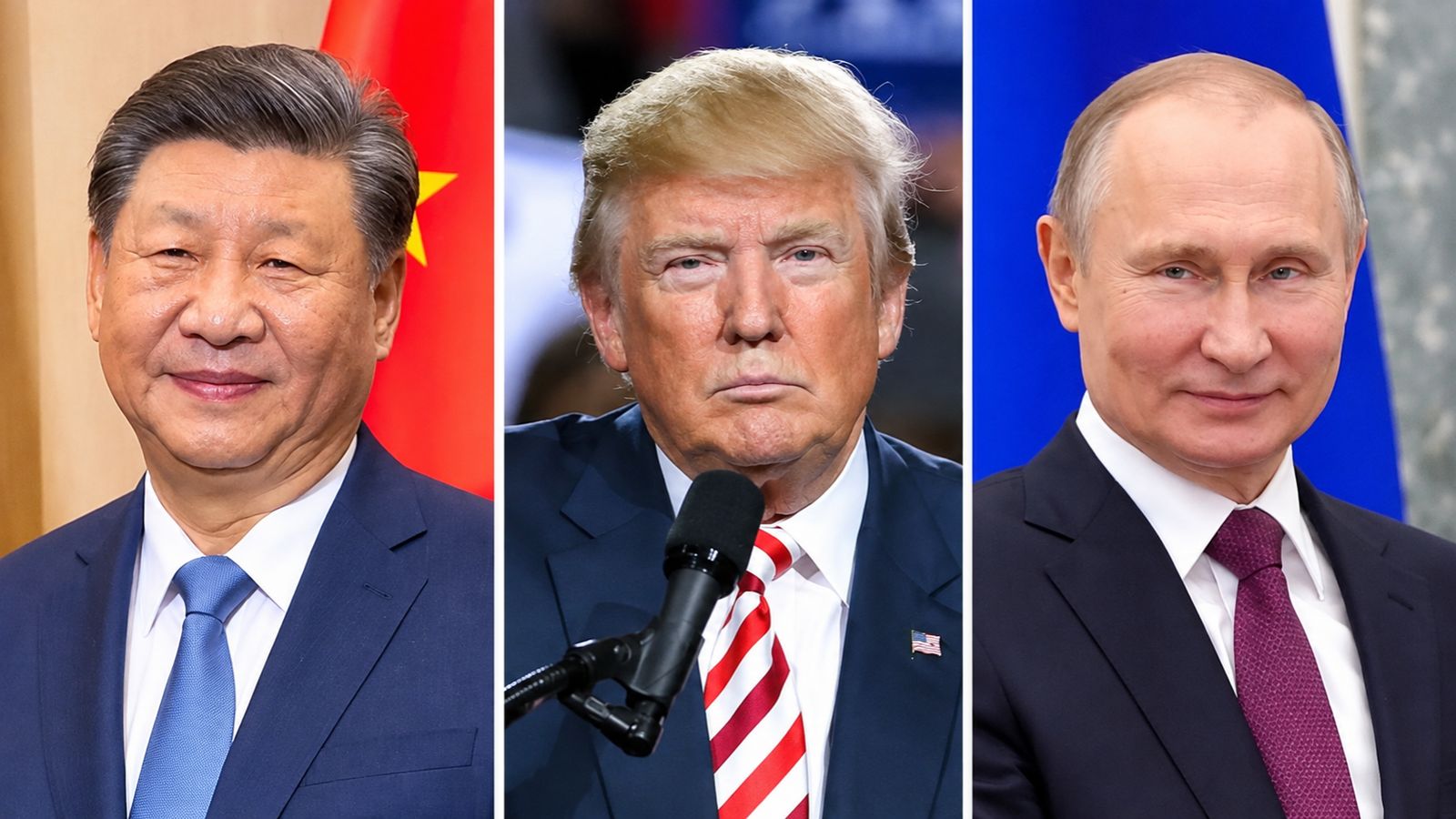
Executing high-stakes trilateral diplomacy while domestic digital infrastructure experiences systemic degradation exposes a fundamental tension in modern statecraft: the collision between external power projection and internal operational resilience. When an American president travels to Beijing for unprecedented trilateral discussions with Chinese President Xi Jinping and Russian President Vladimir Putin during widespread domestic technology outages, the geopolitical calculus shifts from routine bilateral negotiation to crisis-era signaling. Standard breaking-news coverage treats these two events—the summit and the outages—as parallel coincidences. In reality, they operate as interdependent variables in a single strategic equation.
To evaluate the leverage, vulnerability, and probable outcomes of a Trump-Xi-Putin summit occurring against a backdrop of U.S. network instability, analysts must separate theatrical optics from structural power dynamics. The following framework deconstructs the mechanics of triangular diplomacy, the anatomy of cascading digital outages, and the bargaining asymmetries created when domestic infrastructure falters at the exact moment a leader attempts to project strength abroad.
The Structural Mechanics of Triangular Diplomacy
In international relations theory, a three-player negotiation—often modeled through Henry Kissinger’s triangular diplomacy framework—differs fundamentally from a bilateral dispute. In a two-party negotiation, leverage is zero-sum; a gain for Washington is a direct loss for Beijing or Moscow. Introducing a third actor alters the payoff matrix, creating incentives for two parties to form a temporary tactical alignment against the third, or for one party to act as a pivot state that extracts concessions from both sides.
When Donald Trump enters a room with both Xi Jinping and Vladimir Putin, the structural objective is to disrupt the bilateral alignment between Beijing and Moscow. Over the past decade, Western sanctions and strategic containment policies pushed Russia and China into an asymmetric partnership, with Russia functioning as a junior resource and security supplier to China’s industrial and financial base. A trilateral format attempts to reintroduce friction into that dyad by offering selective bilateral incentives—tariff relief or market access for China, sanctions recalibration or territorial security guarantees for Russia—that force each actor to weigh the value of their current partnership against potential gains from Washington.
However, the viability of this pivot strategy depends entirely on the perceived durability and competence of the initiating state. In game theory, credible commitment requires that the signaling state possess the internal cohesion and operational capacity to enforce agreements and absorb retaliatory shocks. If the initiating state arrives at the table while its domestic communications, financial clearing, or cloud infrastructure is visibly compromised, the bargaining dynamic shifts. Instead of viewing Washington as a stable arbiter capable of delivering long-term guarantees, Beijing and Moscow gain empirical evidence of American systemic fragility.
The Three Pillars of Leverage in a Trilateral Summit
- Economic and Market Asymmetry: The United States retains primary control over dollar-denominated liquidity and high-end consumer demand. For Beijing, managing domestic industrial overcapacity and real estate deflation requires stable access to Western markets and semiconductor supply chains. Washington’s primary lever is the credible threat of escalating tariffs or secondary sanctions on Chinese financial institutions.
- Energy and Security Interdependence: Moscow’s strategic priority centers on sanctions relief, energy export corridors, and security architecture in Eastern Europe. While China absorbs discounted Russian hydrocarbons, Beijing avoids triggering direct Western secondary sanctions. Washington’s lever here is the ability to modulate enforcement mechanisms that either choke or release Russian capital flows.
- Technological and Infrastructure Dominance: Historically, American soft and hard power rested on unassailable technological superiority—control over foundational software, cloud architecture, and global routing protocols. This third pillar underwrites the first two; financial sanctions and supply chain controls rely on intact, secure American digital networks.
When widespread U.S. technology outages coincide with the summit, the third pillar suffers immediate reputational and functional erosion. Even if the outages stem from internal configuration errors, software updates, or third-party cloud failures rather than external state-sponsored cyber operations, the strategic effect on the negotiating table remains identical: it narrows the perceived gap between American technological capacity and that of its competitors.
Anatomy of Domestic Tech Outages During Geopolitical Crises
Modern national infrastructure is characterized by tight coupling and single points of failure. A disruption across major U.S. telecommunications carriers, cloud service providers, or enterprise software ecosystems rarely remains isolated to a single sector. Because aviation, logistics, financial trading, and municipal emergency services rely on shared cloud backbones and identity-authentication protocols, a localized technical failure rapidly cascades into a nationwide operational slowdown.
To understand how domestic outages constrain foreign policy execution, it is necessary to distinguish between three distinct failure modes and their geopolitical interpretations:
- Systemic Software and Cloud Monoculture Failures: When a dominant cloud provider or cybersecurity vendor pushes a flawed kernel-level update or suffers a Border Gateway Protocol (BGP) routing collapse, millions of endpoints go offline simultaneously. This is a self-inflicted operational vulnerability. In Beijing and Moscow, analysts interpret such events not as random accidents, but as proof that the American digital ecosystem has grown too complex and centralized to maintain reliability.
- Subsea Cable and Physical Backbone Disruptions: Global data transit relies on a finite network of fiber-optic cables and terrestrial landing stations. Physical damage or routing anomalies in these corridors degrade cross-border communications and corporate operations. During a foreign summit, physical infrastructure vulnerability highlights the exposure of U.S. commercial networks to gray-zone interference.
- Coordinated Cyber Attribution Ambiguity: In the initial hours of a major domestic outage, intelligence agencies and private incident-response teams rarely possess definitive attribution. This attribution lag creates a dangerous information vacuum. Adversaries do not need to claim responsibility for an outage to benefit from it; the mere plausibility of external interference forces the visiting delegation to divert bandwidth from diplomatic strategy to domestic crisis management.
The Operational Drag on Diplomatic Execution
A presidential delegation traveling abroad relies on continuous, high-bandwidth secure communications with Washington, military commands, and intelligence agencies. When domestic U.S. tech networks experience severe outages, the delegation faces immediate operational friction.
First, domestic political capital evaporates. A leader attempting to project strength abroad requires a stable home front. When domestic headlines focus on grounded flights, frozen payment systems, and offline businesses, the president’s domestic political standing weakens. Authoritarian counterparts like Xi and Putin, who operate without real-time electoral or media constraints, recognize that an American president facing domestic disruption operates under a compressed timeline. The visiting leader needs a tangible, rapid diplomatic win to shift the domestic narrative, which incentivizes premature concessions.
Second, economic signaling loses credibility. Threatening new tariffs, export controls, or financial restrictions carries less weight when the threatening nation’s own domestic commerce is temporarily paralyzed by internal technical failures. Beijing and Moscow can simply wait out the initial negotiating posture, calculating that Washington cannot afford to add external supply-chain shocks on top of internal digital disruptions.
The Projection Paradox: Optics Versus Material Reality
In political communication, "projecting strength" is frequently treated as a matter of rhetoric, posture, and media staging. In international negotiation, however, projection is subject to strict market and intelligence verification. Both the Chinese Ministry of State Security and Russian intelligence services maintain exhaustive real-time telemetry on U.S. infrastructure health, supply chain bottlenecks, and financial market volatility.
Attempting to project unyielding strength while domestic systems are visibly failing creates a Projection Paradox: the wider the gap between a leader’s assertive rhetoric and the observable operational reality of their home country, the less credible their threats become.
Consider the mechanics of deterrence and compellence. Deterrence requires convincing an adversary that the cost of an action will exceed any potential benefit. Compellence—forcing an adversary to change an existing behavior, such as altering trade practices or halting military operations—requires an even higher threshold of credibility. When Trump enters a trilateral meeting seeking to compel concessions from Xi and Putin, his leverage depends on their belief that the U.S. economy and administrative state can absorb the blowback of a failed summit.
If U.S. tech outages persist or recur during the talks, Xi and Putin gain a structural advantage in patience. Chinese statecraft operates on multi-year planning cycles, prioritizing regime stability and gradual technological self-sufficiency. Russian statecraft prioritizes endurance and the exploitation of Western institutional fractures. Neither leader faces an immediate domestic penalty for walking away from a summit without a signed agreement. Conversely, an American administration dealing with domestic infrastructure instability faces intense pressure to demonstrate immediate competence and control.
Known Facts Versus Analytical Hypotheses
Rigorous strategic assessment requires separating verifiable realities from analytical projections:
- Verifiable Fact: Trilateral engagement among the U.S., China, and Russia alters the bilateral dynamics that have defined post-2022 geopolitics, creating an opportunity to test the limits of the Sino-Russian partnership.
- Verifiable Fact: Large-scale domestic technology outages expose the concentration risk inherent in modern U.S. cloud and telecommunications architecture, directly impacting commercial productivity and public confidence.
- Verifiable Fact: Negotiations conducted during domestic crises suffer from asymmetric time horizons; the leader facing acute domestic disruption experiences higher pressure to secure a rapid headline outcome.
- Educated Hypothesis: Beijing and Moscow will use the optics of U.S. domestic instability to reinforce their internal narratives of Western institutional decline, hardening their baseline positions on technology transfer, sanctions relief, and regional spheres of influence.
- Educated Hypothesis: If the U.S. delegation attempts to compensate for domestic tech vulnerabilities through aggressive, maximalist rhetoric at the table, China and Russia will likely respond with procedural stalling rather than substantive concessions, waiting to see if domestic U.S. economic indicators deteriorate further.
Strategic Vulnerabilities in the Sino-Russian Counter-Position
While domestic tech outages create an immediate optical and operational handicap for Washington, assuming that Beijing and Moscow hold an unassailable hand ignores their own severe structural constraints. A balanced assessment must account for the vulnerabilities constraining Xi and Putin as they enter the room.
China faces acute structural headwinds: a prolonged contraction in its property sector, local government debt overhang, demographic decline, and youth unemployment. Beijing’s export-led growth model depends on continued access to American and European consumer markets to absorb manufacturing output. Furthermore, Chinese technology firms remain reliant on Western semiconductor design software, advanced lithography equipment, and global financial clearing systems. Xi Jinping cannot afford a total, abrupt decoupling from the U.S. economy without risking domestic social instability.
Russia’s economy has transitioned onto a wartime footing, generating short-term industrial output at the expense of severe inflation, labor shortages, and long-term capital depletion. Moscow’s dependence on Beijing as its primary buyer of energy and supplier of dual-use goods leaves Putin vulnerable to Chinese pricing power and diplomatic subordination. Engaging directly with the U.S. president offers Putin a rare avenue to re-establish Russia as an independent great power rather than a Chinese vassal state, while potentially exploring pathways to relieve the most punitive financial sanctions.
These underlying vulnerabilities mean that both Xi and Putin have genuine incentives to negotiate. However, the presence of U.S. domestic tech outages lowers the price they believe they must pay to secure an agreement. Instead of offering structural concessions—such as verifiable intellectual property protections, reduced industrial subsidies, or binding security commitments—they can offer cosmetic, reversible gestures while demanding concrete, irreversible U.S. concessions in return.
Risk Mitigation and Asymmetric Bargaining Tactics
When a negotiating team enters a high-stakes summit with compromised domestic optics, standard aggressive posturing fails. To neutralize the leverage adversaries gain from domestic infrastructure disruptions, strategic doctrine dictates a shift toward compartmentalization, credible escalation control, and asymmetric issue linkage.
- Compartmentalize Technical Crisis Management from Diplomatic Messaging: The visiting delegation must visibly delegate domestic infrastructure recovery to specialized operational agencies—such as the Cybersecurity and Infrastructure Security Agency (CISA), the Federal Communications Commission (FCC), and private sector incident commanders—while maintaining strict discipline in summit communications. Acknowledging technical failures transparently while demonstrating rapid, methodical remediation projects institutional resilience far more effectively than denying the disruption or overcompensating with bluster.
- Exploit the Sino-Russian Trust Deficit Through Bilateral Side-Channels: In a trilateral setting, the most potent moves occur outside the main plenary room. Washington should avoid treating China and Russia as a monolithic bloc. By conducting targeted, sequential bilateral sessions—offering Moscow specific sanctions-calibration frameworks in exchange for verifiable security concessions, while simultaneously discussing targeted tariff adjustments with Beijing—the U.S. can force each partner to suspect the other of cutting a separate deal.
- Anchor Agreements to Verifiable, Phased Benchmarks: Because domestic disruptions incentivize a quick, headline-grabbing deal, the primary trap for the U.S. delegation is signing an ambiguous framework agreement that grants immediate relief to Beijing or Moscow in exchange for future promises. Every U.S. concession must be structured as a phased, automatically reversible mechanism tied to objective, third-party-verified compliance metrics.
- Reframe Infrastructure Resilience as a Shared Systemic Risk: Rather than allowing Beijing to weaponize U.S. tech outages as proof of American decline, the U.S. delegation should pivot the discussion toward global critical-infrastructure stability. Establishing baseline rules of the road regarding non-interference in civilian cloud networks, subsea cables, and financial clearing systems puts China and Russia on the defensive, forcing them to either endorse global digital stability norms or expose their own gray-zone operational doctrines.
Limitations of the Triangular Pivot Strategy
No diplomatic framework eliminates underlying material constraints. Attempting a trilateral pivot while domestic infrastructure is unstable carries distinct limitations that cannot be resolved through clever negotiation tactics alone:
- Domestic Political Polarization: Unlike Xi and Putin, an American president cannot guarantee that executive agreements will survive changes in congressional control or judicial review. Both Beijing and Moscow discount long-term U.S. commitments accordingly, favoring immediate, transactional gains over multi-year strategic frameworks.
- Private-Sector Infrastructure Ownership: Roughly 85 percent of U.S. critical digital infrastructure is owned and operated by private corporations. The federal government cannot unilaterally mandate instant architectural redundancy across cloud providers and telecommunications carriers during a summit. Systemic resilience requires multi-year regulatory and capital-allocation shifts, leaving the executive branch exposed to private-sector software failures in the short term.
- Alliance Blowback: Engaging directly with Putin and Xi in a trilateral format risks alienating traditional U.S. allies in Europe and the Indo-Pacific. If allies perceive that Washington is cutting bilateral or trilateral deals over their heads to distract from domestic instability, alliance cohesion degrades, reducing Washington’s collective bargaining power in future crises.
Final Strategic Play
The U.S. delegation must immediately abandon the pursuit of a sweeping, grand-bargain summit communique and pivot to a strict, transactional containment posture. Washington should lock in narrow, reversible bilateral agreements—specifically targeting maritime incident-prevention protocols with Beijing and localized de-escalation mechanisms with Moscow—while refusing any permanent removal of tariffs or technology export controls until domestic U.S. digital infrastructure is fully stabilized and independent audit mechanisms confirm adversary compliance. Concurrently, the administration must initiate an immediate federal audit of single-point-of-failure cloud dependencies across critical U.S. sectors, treating domestic software monoculture not as a routine corporate IT issue, but as a primary national security vulnerability that directly dictates American bargaining power abroad.


