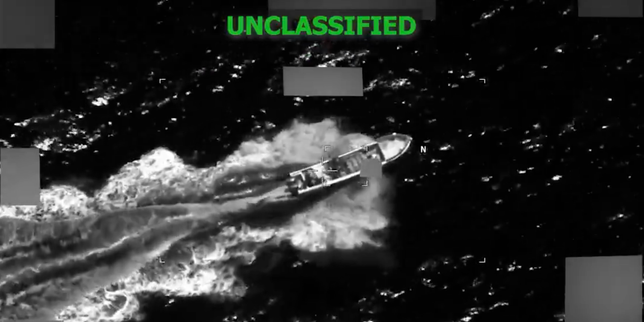
The media loves a good action movie narrative. A high-speed chase in the Pacific. A low-profile vessel slicing through international waters. A US Navy or Coast Guard cutter intercepting the target, resulting in a dramatic clash, two dead suspects, and a seized haul of cocaine. The headlines practically write themselves, painting a picture of a thin blue line on the ocean keeping Western streets safe from the cartel menace.
It is a comforting story. It is also an expensive, deadly lie.
The recent lethal confrontation in the Pacific between US forces and a suspected smuggling vessel is not a victory. It is a symptom of structural failure. For decades, maritime security strategies have treated the interception of narco-subs and go-fast boats as a metric of success. Look at the tonnage seized, the press releases scream. Look at the street value neutralized.
But if you look at the actual economics of global supply chains, these high-seas dramatic showdowns are entirely irrelevant. They are a rounding error on a cartel balance sheet. They are the cost of doing business, priced into the market long before the boat ever leaves the coast of Colombia or Ecuador.
By treating a supply-side logistics problem as a military tactical problem, western governments are burning billions of dollars to achieve a net-zero impact on the availability of illicit goods. We need to stop celebrating these kinetic engagements and start dismantling the flawed premise of maritime interdiction entirely.
The Flawed Math of Tonnage and Street Value
The fundamental error in standard reporting on maritime drug seizures is the reliance on "street value" as a metric. When an agency announces it seized $50 million worth of cocaine at sea, they are calculating the value of that product as if it had already been cut, packaged, distributed, and sold by the gram on the streets of New York, Chicago, or Paris.
That is not how wholesale logistics work.
In the supply chain of illicit commodities, value is added exponentially at every border crossing and distribution node.
- At the source: A kilogram of cocaine base in the jungles of South America costs roughly $1,000 to $1,500 to produce.
- At the coast: Once processed and ready for maritime transit, that same kilo is worth perhaps $3,000 to $5,000.
- At the destination: It is only when that product successfully crosses a major international border—like the US southwest border or into a European port—that the value jumps to $20,000 or $30,000 wholesale.
When a US military asset sinks or captures a boat in the deep Pacific, they are destroying product that cost the cartel a fraction of its final market value. The financial hit to the criminal enterprise is minimal.
I have analyzed supply chain mechanics across various risk-heavy environments, and the economic reality is brutal: cartels factor in a 30% to 40% loss rate on maritime shipments. They expect to lose boats. They expect some crews to get captured or killed. They simply launch five boats knowing that if only three make it through, the profit margins are still high enough to fund the next ten operations.
Interdicting a vessel in the Pacific does not restrict supply. It merely shifts the cost structure slightly, a cost that is ultimately passed down to the end consumer without ever denting the cartel's liquidity.
The Narco Submarine Myth: High-Tech vs. Disposable Logistics
The media frequently characterizes low-profile vessels (LPVs) and semi-submersibles as "cutting-edge" or sophisticated criminal engineering. This completely misreads the strategy behind their construction.
These vessels are not engineering marvels; they are built to be disposable. They are constructed from fiberglass and wood in makeshift jungle shipyards. They use standard, mass-produced diesel engines. They are designed for a single one-way voyage. Once the cargo is offloaded onto smaller vessels near the destination coast, or if law enforcement approaches, the crew opens the scuttling valves. The boat sinks to the bottom of the ocean, erasing the evidence.
The cartel views the vessel, and often the crew, as entirely expendable assets.
When international forces engage these vessels, they are deploying multi-billion-dollar naval assets—destroyers, cruisers, advanced maritime patrol aircraft, and elite tactical teams—against a fiberglass shell powered by a commercial motor. The asymmetry of cost is absurd. The taxpayer spends millions of dollars per day to keep a naval task force operational in the Eastern Pacific, all to capture a vessel that cost the cartel less than $200,000 to build.
This is not strategic victory; it is a resource sink.
Why Kinetic Force Fails on the High Seas
The recent incident resulting in two fatalities highlights the rising escalation of violence in international waters, but it exposes a deeper tactical dead end. The introduction of lethal force during an interdiction does not act as a deterrent.
The individuals piloting these boats are not cartel executives. They are not high-ranking operatives. They are usually impoverished fishermen from coastal villages in Ecuador, Colombia, or Central America, recruited or coerced into making the journey for a payout that represents years of honest wages. They are entirely unaware of the broader organizational structure they serve.
Killing or capturing them does not disrupt the network. The cartel leadership remains untouched, safely insulated by layers of shell companies, corrupt officials, and encrypted communication networks thousands of miles away from the target zone.
Furthermore, using military force to solve a transnational policing issue creates massive legal and diplomatic friction. It forces naval personnel into the role of maritime police, navigating complex international laws regarding hot pursuit, stateless vessels, and the use of force on the high seas. When an operation goes wrong and lives are lost, it creates diplomatic headaches and lengthy investigations, while the flow of illicit goods continues completely unabated a few hundred miles to the west.
The Real Bottleneck: Financial Infrastructure over Physical Cargo
If stopping boats in the ocean is a proven exercise in futility, how do you actually disrupt a transnational criminal enterprise? You stop looking at the cargo and start looking at the ledger.
Cartels are not product companies; they are investment funds and logistics networks. Their biggest vulnerability is not losing a shipment of white powder; it is the inability to integrate billions of dollars in cash back into the legitimate global financial system.
[Physical Cargo Seizure]  --> Low Impact  --> Cartel absorbs 30% loss as standard cost.
[Financial Interdiction]   --> High Impact --> Freezes liquidity, halts payroll, stops acquisitions.
Every major maritime seizure is accompanied by a photo op of stacked bales of contraband on the deck of a ship. You rarely see a photo op of a seized trade-based money laundering network, a compromised correspondent banking channel, or a dismantled network of real estate shell companies in Miami, London, or Dubai. Yet, the latter is what actually keeps cartel bosses awake at night.
Consider the data from the Financial Action Task Force (FATF). Globally, authorities asset-freeze or seize less than 1% of the illicit financial flows generated by transnational organized crime. The cartels are winning not because their boats are faster than navy helicopters, but because their financial lawyers are smarter than state prosecutors.
Focusing resources on physical interdiction at sea allows politicians to point to tangible results—tons of drugs burned, boats sunk—while ignoring the systemic corruption and lax financial regulations that allow the profits from those drugs to be laundered through major western economies.
Dismantling the Premise of the "War on Drugs" Success Metrics
The public frequently asks: "If we don't stop them at sea, won't the streets be flooded?"
This question assumes that supply is the sole driver of addiction and consumption. Decades of economic data show that drug markets are demand-driven. As long as the demand exists in destination countries, the supply will find a way to meet it. If you close the Eastern Pacific maritime route, the traffic shifts to containerized commercial shipping through major ports. If you tighten port security, it shifts to general aviation or cross-border tunnels.
By framing maritime interdiction as a frontline defense, security agencies are asking the wrong question. They are asking, "How do we catch more boats?" instead of "Why is our strategy completely failing to impact the retail price and purity of the product on our streets?"
According to data from the Drug Enforcement Administration (DEA) and European monitoring agencies, despite record-breaking maritime seizures year after year, the purity of cocaine in western markets has remained consistently high, while the inflation-adjusted price has stayed stable or decreased. In any legitimate business, a massive supply chain disruption would cause prices to skyrocket and availability to drop. The fact that prices remain stable proves that our maritime interceptions are not even making a dent in the overall volume of production.
Shift the Assets to Where It Hurts
The contrarian approach to maritime security requires admitting that we cannot police millions of square miles of open ocean against disposable vessels. The rational play is to divest from high-cost, low-yield physical interceptions and reallocate those resources toward systemic vulnerabilities.
- Trade-Based Money Laundering (TBML) Task Forces: Shift funding from naval deployments to forensic accountants and intelligence units targeting the agricultural, electronics, and textile import-export schemes used to move value back across borders.
- Port Infrastructure Integrity: The vast majority of illicit volume moves not in low-profile vessels, but hidden inside legitimate commercial container shipping. Investing in automated, non-intrusive scanning technology at major hub ports yields a far higher return on investment than hunting individual go-fast boats in the deep ocean.
- Targeting the Chemical Precursors: Cocaine and synthetic drugs cannot be produced without massive quantities of regulated precursor chemicals. Targeting the supply chains of these chemicals before they ever reach the jungle laboratories is vastly more efficient than trying to catch the finished product on a boat.
The downside to this approach is that it lacks the cinematic appeal of a Navy crew boards a smuggling vessel at gunpoint. It involves dry financial audits, regulatory tightening, and political battles against banking institutions that profit from turning a blind eye to suspicious capital. It requires acknowledging that the enemy is not just a group of smugglers on a boat, but the systemic weaknesses within our own financial structures.
The two men who died on that boat in the Pacific were entirely irrelevant to the organization that employed them. Their deaths changed nothing. Their cargo will be replaced by next week. Until we stop treating the symptoms of global smuggling networks and start targeting the financial architecture that sustains them, every high-seas seizure is just an expensive piece of theater.
Stop hunting the boats. Free the naval assets. Audit the banks.