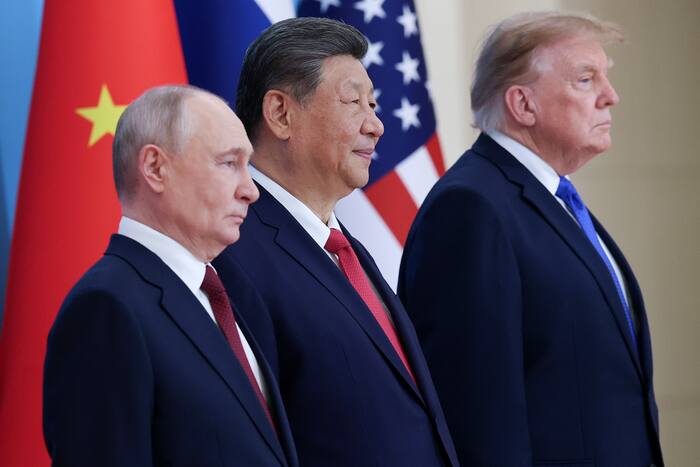
When the leaders of the United States, Russia, and China convene simultaneously on Chinese soil, standard journalistic coverage defaults to theatrical metaphors—calling the event "historic" while cataloging handshakes, motorcades, and boilerplate communiqués. That surface-level reporting misses the underlying structural mechanics. A trilateral summit involving Donald Trump, Vladimir Putin, and Xi Jinping is not a spontaneous diplomatic breakthrough; it is a high-stakes negotiation over global systemic architecture driven by asymmetric vulnerabilities, coercive bargaining, and shifting balance-of-power constraints.
To analyze this convergence accurately, we must strip away diplomatic pageantry and examine the meeting through established international relations frameworks: tripolar bargaining theory, coercive diplomacy, and strategic interdependence. In any three-player geopolitical system, bilateral agreements rarely remain isolated. Every concession made between two actors directly alters the security and economic payoff matrix of the third. Read more on a connected topic: this related article.
The Structural Architecture of Tripolar Bargaining
In traditional bipolar systems, such as the Cold War, deterrence and diplomacy operate along a single axis of tension. Adding a third major pole—China alongside the United States and Russia—introduces pivotal deterrence dynamics. The objective of each leader entering a trilateral summit is to avoid being the isolated vertex in a "two-against-one" alignment.
Asymmetric Payoff Matrices
Each participant enters the room with fundamentally different domestic constraints, time horizons, and strategic assets: Additional analysis by USA Today explores similar perspectives on the subject.
- The United States (Trump): Operates under short-term electoral cycles and transactional trade imperatives. The primary U.S. objective is reducing direct fiscal and military overextension in European and Indo-Pacific theaters while securing bilateral economic concessions—specifically tariff adjustments, intellectual property enforcement, and market access—that yield immediate domestic political capital.
- The People's Republic of China (Xi): Operates on multi-decade institutional timelines focused on regime stability, technological self-sufficiency, and regional hegemony in the Western Pacific. Hosting the summit allows Beijing to project systemic centrality, positioning itself as the indispensable diplomatic clearinghouse of Eurasia while attempting to decouple Washington's European allies from U.S.-led containment strategies.
- The Russian Federation (Putin): Operates under acute economic sanctions, demographic strain, and prolonged military attrition. Moscow’s core imperative is breaking diplomatic isolation, securing sanctions relief or trade workarounds, and locking in territorial and security sphere recognition in Eastern Europe without becoming entirely subordinate to Chinese economic monopsony.
Standard news reports treat these agendas as parallel wish lists. In reality, they form an interlocking constraint system. Washington cannot extract maximum trade concessions from Beijing without offering security or economic bandwidth elsewhere. Beijing cannot sustain its export-driven growth model if both Washington and European markets erect synchronized tariff walls. Moscow cannot maintain long-term war-economy solvency if Chinese financial institutions enforce secondary sanctions compliance to protect their own access to Western capital markets.
Deconstructing the Four Core Negotiation Pillars
Media coverage of high-level summits typically aggregates discussions into vague categories like "trade," "security," and "global stability." Operational analysis requires breaking these down into the specific mechanical levers on the negotiating table.
1. The Eurasian Security Architecture and Escalation Control
The primary kinetic flashpoint governing U.S.-Russia relations remains the European security order and the resolution mechanism for ongoing armed conflict in Eastern Europe. In a trilateral setting, Washington's leverage rests on weapons supply chains, intelligence sharing, and financial sanctions enforcement. Moscow's leverage rests on escalation dominance at the regional level and nuclear signaling.
Beijing's role here is neither neutral mediator nor unconditional Russian ally. China benefits from a distracted Washington, yet prolonged instability disrupts Belt and Road overland transit corridors and accelerates European rearmament. Therefore, Beijing's optimal outcome is a frozen conflict or a negotiated ceasefire that preserves Russian regime stability while reducing Western pressure on Chinese dual-use exports. Analysts must distinguish between publicly stated "peace frameworks" and actual enforcement mechanisms—specifically verification protocols, demilitarized buffer zones, and the exact sequencing of sanctions removal.
2. Tariff Regimes, Supply Chain Decoupling, and Trade Rebalancing
Economic statecraft forms the core of the U.S.-China bilateral track. Rather than viewing tariffs merely as protectionist taxes, practitioners view them as coercive bargaining chips designed to alter supply chain geography.
- Washington's Mechanism: Broad-spectrum tariffs combined with targeted export controls on advanced semiconductors, artificial intelligence compute infrastructure, and quantum computing components. The goal is to impose a structural ceiling on China's technological ascent while incentivizing manufacturing reshoring or friend-shoring.
- Beijing's Counter-Mechanism: Asymmetric retaliation targeting politically sensitive U.S. agricultural sectors, dominance over critical mineral refining (gallium, germanium, rare earth elements), and currency valuation adjustments to absorb tariff shocks.
When Putin enters this equation, energy and commodity flows become the mediating variables. Russia supplies discounted hydrocarbons and raw materials to China, lowering Chinese industrial input costs and offsetting U.S. tariff pressure. Any comprehensive U.S.-China trade stabilization requires addressing the secondary sanctions architecture surrounding Russian energy exports.
3. Strategic Arms Control and Deterrence Stability
The expiration and erosion of legacy bilateral arms control treaties—such as the Intermediate-Range Nuclear Forces (INF) Treaty and New START—have created an unregulated tripolar nuclear environment. Historically, Washington and Moscow maintained parity through bilateral verification regimes. China's rapid expansion of its nuclear silo fields and delivery systems renders bilateral U.S.-Russia caps obsolete from Washington's perspective.
Bringing all three leaders together introduces the baseline requirement for trilateral strategic stability talks. However, an immediate treaty is structurally impossible due to asymmetric arsenal sizes:
- The U.S. and Russia maintain deployed warhead counts in the thousands, backed by mature triad delivery systems.
- China maintains a significantly smaller, though rapidly growing, arsenal and refuses quantitative caps that would lock in permanent numerical inferiority.
Consequently, realistic outcomes in this domain are restricted to confidence-building measures: missile launch notification agreements, crisis communication hotlines, and rules of engagement regarding artificial intelligence integration into nuclear command-and-control systems.
4. Currency Hegemony and Alternative Settlement Networks
A less publicized but structurally critical variable in any Beijing-Moscow-Washington triangle is the architecture of cross-border financial settlement. Extensive U.S. and European sanctions against the Russian central bank and commercial lenders accelerated the use of the Chinese yuan (RMB) for bilateral Sino-Russian trade and spurred discussions around alternative settlement mechanisms within expanded BRICS frameworks.
Washington possesses the ultimate financial weapon: secondary sanctions restricting access to the U.S. dollar clearing system (CHIPS and SWIFT connectivity). Chinese state-owned banks remain heavily exposed to dollar-denominated global trade, creating a severe divergence between Beijing's geopolitical rhetoric and its institutional risk tolerance. At a trilateral summit, financial diplomacy centers on the precise boundaries of dollar weaponization—specifically where Washington draws red lines on Chinese financial clearing for Russian defense-industrial entities versus civilian trade.
Separating Known Facts from Analytical Hypotheses
Rigorous intelligence and policy analysis demands a strict boundary between verified occurrences, structural realities, and speculative projections. When evaluating reports of a Trump-Putin-Xi summit in China, observers must filter information through three distinct epistemic tiers:
Tier 1: Verified Structural Realities (Known Facts)
- Host-Nation Advantage: Holding the summit in China grants Beijing control over protocol, media framing, bilateral sequencing (who meets whom first and for how long), and domestic propaganda narratives.
- Asymmetric Economic Leverage: The United States remains the world's largest consumer market and issuer of the primary global reserve currency; China remains the world's largest manufacturing hub and dominant processor of critical minerals; Russia remains a top-tier supplier of global energy, grains, and fertilizers.
- Institutional Friction: Even when executive leaders reach high-level verbal understandings, implementation passes through entrenched domestic bureaucracies—the U.S. Congress, defense establishments, regulatory agencies, and state-owned enterprises—which frequently slow, dilute, or block rapid policy reversals.
Tier 2: High-Probability Mechanisms (Educated Hypotheses)
- Issue Linkage: None of the three leaders will grant unilateral concessions within a single policy silo. Progress on Eastern European ceasefire terms will likely be implicitly linked to U.S. restraint on new secondary sanctions against Chinese banks or moderation of specific tariff tranches.
- Wedge Strategy Execution: Both Putin and Xi will attempt to exploit tactical differences between Washington and its European and Indo-Pacific treaty allies, framing bilateral deals with the U.S. executive branch as evidence that allies cannot rely on permanent American security guarantees.
Tier 3: Low-Probability / Speculative Narratives (Noise)
- The "Grand Bargain" Fallacy: Media narratives suggesting a comprehensive, permanent division of the world into mutually respected spheres of influence ignore the fundamental irreconcilability of core national interests—specifically sovereignty disputes in the South China Sea, the status of Taiwan, and NATO's eastern flank commitments.
- Immediate Alliance Realignment: Hypotheses claiming that Washington can swiftly detach Russia from China (a "Reverse Nixon" maneuver) underestimate the deep structural integration of the Sino-Russian energy, defense-industrial, and intelligence ecosystems forged over the past decade.
Operational Limitations of Summit Diplomacy
Practitioners who manage international negotiations understand that leader-level summits are high-risk instruments with severe operational limitations. Relying on personal rapport between executives introduces specific failure modes:
- The Commitment Problem: In an anarchic international system without a supranational enforcement body, agreements are only as durable as the balance of power sustaining them. A promise made during a summit to halt territorial expansion, respect intellectual property, or cap tariff rates carries zero binding force if domestic political shifts or military opportunities alter the incentive structure six months later.
- Ambiguity vs. Precision Trade-offs: To claim diplomatic victory for domestic audiences, leaders frequently sign joint statements drafted in constructive ambiguity. While vague language prevents immediate summit collapse, it guarantees friction during the implementation phase when technical teams clash over conflicting interpretations of what was actually agreed upon.
- Allied Alienation Costs: For the United States, unlike Russia or China, global power projection depends heavily on formal treaty alliances (NATO, the U.S.-Japan alliance, the U.S.-South Korea alliance, AUKUS). Bilateral or trilateral deals struck over the heads of treaty allies erode alliance cohesion, potentially prompting regional powers to pursue independent nuclear deterrents or hedge toward Beijing—an outcome that degrades long-term U.S. strategic leverage.
Diagnostic Framework for Evaluating Summit Outcomes
Do not evaluate the success or failure of a Trump-Putin-Xi summit based on press conference tone, body language, or the signing of non-binding Memoranda of Understanding (MOUs). Apply the following four-point verification test to the post-summit reality over the subsequent 90 to 180 days:
- Metric 1: Capital and Trade Flow Adjustments. Track actual customs data, tariff schedule modifications in the U.S. Federal Register, and Chinese Ministry of Commerce export license approvals for critical minerals. Policy shifts that do not appear in customs enforcement codes do not exist.
- Metric 2: Force Posture and Kinetic Tempo. Monitor measurable changes in military deployments: naval transit frequency in the Taiwan Strait, artillery expenditure rates and front-line territorial shifts in Eastern Europe, and strategic bomber patrol routes. Diplomatic rhetoric accompanied by unchanged force posture indicates tactical stalling rather than strategic de-escalation.
- Metric 3: Sanctions Enforcement and Financial Clearing. Observe U.S. Treasury (OFAC) designation velocity against third-country intermediaries and transaction volume shifts in cross-border yuan clearing systems. A slowdown in secondary sanctions designations signals an implicit financial truce.
- Metric 4: Working-Group Institutionalization. Check whether the summit produces empowered, technical-level working groups with scheduled quarterly deliverables on nuclear risk reduction, fentanyl precursor interdiction, or trade dispute resolution. Summits without institutionalized follow-through mechanisms rapidly decay back to baseline hostility.
Strategic Forecast and Positioning
A trilateral summit among Trump, Putin, and Xi in China does not herald a new era of cooperative multipolarity; it represents a tactical stabilization pause within an enduring systemic rivalry. Each leader faces acute domestic and external pressures that make unchecked escalation mutually destructive in the near term, creating temporary convergence around risk management and transactional deal-making.
Decision-makers across multinational enterprises, institutional investment funds, and policy bodies must treat any resulting agreements as short-duration tactical windows rather than permanent structural shifts. Capital allocation, supply chain diversification, and geopolitical risk hedging should proceed on the baseline assumption that core technological decoupling between Washington and Beijing, alongside structural security friction between Washington and Moscow, will reassert themselves once the immediate political utility of the summit expires. Prepare operational contingencies for renewed tariff volatility and sanctions enforcement cycles within two quarters of the closing communiqué.