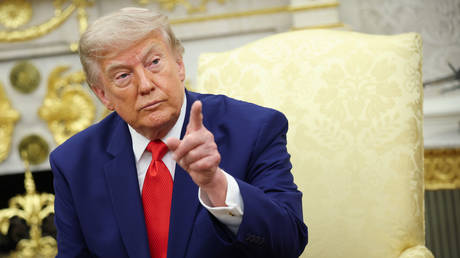
The headline runs hot across every cable ticker: Donald Trump claims the United States can take whatever we want from Ukraine.
Commentators lose their minds. Pundits scream about neo-imperialism, transactional foreign policy, and the death of the rules-based international order. They treat the statement like a radical break from standard operating procedure. They frame it as a crude shakedown of a sovereign nation bleeding on the wire.
They are completely wrong. Not because Trump is right, but because they are arguing about the wrong century.
The lazy consensus says this is about raw extraction. It assumes Washington wants to loot mineral deposits, seize agricultural tracts, or recoup foreign aid dollars through a medieval plunder economy. That narrative plays well for television ratings and social media outrage loops. It is also dangerously naive.
I have spent two decades watching foreign policy elites and defense contractors structure bilateral agreements behind closed doors. I have seen multi-billion-dollar aid packages signed with fanfare while the actual mechanics of future leverage were buried in structural adjustment clauses and debt-servicing formulas.
Washington does not need to take anything by force. The architecture of modern statecraft already guarantees that post-war reconstruction functions as a private equity roll-up.
The Myth of Direct Extraction
Let us dismantle the physical resource argument first. People hear rhetoric about seizing wealth and imagine cargo ships hauling titanium, lithium, and wheat out of Odessa while armed guards watch from the docks.
That is not how twenty-first-century hegemony operates. Physical asset grabs are messy, expensive, and politically toxic. They invite sabotage, guerrilla resistance, and international isolation. Modern capital extraction is far more sophisticated. It happens through balance sheets, intellectual property frameworks, and debt dependency.
When officials talk about recouping investments, they are not eyeing Ukrainian farmland with a shovel. They are looking at privatization schedules.
Imagine a scenario where a war-ravaged nation signs over its critical infrastructure grid, telecommunications networks, and energy distribution systems to international consortia in exchange for debt relief and reconstruction capital.
That is not theft. It is a legal contract signed in a boardroom under the crushing weight of insolvency.
The lazy consensus misses this entirely because it looks for boots on the ground when it should be looking at auditing firms and sovereign debt restructuring agreements. Trump’s blunt-force phrasing obscures a much colder reality: the United States does not need to steal Ukraine because the financial architecture of international aid already writes the title deeds before a single brick is laid.
Why the Aid Package Was Never Charity
Let us inject some baseline historical literacy into the discourse. Foreign aid has never been an act of pure altruism. Since the Marshall Plan, statecraft has operated on a simple transactional ledger: capital in exchange for geopolitical alignment, regulatory compliance, and market access.
When Congress passes multi-billion-dollar support bills, the vast majority of that money never leaves the United States. It goes straight to domestic defense contractors, aerospace manufacturers, and logistical suppliers in key congressional districts.
The funds cycle through domestic firms, producing hardware that gets shipped overseas, while the recipient nation accrues a sovereign liability denominated in foreign currency.
To call this taking whatever we want ignores the fact that the terms of extraction were baked into the financing mechanism from day one. Ukraine is not being looted; it is being integrated into a Western corporate debt structure that will dictate its economic policy for the next fifty years.
Critics who clutch their pearls over transactional rhetoric fail to realize that the traditional diplomatic model of "spreading democracy" was always a marketing wrapper for market expansion. Trump simply dropped the packaging.
That lack of polish terrifies the diplomatic corps because it exposes the underlying machinery. But exposing the machinery does not make the machinery new.
The Downside of the Transactional Trap
Now let us look at the flaw in the aggressive transactional approach itself. If you treat an ally purely as a ledger entry, you trigger a predictable systemic failure.
I have watched corporate acquisitions implode because the acquirer squeezed the acquired entity so hard that the core talent walked out the door and the operational culture dissolved. Apply that same principle to geopolitics.
When you signal to a partner fighting an existential war that their country is merely collateral for a past-due invoice, you destroy trust. You incentivize local actors to hedge their bets, carve out back-channel deals, and resist long-term structural reforms that benefit foreign investors.
A hyper-transactional stance creates friction where you need compliance. It turns partners into reluctant hostages.
My own contrarian take carries this distinct vulnerability: it relies on rational actors calculating long-term leverage. But politics is driven by emotion, panic, and pride. By reducing complex geopolitical alignments to a crude real estate transaction, leaders risk alienating the very populations whose stability is required to secure those investments in the first place.
The Real Question You Should Be Asking
People keep asking: Will the United States actually take Ukrainian resources?
That question falls into the trap. It accepts the premise that extraction is an active, hostile choice happening tomorrow.
The better question is: Who holds the senior debt position on Ukraine’s recovery, and what sovereign assets are pledged as collateral?
The answer dictates the future of Eastern Europe far more than any soundbite coming out of a campaign rally or a press briefing. The infrastructure of control is already built. Reconstruction loans, International Monetary Fund structural adjustments, and private equity infrastructure funds form a velvet cage.
You do not need to take anything when you write the rules of the ledger. You just sit back and collect the interest.
Stop worrying about what politicians say they will seize. Watch who gets the contracts to rebuild the grid.