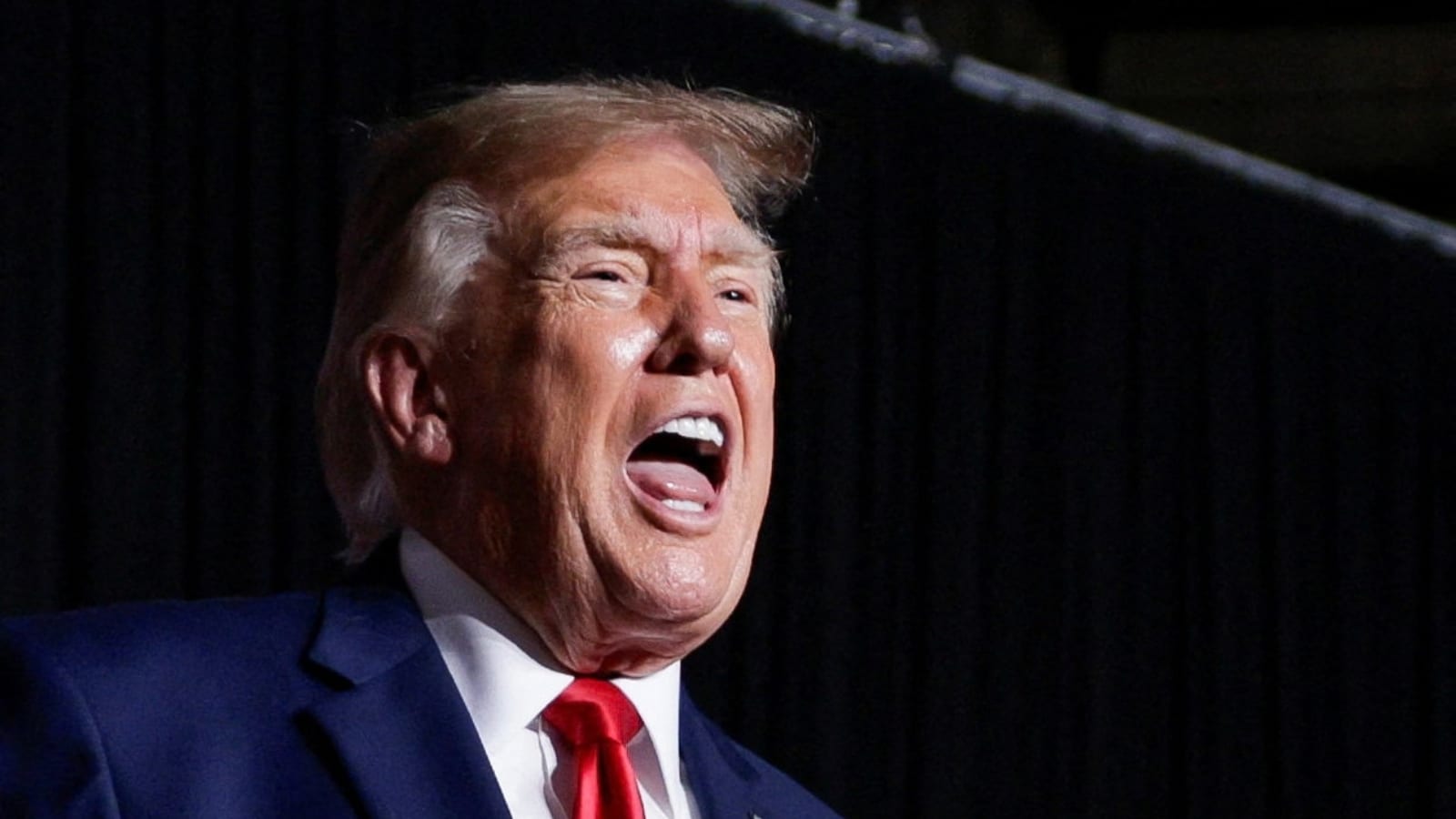
Mainstream foreign policy desks are breathless over the latest wire reports. Donald Trump is picking up the phone to discuss Tehran and "denuclearisation" with Xi Jinping and Vladimir Putin. The conventional wisdom frames this as a high-stakes summit of strongmen—the ultimate geopolitical board game where Washington, Beijing, and Moscow carve up spheres of influence and force Iran to heel.
It is a seductive narrative. It is also completely detached from how modern proliferation, sanctions evasion, and multipolar deterrence actually work. For a different look, check out: this related article.
If you are watching those phone calls expecting a grand bargain that neutralizes Iran’s nuclear ambitions or cools a regional war, you are watching the wrong theater. The legacy media treats Xi and Putin as reluctant sheriffs who just need the right transactional sweetener from the White House to rein in an unruly client state. That premise is dead on arrival. Neither Beijing nor Moscow views a nuclear-capable or threshold Iran as a crisis they need to solve for Washington. They view it as a structural asset that bleeds American bandwidth, drains Western munitions stockpiles, and fractures the global financial system.
The Myth of the Great Power Off-Switch
Spend enough time analyzing sanctions enforcement and illicit maritime logistics, and you learn a brutal truth about Washington’s diplomatic reflexes. American policymakers suffer from chronic main-character syndrome. They assume that because the United States views nuclear proliferation in the Middle East as an existential emergency, every other major capital shares that exact hierarchy of threats. Similar coverage regarding this has been provided by NBC News.
Let’s look at the actual incentives on the table.
For Vladimir Putin, every week that the United States is bogged down managing escalation ladders in the Persian Gulf or the Levant is a week that Washington’s attention, air-defense interceptors, and diplomatic capital are diverted away from Eastern Europe. Russia’s defense industrial base has integrated deeply with Iranian drone production and missile supply chains. Moscow is not going to burn a vital wartime logistics partner just to hand an American president a legacy-defining diplomatic win. When Putin hears "denuclearisation" on a call with Trump, he hears an opening to extract unilateral concessions on NATO architecture, Ukrainian territory, or European sanctions relief—in exchange for vague diplomatic assurances that cost the Kremlin nothing to break six months later.
Xi Jinping’s calculus is even colder, and far more structural.
China buys the overwhelming majority of Iran’s sanctioned crude oil, settling transactions outside the U.S. dollar system through smaller independent refineries—known as "teapots"—and shadow banking networks. To Beijing, Iran is both a discounted energy spigot and a strategic buffer that keeps the U.S. Navy tethered to the Fifth Fleet’s area of responsibility rather than concentrated in the First Island Chain. Beijing already brokered the 2023 Saudi-Iranian diplomatic restoration precisely to prove it can stabilize Gulf oil flows without American security guarantees. Xi has zero incentive to join an American-led pressure campaign that threatens China's energy security or validates Washington’s coercive sanctions regime.
Defining "Denuclearisation" in a Threshold World
The lazy consensus also collapses on technical terminology. Headlines throw around the word "denuclearisation" as if Iran’s program is a single warehouse of warheads waiting to be padlocked and shipped out of Bandar Abbas.
That is not how nuclear latency works.
Over the past decade, following the collapse of the Joint Comprehensive Plan of Action (JCPOA), Iran systematically dismantled the breakout timeline metrics that arms control diplomats used to obsess over. By deploying advanced cascades of IR-6 centrifuges at hardened, deeply buried facilities like Fordow, and accumulating stockpiles of uranium enriched up to 60 percent—a short technical step from weapons-grade 90 percent—Tehran achieved what strategists call nuclear threshold status.
You cannot bomb knowledge out of a physicist’s head. You cannot sanction away domestic centrifuge manufacturing capabilities that have already been localized.
Even if Trump, Xi, and Putin drafted a joint communiqué tomorrow demanding total dismantlement, verification is the entire ballgame. In international security studies, realists like Kenneth Waltz and John Mearsheimer have long pointed out that states pursue nuclear latency when they face acute regime survival threats from superior conventional powers. Look at the regional wreckage from Tehran’s perspective: Muammar Gaddafi gave up Libya’s nuclear program in 2003 in exchange for Western normalization, and eight years later he was dead in a drainage ditch after a NATO intervention. Saddam Hussein had no active weapons of mass destruction in 2003, and his regime was toppled anyway. Meanwhile, North Korea sprinted across the nuclear finish line, and Washington treats Pyongyang with cautious deterrence.
The Supreme Leader’s inner circle didn't miss that lesson. To ask Tehran to surrender its nuclear leverage in the middle of an active regional war—while its conventional proxy network has absorbed severe kinetic blows—is to ask the regime to sign its own death warrant. No phone call between Washington, Beijing, and Moscow changes that survival equation.
What Everyone Is Asking—And Why the Questions Are Flawed
When news of three-way great power diplomacy breaks, public discourse immediately defaults to predictable, binary questions. Most of them miss the underlying mechanics entirely.
Can China and Russia actually force Iran to abandon its nuclear program?
No. Because Iran is not a Soviet satellite state from 1956. Tehran’s revolutionary ideology is built on fierce strategic autonomy—"Neither East nor West." While sanctions forced Iran into an asymmetric economic reliance on Beijing and military cooperation with Moscow, Tehran still holds massive asymmetric veto power over the global economy. Iran sits astride the Strait of Hormuz, through which roughly a fifth of the world’s petroleum liquids pass. If Beijing or Moscow tried to join a Western blockade to strangle Iran’s economy into total submission, Tehran could disrupt Gulf shipping lanes overnight—sending global crude prices past $150 a barrel and triggering an inflationary shock that would hammer China’s export-dependent economy just as hard as the West's.
Does bringing Xi and Putin into the room revive a better version of the 2015 nuclear deal?
Stop looking in the rearview mirror. The 2015 JCPOA was built on a specific, temporary geopolitical alignment: a P5+1 coalition where Russia and China still saw value in preserving the global non-proliferation regime alongside Washington, and where Iran’s enrichment infrastructure was far less advanced. That world is gone. Today, the United Nations Security Council is paralyzed, snapback sanctions mechanisms are functionally dead letters because Russia and China simply ignore unilateral U.S. secondary sanctions, and Iran’s breakout time is measured in days or weeks rather than a year. Attempting to resurrect a 2015-style inspection regime in 2026 is like trying to patch a breached dam with masking tape.
Is direct great-power diplomacy better than regional escalation?
Talking is always cheaper than kinetic war, which is the lone valid point in the mainstream coverage. Deconfliction channels between Washington, Moscow, and Beijing reduce the risk of an accidental superpower collision in the Middle East. However, confusing deconfliction with denuclearisation is a catastrophic analytical error. Using a great-power summit to pretend you are solving proliferation when you are merely managing escalation lulls the public—and markets—into pricing in a peace dividend that does not exist.
The Uncomfortable Downside of Rejecting the Grand Bargain
Let’s be intellectually honest about the alternative. Walking away from triangular diplomacy with Beijing and Moscow carries severe, unavoidable risks.
If Washington refuses to engage Xi and Putin on Tehran, the United States is left with two grim options: accept a nuclear-armed or permanently threshold Iran under a policy of extended deterrence, or execute a massive, sustained military campaign against deeply buried Iranian nuclear sites. Neither path is clean. Extended deterrence in the Middle East would almost certainly trigger a regional proliferation cascade, pushing Saudi Arabia—and potentially Turkey and Egypt—to acquire their own nuclear capabilities. Conversely, a major military strike risks closing the Strait of Hormuz, igniting a multi-front war of attrition, and still only setting Iran’s program back by two or three years while guaranteeing Tehran sprints for a bomb in secret.
Admitting those trade-offs doesn't validate the current diplomatic theater. It exposes why serious strategy requires dealing with reality as it is, not as cable news anchors wish it were.
What Real Leverage Actually Looks Like
If phone calls to Beijing and Moscow won't denuclearize Tehran, what actually shifts the strategic balance? You stop treating Iran’s nuclear file as an isolated diplomatic puzzle and start attacking the economic and technological arteries that keep the regime solvent—without asking permission from Xi or Putin.
- Target the maritime shadow fleet, not just paper entities. Treasury Department sanctions against shell companies in Dubai or Hong Kong are theatrical; new ones are incorporated before the press release hits the wire. Real pressure means interdicting, insuring-blacklisting, and seizing the aging, transponder-dark tankers moving illicit crude through the Malacca Strait and the Persian Gulf. When the cost of maritime transport exceeds the discount on Iranian crude, Beijing’s teapot refineries stop buying on pure commercial math—no diplomatic favor from Xi required.
- Harden regional air and missile defense integration. Iran’s nuclear threshold status is only intimidating when paired with a credible delivery system. Accelerating a unified, sensor-fused air defense architecture across Gulf Cooperation Council states, Israel, and U.S. Central Command degrades the coercive value of Iran’s ballistic missile arsenal. When your missiles can’t penetrate, your nuclear ambiguity loses half its deterrent punch.
- Separate tactical deconfliction from strategic concessions. Keep the hotlines to Moscow and Beijing open to prevent accidental clashes between Russian, Chinese, and American naval or air assets in the region. Never pay for those conversations by trading away core alliances in Europe or the Indo-Pacific.
Great powers do not solve each other’s regional nightmares out of goodwill, and they certainly don't do it for free. Until Washington stops outsourcing its Iran problem to the very capitals profiting from American distraction, every headline about a "historic phone call" is just noise masking a slow-motion strategic defeat.