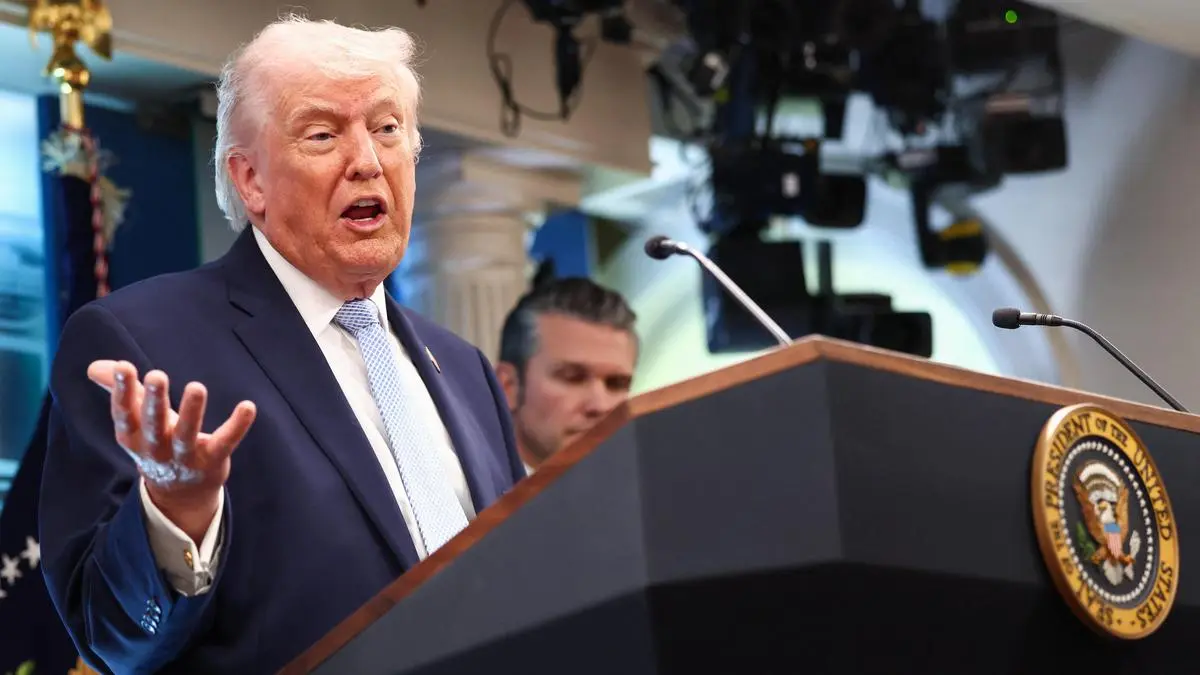
Donald Trump doesn't care about the traditional playbook for international conflict. He just proved it again. By doubling down on threats to hit Iranian infrastructure—including cultural sites—the former president isn't just talking tough. He’s actively signaling a complete departure from the Geneva Convention norms that have governed Western warfare for decades. If you think this is just campaign rhetoric, you haven’t been paying attention to how he handled the Soleimani strike or the "maximum pressure" campaign.
The core of the current tension involves Trump’s blunt dismissal of war crime concerns. When critics point out that targeting cultural heritage or civilian-heavy infrastructure violates international law, his response is usually some version of "they’re allowed to kill our people, but we can't touch their sites?" It’s a gut-level argument that resonates with his base but sends shivers through the Pentagon and the State Department. You might also find this similar article useful: The Bio-Economic Mechanics of Avian Reintroduction in Urban Ecosystems.
The Infrastructure Target List
What exactly are we talking about when we say infrastructure? In the context of Iran, it’s not just roads and bridges. We’re talking about the backbone of their economy and their regional power projection.
- Oil Refineries and Terminals: Specifically Kharg Island. Iran’s economy lives and dies by its ability to export crude. If that goes away, the regime loses its primary source of hard currency.
- Nuclear Facilities: Natanz and Fordow. These are deep underground and would require specialized ordnance that most countries don't possess.
- Electrical Grids: Modern warfare often starts with turning the lights off. It’s effective, but it creates a massive humanitarian crisis almost instantly.
- Cultural Landmarks: This is the big one. Trump specifically mentioned 52 Iranian sites—representing the 52 American hostages taken in 1979—some of which are of high cultural importance.
Military leaders generally hate this kind of talk. Why? Because it makes their jobs harder. It turns the local population against the intervening force and strips away the moral high ground that the U.S. relies on to maintain its global alliances. But Trump’s perspective is different. He views these rules as shackles that prevent the U.S. from winning. It’s a scorched-earth philosophy that treats war as a zero-sum game where "winning" is the only metric that matters. As highlighted in detailed articles by The New York Times, the effects are widespread.
Why International Law Often Feels Toothless
People talk about the Geneva Convention like it’s a physical barrier. It isn't. It’s a set of agreements that only work if everyone agrees to play by them. When a superpower like the U.S. indicates it might ignore these rules, the entire system of international law starts to look very fragile.
There’s a massive gap between what the UN says and what actually happens on the ground. For years, Iran has used proxies—groups like Hezbollah and the Houthis—to do its dirty work. This gives the Iranian government "plausible deniability." Trump’s argument is that if Iran can use "illegal" tactics like proxy terrorism and IEDs, the U.S. shouldn't be forced to fight with one hand tied behind its back.
It’s a dangerous path. If the U.S. officially abandons the prohibition on targeting cultural sites, it opens the door for every other nation to do the same. Imagine a world where every conflict involves the systematic destruction of history. That’s what’s at stake here.
The Strategy of Unpredictability
You have to understand the "Madman Theory." It’s a concept often attributed to Richard Nixon, but Trump has perfected it. The idea is simple: make your enemies think you’re crazy enough to do anything. If Tehran believes Trump actually will bomb their most sacred sites, they might be more likely to come to the negotiating table.
Does it work? Sometimes. It certainly kept the Iranian leadership on their toes during his first term. But there’s a thin line between "calculated unpredictability" and "genuine instability." When you threaten infrastructure, you aren't just threatening the government. You’re threatening the 85 million people who live there.
The Real World Impact of Sanctions and Threats
We’ve already seen what "maximum pressure" looks like. It’s not pretty.
- The Iranian Rial has plummeted in value, making basic goods like medicine and food unaffordable for many.
- Black market economies have exploded.
- The IRGC (Islamic Revolutionary Guard Corps) has actually tightened its grip on the economy by controlling the smuggling routes.
Trump argues that more of this—plus the threat of physical destruction—is the only way to stop Iran’s nuclear ambitions. The Biden-Harris administration took a more diplomatic approach, trying to revive the JCPOA (the Iran Nuclear Deal), but that hasn't exactly led to a peaceful Middle East either.
The Legal Reality of War Crimes
Let’s be clear about what constitutes a war crime under the Rome Statute and the 1954 Hague Convention. Targeting "buildings dedicated to religion, education, art, science or charitable purposes, historic monuments" is a direct violation unless those sites are being used for military purposes.
Trump’s dismissal of these concerns isn't just a "tough guy" act. It’s a fundamental challenge to the post-WWII international order. He’s basically saying that the rules created in 1945 don't apply to the threats of 2026. If the U.S. executive branch decides to ignore the Department of Defense’s own Law of War Manual, there isn't much the international community can do to stop them in the moment.
Moving Beyond Rhetoric
If you're watching this situation, don't get distracted by the tweets or the rally speeches. Look at the appointments. Look at who’s being tapped for National Security Advisor or Secretary of State. Those are the people who will have to actually sign off on target lists.
In the past, "adults in the room" like Jim Mattis or H.R. McMaster acted as a buffer against these kinds of extreme kinetic options. In a potential second term, those buffers might not exist. Trump has made it clear he wants loyalists who will execute his vision without hesitation.
The next few months will be telling. Watch for how the Iranian regime responds to these specific infrastructure threats. Usually, they respond with their own threats to the Strait of Hormuz—the world’s most important oil chokepoint. If things escalate, we could see a spike in global energy prices that makes the 1970s look like a walk in the park.
Stay informed by checking primary sources. Don't just read the headlines. Look at the actual transcripts of these speeches and compare them to the official DOD stance on ROE (Rules of Engagement). The gap between the two is where the real danger lives. Follow the movement of carrier strike groups in the Persian Gulf; that’s a better indicator of reality than any campaign speech.


