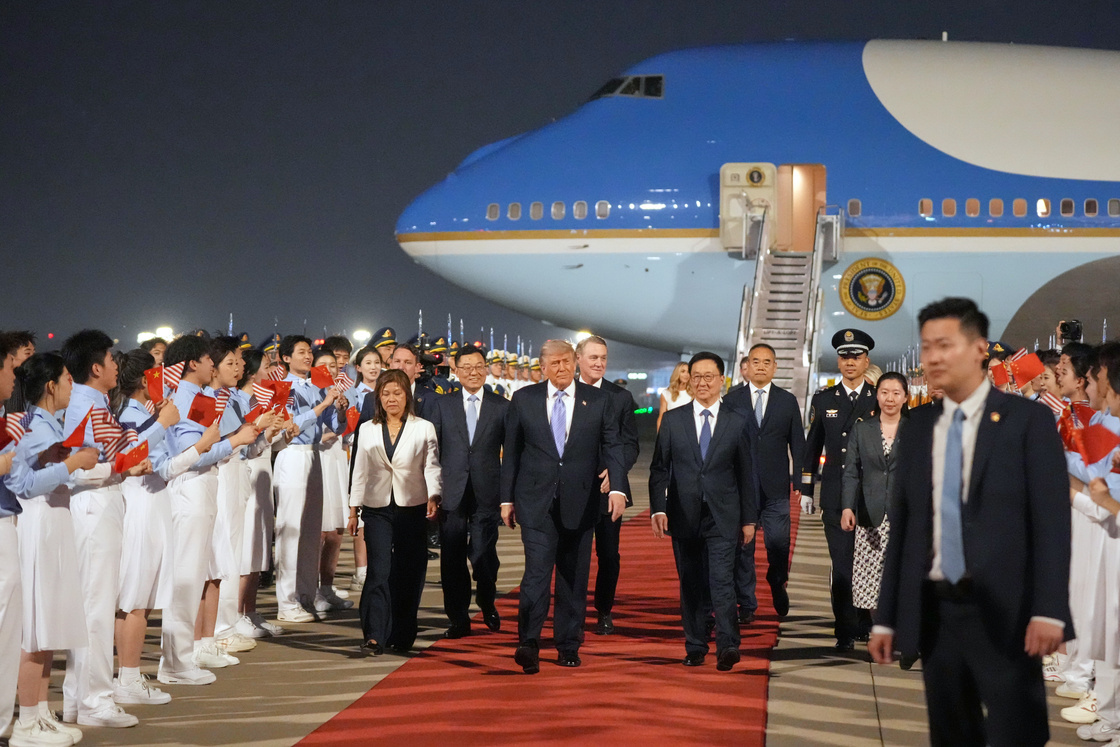
Donald Trump didn't just land in Beijing for a photo op. When Air Force One touched down on Wednesday, it marked the first time a sitting U.S. president has set foot in China in nearly a decade. He walked off that plane with a literal army of tech titans—Elon Musk, Jensen Huang, and Tim Cook—trailing behind him. This isn't just about "trade talks." It's a high-stakes gamble to fix a global economy currently being strangled by a war in Iran and a crippled supply chain.
If you’re looking for the short answer: Trump needs a win. With inflation spiking and the Strait of Hormuz effectively closed, he’s looking to Xi Jinping to play ball on energy and agriculture while keeping the lid on a simmering conflict over Taiwan.
The Iran Problem Nobody Can Ignore
Don't let the public bravado fool you. Trump told reporters before leaving that he doesn't "need any help with Iran," but the math says otherwise. China buys about 90% of Iran’s exported oil. They’re the only ones with real leverage over Tehran right now.
The blockade in the Persian Gulf has sent oil prices into a tailspin, and it’s hitting American pockets hard. Trump’s strategy? He’s banking on his "fantastic" relationship with Xi to get China to lean on Iran. In exchange, Xi wants the U.S. to back off the aggressive tariff hikes that defined 2025. It’s a classic "you scratch my back, I'll scratch yours" scenario, but with global stability on the line.
Taiwan and the $11 Billion Elephant in the Room
The most dangerous part of this trip isn't trade—it's Taiwan. Last December, the U.S. authorized an $11 billion weapons package for the island, the largest ever. China is livid. They’ve called Taiwan their "first red line," and they aren't kidding.
The irony? We need Taiwan for the very tech Trump brought along on this trip. Nvidia and Apple can't function without Taiwanese chips. Trump is trying to walk a tightrope: he wants to show strength by selling arms to Taipei, but he also needs to convince Xi not to block the flow of semiconductors. There's a real fear among DC insiders that Trump might use Taiwan as a bargaining chip—toning down military support in exchange for a massive "Phase 2" trade deal that makes him look like a hero back home.
The Musk and Nvidia Factor
Why bring Jensen Huang and Elon Musk? Because the real war isn't being fought with tanks; it's being fought with GPUs.
- Nvidia's Stake: China is a massive market for AI hardware, but U.S. export controls have been a chokehold. Huang is there to see if there's a middle ground where Nvidia can sell high-end chips without "betraying" national security.
- Tesla’s Leverage: Musk has deep ties in China. He’s essentially acting as a shadow diplomat, trying to ensure Tesla’s gigafactories don't get caught in the crossfire of new tariffs.
- The "Board of Trade": There’s talk of creating a permanent U.S.-China Board of Trade to stop the constant back-and-forth tariff wars. This would be a massive shift from the chaos of the last two years.
What's Actually on the Table
Trump wants headlines. He wants to fly back to Washington with signed contracts for:
- Boeing Jets: A multi-billion dollar deal to refresh China's aging fleet.
- Soybeans and Beef: Keeping the Midwest voters happy by opening Chinese markets even wider.
- Energy Guarantees: Getting China to stop scooping up all the "grey market" oil and start buying American LNG.
Xi, on the other hand, wants "strategic stability." He wants the U.S. to stop treating every Chinese tech company like a spy agency. He’s looking for a predictable environment so he can fix China's own sluggish economy.
What You Should Watch For Next
The next 48 hours will tell us if this is a breakthrough or just a fancy dinner in the Forbidden City. Watch the language used around Taiwan in the joint statements. If the U.S. uses the phrase "oppose Taiwan independence" instead of "do not support," it’s a massive concession to Beijing.
Also, keep an eye on the oil markets. If there's even a hint that China will help reopen the Strait of Hormuz, expect gas prices to drop almost instantly.
The reality is that both these leaders are currently backed into a corner. Trump has a war he can't finish, and Xi has an economy he can't jumpstart. When two giants are both hurting, they usually find a way to stop punching each other—at least for a little while.
Check the live news feeds for the official joint statement on Friday. If you see a "Board of Investment" mentioned, it means the tech leaders got what they wanted. If the talk is all about "historical grievances," start worrying about your stock portfolio.
Trump's 2026 Beijing Visit and Global Impact
This video provides an expert breakdown of the geopolitical stakes involved in the summit, specifically regarding the security of the Taiwan Strait and the role of tech industries.