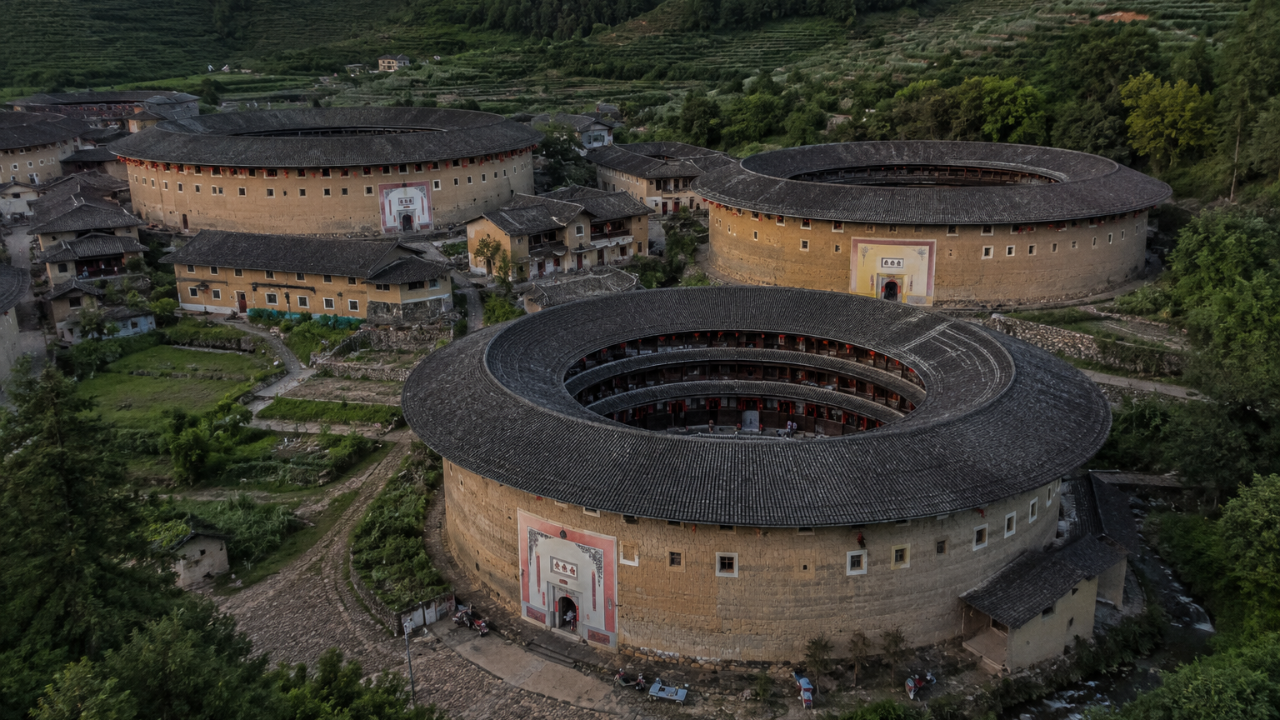
In the mid-1980s, American satellite imagery picked up a series of bizarre, giant doughnut-shaped structures hidden deep in the mountainous ravines of southern Fujian, China. The Pentagon panicked. To the Cold War intelligence apparatus, these massive circular footprints looked exactly like a network of underground nuclear missile silos.
They weren't weapons of mass destruction. They were apartment complexes.
Specifically, they were the Fujian Tulou—immense, rammed-earth fortresses built by the Hakka and Hoklo peoples. Some of these structures are over 700 years old, housing up to 800 people under a single roof. While casual tourists view them as quaint, photogenic anomalies, these circular villages are actually the product of a brutal history of displacement, relentless banditry, and a radical experiment in egalitarian survival.
If you think you understand traditional Chinese architecture from looking at the imperial palaces of Beijing, these earthen fortresses will completely shatter your assumptions.
Built for Blood and Bandits
You don't build a house with six-foot-thick walls just for the aesthetic. The story of the circular homes is rooted in centuries of ethnic friction and violence.
The Hakka people weren't originally from Fujian. Their name literally translates to "guest families." They were refugees who fled catastrophic wars, famines, and invasions in central China during the Tang and Song dynasties. As they migrated south, they found the fertile coastal plains already claimed by the native Hoklo populations. The Hakka were forced into the harsh, malaria-ridden, lawless mountains of southwestern Fujian.
They weren't welcome. Resources were scarce, and the dense forests crawled with bandits, pirates, and hostile neighboring clans.
To survive, the Hakka couldn't just build normal houses. They had to build tanks.
They started with square fortresses, but quickly realized a fatal design flaw: square corners created defensive blind spots. If attackers reached the base of a corner, guards on the upper levels couldn't shoot down at them without exposing themselves. The circular design solved this perfectly. A continuous, curved wall eliminated all blind spots, allowing defenders to rain arrows, rocks, and eventually gunfire from any angle.
The Chemistry of Sticky Rice and Sugar Walls
Calling these structures "mud huts" is an insult to ancient engineering. The construction of a single Tulou often took decades, spanning multiple generations. The recipe for these walls is closer to modern concrete than dirt.
Builders mixed local clay and sandy soil with organic binders that sound more like a grocery list than construction materials: sticky rice broth, brown sugar, and liquid lime.
They reinforced this slurry with an internal skeleton of interwoven bamboo strips and pine branches. Workers poured the mixture into wooden frameworks and manually packed it down using heavy wooden rammers.
The result? The walls hardened into a substance so resilient that it actually cured and grew tougher over centuries. When the Yuchang Tulou was built in 1308, its builders didn't realize it would survive dozens of major earthquakes over the next seven centuries. Today, its interior wooden pillars lean at a dizzying 15-degree angle due to seismic shifts, yet the massive earthen outer ring remains completely unbothered.
The defense mechanics built into these walls are ruthlessly clever:
- The base is thick. Walls are up to six feet thick at ground level, tapering slightly as they reach the top floors to keep the structure stable.
- Zero ground windows. The first and second floors have absolutely no windows or openings facing the outside world.
- Ironclad entry. There's only one main entrance to the entire complex. The massive wooden doors, often four to five inches thick, are armored with iron plates.
- Fire defense. If bandits tried to burn the front gate, built-in water channels above the door frame allowed residents to flood the entrance from the second floor like an ancient sprinkler system.
Inside the Radical Equality of Clan Life
Step through the fortified gate of a circular Tulou and the stark, militaristic exterior instantly gives way to a sprawling, multi-tiered hive of human activity.
What makes the Tulou truly fascinating isn't just the defense; it's the social structure. These buildings are monuments to radical communal living. An entire Tulou is typically occupied by a single extended clan. Hundreds of people, all sharing the same surname, living together.
Western architecture of the same era emphasized hierarchy—the lord lived in the high tower, the servants in the cellar. The Tulou completely rejects this. Every single room in the outer ring is identical in size, layout, and window placement. There's no penthouse. There's no master suite.
Instead of buying a horizontal house, each family unit owns a vertical slice of the circle.
The ground floor functions as the kitchen and dining area. The second floor serves as enclosed storage for grain and dried goods. The third, fourth, and sometimes fifth floors contain the private bedrooms.
A continuous open-air wooden corridor runs along the inside of each upper floor, facing the central courtyard. You don't have private hallways. Your life is entirely on display to your cousins, aunts, and grandparents.
Right at the geometric center of the courtyard sits the ancestral hall. This is the spiritual heart of the community. It serves as a school, a town hall, a wedding venue, and a funeral home. By placing the ancestors at the center and arranging everyone else in an equidistant circle around them, the architecture constantly reinforces the message that the individual is nothing without the clan.
The Microclimate Machine
Living in a mountain fortress sounds dark and suffocating, but the geometry of the circle creates an incredibly comfortable microclimate.
The open central courtyard acts as a giant thermal chimney. During hot summer months, the sun heats the courtyard air, causing it to rise and draw cooler air through the building's upper windows and shaded corridors. The massive earth walls possess high thermal mass, meaning they absorb heat during the day and slowly radiate it back into the living spaces at night. It's an ancient, zero-energy air conditioning system. In the winter, those same thick walls block the biting mountain winds, keeping the interior warm.
The circular shape also maximizes natural light. Unlike square buildings where northern rooms are permanently cast in shadow, the sun hits every part of a circular Tulou interior at some point during the day.
How to Experience the Tulou Without the Tourist Traps
If you want to see these structures for yourself, don't just book a generic day-trip bus from Xiamen that drops you at the heavily commercialized sites for a quick photo. You'll miss the actual magic.
Fly into Xiamen, rent a car or hire a local driver, and head straight into the valleys of Nanjing or Yongding counties.
Skip the ultra-famous Chengqi Lou (the so-called "King of Tulou") if you hate crowds. It's spectacular, but you aren't allowed to climb the upper floors due to preservation laws. Instead, head to the Tianluokeng cluster, famous for its "four dishes and one soup" layout—four round structures surrounding a single square one.
For an authentic look at how these buildings are adapting to the modern world, find the Zhaihe Tulou in Pinghe County. It's a fascinating example of modern adaptive reuse. The structure sits next to ancient kiln ruins, and its rammed-earth walls are actually studded with fragments of historical porcelain. Local preservationists have converted sections of it into an exhibition space that details the region's trade history, proving these structures don't have to be dead museums—they can still function as public hubs.
Pack light, bring sturdy walking shoes for the uneven cobblestones, and always ask permission before entering the private residential zones of the non-tourist structures. Many elderly residents still live here, drying tea leaves and tobacco in the courtyards just as their ancestors did during the Ming Dynasty. Sit down, buy some local Oolong tea from them, and listen to the echo of the mountain winds against the mud walls. You're sitting inside a fortress built out of survival, rice, and sugar.