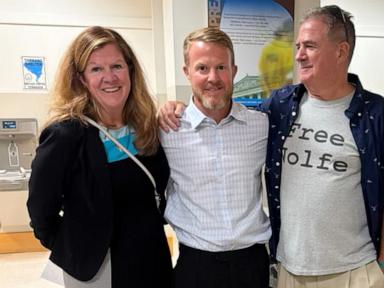
Justin Wolfe walked out of a Virginia prison after spending a quarter-century behind bars for a murder-for-hire plot he did not commit. His freedom, secured after his conviction was finally vacated, marks the end of an agonizing legal marathon. Yet his release is less a triumph of institutional transparency than an indictment of a machinery that took twenty-five years to correct its own catastrophic errors.
When the case began in 2001, Wolfe was a nineteen-year-old embedded in a suburban Northern Virginia drug network. The trade dealt in millions of dollars of marijuana and ecstasy, fueling high-end trips while masking the reality of teenage enterprise. When his high school friend and drug supplier, Daniel Petrole, was shot and killed, law enforcement zeroed in on Wolfe. The prosecution's entire narrative hinged on Owen Barber IV, the triggerman who pointed the finger at Wolfe to save his own skin. Barber avoided a death sentence by pleading guilty and accepting a sixty-year term, becoming the state's star witness.
Convicted primarily on Barber’s testimony in 2002, Wolfe was handed a death sentence. He became one of the youngest men on Virginia's death row, facing execution while maintaining absolute innocence. What followed was a masterclass in how rigid judicial systems resist self-correction.
Years later, the architecture of the state's case began to fracture. Barber recanted, admitting publicly that Wolfe had no involvement in Petrole's death. Barber confessed that police officers had repeatedly pressured and threatened him with capital punishment to secure his cooperation against Wolfe. Federal courts eventually uncovered significant prosecutorial misconduct, revealing that the state had withheld crucial information during the initial trial.
Instead of an immediate exoneration, Wolfe found himself trapped in a procedural purgatory. When a federal judge vacated his death sentence and ordered a retrial, prosecutors doubled down. They approached Barber in prison and, on the record, threatened him with a fresh death penalty trial if he dared to exonerate Wolfe on the stand. Facing the ultimate state coercion, Barber invoked his Fifth Amendment right and refused to testify.
Trapped by the threat of a renewed capital trial, Wolfe accepted a 2016 plea deal that capped his sentence at forty-one years and required a public apology to the victim's family. It was a coercive compromise born of a broken process.
The legal landscape shifted permanently when Virginia abolished the capital punishment statute in 2021. With the shadow of the death penalty finally lifted from Barber, he signed a fresh sworn affidavit in 2023. He stated unequivocally that Wolfe had zero involvement in the murder. Corroborating statements from multiple other individuals confirmed that Barber had long admitted to framing Wolfe under duress.
Legal advocacy groups, including the Innocence Project at the University of Virginia School of Law, utilized these new declarations to puncture the remnants of the state's case. The Fourth Circuit ultimately cleared the path for Wolfe's habeas corpus appeal to move forward, dismantling the coerced plea agreements of the past.
The cost of this systemic failure is staggering. Twenty-five years of life erased. Decades spent under the constant threat of lethal injection, followed by long stretches in isolation. Now adjusting to the sensory overload of everyday environments like grocery stores, Wolfe faces the daunting task of reclaiming an existence stolen by institutional stubbornness.
As he steps into a world that changed entirely during his confinement, the questions remain. The prosecutors who manufactured a wrongful conviction faced no professional ruin. The state apparatus that defended a tainted verdict for decades admitted no direct fault. A man walks free, but the architecture that locked him away for a quarter-century remains entirely intact.
Justin Wolfe walks free after 25 years as Virginia murder conviction is vacated
This video provides visual context on Justin Wolfe's release from prison after serving 25 years and having his murder conviction vacated.