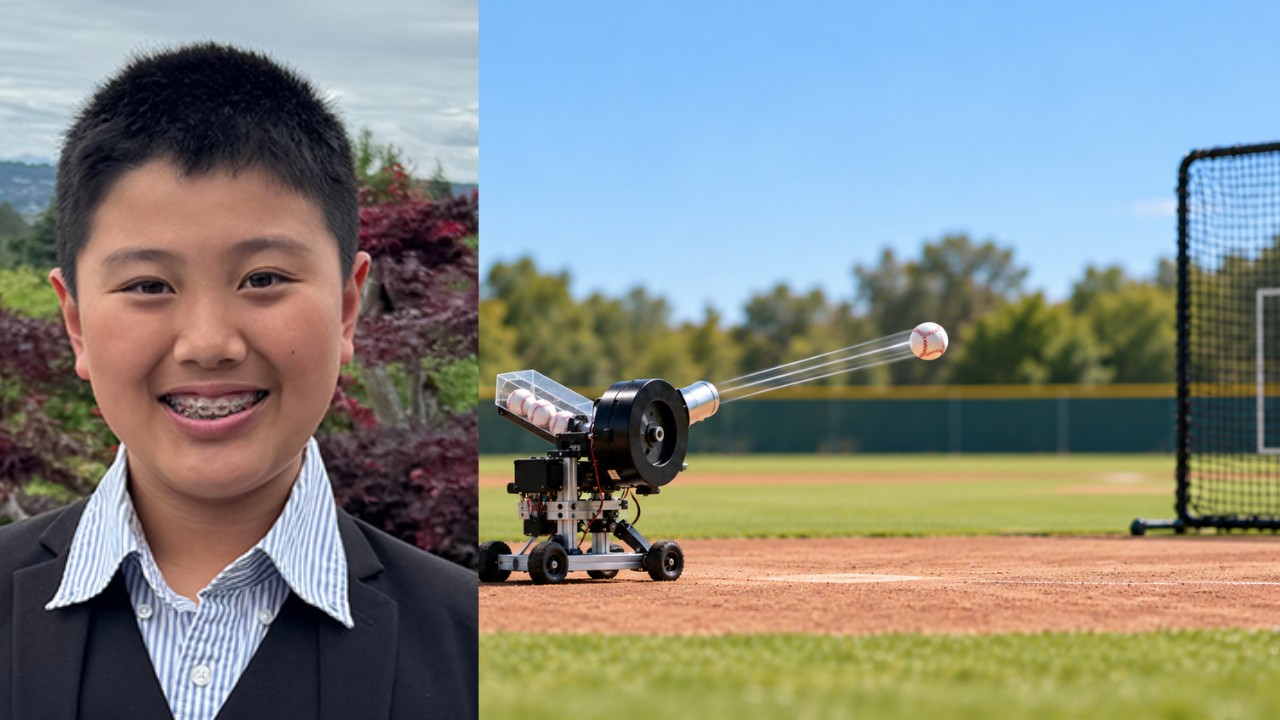
Everybody lost their minds over Andrew Sun-Zhuang building a two hundred and sixty dollar artificial intelligence pitching machine boasting ninety-four percent strike accuracy. Tech blogs hailed it as a democratization of athletics. Parents opened their checkbooks. Little League coaches started sketching blueprints on napkins, convinced that code and cheap servos could replace thousands of hours of live batting practice.
It is a brilliant engineering project. It is a terrible training tool. Recently making news recently: Alexander Ovechkin is Not Retiring When He Breaks Gretzky’s Record And That is Terrifying.
We have institutionalized a dangerous illusion in modern sports technology. We look at a machine that can paint the black with ninety-four percent precision and we mistake mathematical consistency for athletic development. Real pitching does not feature ninety-four percent accuracy. Real pitching features chaos, deception, arm angles, extensions, spin decay, and human imperfection. By training hitters against a mechanical sniper rifle that repeats the exact same release vector over and over again, we are not building elite bats. We are building expensive robots who can solve a math equation they have already memorized.
I have spent two decades watching organizations throw millions of dollars at shiny gadgets, trying to engineer away the messy, uncomfortable reality of human development. They want a shortcut. They want a metric they can slap on a dashboard. But sports do not care about your dashboards. Additional information regarding the matter are detailed by ESPN.
The Fallacy of Mechanical Perfection
Let us look at what Andrew actually built. He took off-the-shelf components, programmed a vision system, and created a device that hits its spot with metronomic predictability. That is an impressive feat of hardware hackery. But let us examine the lazy consensus surrounding it: the belief that hitting a baseball is merely a problem of hand-eye coordination against a localized target.
It is not. Hitting is an exercise in pattern recognition under extreme time constraints.
When a pitcher stands on a mound, they provide a narrative. They provide a history. They sweat, they tire, they alter their mechanics by two millimeters in the seventh inning because their hamstring is tightening up. Their release point fluctuates. The ball spins differently based on moisture and seam wear. Your brain reads those micro-cues across the first twenty feet of ball flight long before the projectile reaches the decision zone.
A budget AI machine stripping away that narrative gives you a sterile projectile. You are practicing against a glorified pitching wedge that has been trained to output consistent coordinates. You might groove your swing against that specific cadence, but the moment you step into a batter box against a live sophomore throwing an 84-mph sinking fastball with a funky cross-fire delivery, your ninety-four percent machine-trained timing will utterly collapse.
You are teaching your nervous system to react to a static variable in a dynamic environment. That is not preparation. That is de-skilling.
Why Precision Destroys Real-World Adaptation
In motor learning, variability is not a bug. Variability is the core feature of skill acquisition.
If you want a muscle memory network to become robust, you must force it to adapt to constant noise. When every single pitch from a budget machine lands within a one-inch radius, your brain stops doing the heavy lifting of predictive variance. It defaults to a closed-loop feedback cycle: see ball, start rotation, hit ball.
Real pitching breaks that cycle constantly. A great pitcher doesn't just throw strikes; they throw pitches that look like strikes until the very last frame, or they throw balls that induce ugly chases because the spin axis messes with your depth perception.
Imagine a scenario where a hitter faces Andrew's machine for a thousand consecutive reps. They will rack up incredible metrics in the cage. Their exit velocities will look pristine on the iPad. Their coach will smile and post a clip to social media. Then that same hitter steps up in a playoff game against an arm-side runner who elevates away. The machine has taught them nothing about recognizing spin out of the hand because the machine lacks the anatomical variance that creates authentic visual cues.
We are mistaking the map for the territory. A high strike accuracy metric measures the machine, not the hitter.
The Cost of Cheap Innovation
There is a deeper economic and cultural sickness here. We love the narrative of the garage hacker beating the system. It plays well on the internet. But it obscures a harsh economic truth: cheap shortcuts in athletic training usually shift the cost from capital expenditure to wasted human potential.
Professional player development is expensive for a reason. High-end training environments invest in multi-camera optical tracking, live arms, varied velocity profiles, and sensory-deprivation or sensory-enhancement tools that force hitters to solve visual puzzles. That costs money.
When we pretend that a couple of hundred dollars and an Arduino board can replicate high-end pitching development, we sell a dangerous bill of goods to parents and players who cannot afford elite infrastructure. We tell them that if they just buy the right cheap components, they can bridge the gap.
They cannot. You cannot hack your way around the fundamental requirement of facing live, unpredictable human beings who are actively trying to deceive you. You can build all the low-cost hardware you want, but you cannot download competitive intelligence into a microcontroller.
The Honest Alternative
If you actually want to improve hitting performance without a half-million-dollar setup, stop worshipping mechanical consistency.
Bring back live arms. Use tennis ball BP with a coach hiding behind a blanket to simulate deceptive arm slots. Throw weighted balls at irregular intervals. Create chaotic, high-stress cage sessions where the rules change pitch by pitch. Force the hitter's visual cortex to struggle, fail, guess, and adapt.
A machine that throws strikes ninety-four percent of the time is a great way to test a motor controller. It is a terrible way to build a hitter.
Stop looking for the magic algorithm that fixes your swing in a garage. Go find someone who throws harder than you are comfortable with, and learn how to fail against a human being.