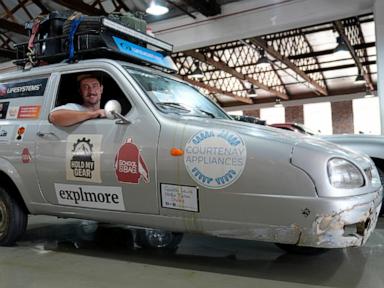
Driving across the African continent is a feat that tests the most rugged 4x4 vehicles ever built. Most people wouldn't dream of doing it in anything less than a Land Cruiser with a snorkel and twin fuel tanks. Then you have Matt Bishop and Rossie Wells. They decided to tackle the 10,000-mile journey from the tip of the UK to Cape Town in a vehicle that most people use for five-minute grocery runs in Bangkok.
They chose a Piaggio Ape. It's a three-wheeled, 175cc glorified lawnmower with a top speed of about 35 miles per hour on a good day. It has no air conditioning, no suspension to speak of, and a structural integrity that feels more like a tin can than a car. Yet, these two men claimed a world record by dragging this machine through some of the most unforgiving terrain on the planet.
This wasn't just a quirky road trip. It was a test of sanity. You don't just "drive" an Ape across the Sahara; you negotiate with it. You beg it to stay upright. You spend half your day fixing things that shouldn't have broken in the first place.
The Ridiculous Logistics of a Three Wheeled Expedition
When you look at the map of Africa, you see vast stretches of desert, mountain ranges, and tropical forests. A standard Tuk Tuk or Piaggio Ape is designed for flat, paved city streets. It’s meant for navigating traffic, not fording rivers or climbing the Ethiopian Highlands.
Bishop and Wells didn't just buy a stock Ape and hope for the best. They had to make modifications, but even those were limited by the vehicle's tiny frame. They added a roof rack—which arguably made the center of gravity even more terrifying—and carried enough spare parts to basically rebuild the engine twice over.
Weight is the enemy of the Ape. With two grown men and all their gear, the 175cc engine was constantly screaming at its limit. Imagine trying to run a marathon while breathing through a cocktail straw. That’s what the engine was doing for months. They had to be meticulous about what they carried. Every extra kilogram meant more strain on the single front wheel and the flimsy rear axles.
Surviving the Sahara in a Tin Box
Crossing the Sahara is the part that usually breaks people. For Bishop and Wells, it was an exercise in patience and heat management. The Ape doesn't have windows in the traditional sense; it’s an open-air experience that invites every bit of dust and grit into your lungs.
The heat in Sudan and northern Ethiopia can regularly top 40°C. In a vehicle with a metal roof and a vibrating engine inches from your backside, it feels like sitting in an oven. They faced sandstorms that pitted the paint and clogged the air filters every few miles.
Most travelers in the Sahara worry about getting stuck in deep sand. In a 4x4, you deflate your tires and use your torque to pull out. In an Ape, you have no torque. You have tiny wheels that sink instantly. Bishop and Wells spent a significant amount of time physically lifting the vehicle or pushing it through soft patches. It’s a literal hands-on approach to travel that most modern adventurers avoid.
Navigating Bureaucracy and Border Crossings
The mechanical failures were only half the battle. If you’ve ever tried to cross an African border, you know it can be a labyrinth of paperwork, "fees," and long waits. Now, imagine doing that in a vehicle that the border guards don't even recognize as a car.
In many countries, the Ape was a curiosity. It opened doors because people found it hilarious. It’s hard to be an intimidating border official when two dusty, exhausted British guys roll up in a bright yellow tricycle. It became a social icebreaker. People would crowd around, wanting to know why on earth they were doing this.
However, the "why" was tied to a larger cause. They were raising money for The Adventurists, an organization known for promoting high-risk, low-tech adventures for charity. This gave them a mission when the engine died for the tenth time in a day. It wasn’t just about the record; it was about the schools they were supporting and the awareness they were building.
Why the Piaggio Ape is the Worst Best Choice
The Piaggio Ape is an Italian icon, but it was never intended for transcontinental travel. Its engine is a two-stroke relic that requires a specific oil-to-fuel mix. Finding high-quality oil in remote parts of Mali or the Congo isn't always easy. They often had to make do with whatever they could find, which led to carbon buildup and fouled spark plugs.
The stability—or lack thereof—is the biggest danger. Three wheels create a tripod effect that is notoriously unstable on uneven ground. African roads are famously potholed. One wrong move at "high speed" (which, again, is only 30 mph) and the whole thing flips.
I’ve seen people try to take scooters across continents, but the Ape is different. It’s top-heavy. It catches the wind like a sail. When a massive semi-truck blasts past you on a narrow highway in Kenya, the air pressure alone is enough to shove you off the road. You’re constantly fighting the steering bar to stay upright.
Lessons from the Slowest Race in the World
What Bishop and Wells proved is that adventure isn't about having the best gear. It’s about the willingness to look stupid while doing something difficult. We live in an era where "overlanding" has become a billionaire’s hobby, with six-figure rigs and satellite internet.
These guys did the opposite. They embraced the struggle. By choosing a vehicle that was fundamentally "wrong" for the task, they experienced Africa in a way a Land Rover driver never would. They were at eye level with the locals. They were moving slow enough to actually see the landscape.
If you’re planning your own trip, don't wait for the perfect vehicle. You don't need a modified Jeep or a $20,000 adventure bike. The lesson from the Ape is that as long as you can fix what breaks and you have enough patience to deal with the slow pace, you can go anywhere.
What You Can Learn for Your Next Trip
- Slow down. When you travel at 30 mph, you see things you’d miss at 70. You notice the small villages, the roadside stalls, and the way the vegetation changes.
- Be approachable. A weird vehicle is a magnet for help and friendship. If you look like a high-tech commando, people might stay away. If you look like a lost tourist in a lawnmower, people will go out of their way to help you.
- Carry spares. If you’re using low-tech gear, know how to fix it. Bishop and Wells survived because they understood their engine. They didn't need a computer to diagnose a problem; they just needed a wrench and a screwdriver.
- Embrace the absurdity. Things will go wrong. You will get stuck. You will be hot and miserable. If you can laugh at the ridiculousness of your situation, you’re halfway to finishing the journey.
Stop overthinking your gear and just go. Whether it's a three-wheeled van or a beat-up hatchback, the destination stays the same. The only difference is the quality of the stories you'll tell when you get back.