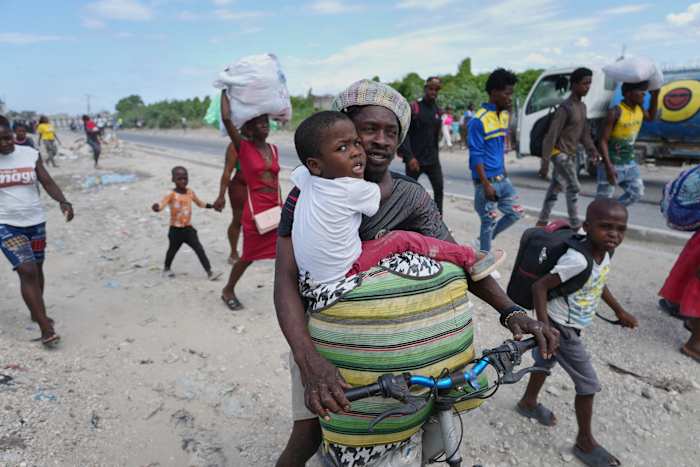
Haiti isn't just "in trouble." It’s facing a systematic collapse that's been decades in the making, and if you're only following the mainstream snippets, you're missing the core of the problem. Most reports focus on the shock value of burning cars or armed men in the streets of Port-au-Prince. They don't tell you that the gang violence in Haiti is actually a deeply entrenched political tool. Armed groups aren't just random criminals; they've become the de facto governance in a vacuum left by a shattered state.
I’ve looked at the data and the history. It’s messy. You can't understand why the streets are on fire today without looking at how the police lost control and how the international community's "help" often made things worse. This isn't about a lack of resources alone. It's about a lack of sovereignty.
Why Port au Prince is a Battlefield
Right now, gangs control roughly 80% of the capital. That isn't a typo. Imagine living in a city where your trip to the grocery store or your commute to work depends on the whim of a 19-year-old with an illegal AR-15. These groups, like the G9 Family and Allies led by Jimmy "Barbecue" Chérizier, aren't just looking for lunch money. They control the ports. They control the fuel terminals. They control the food supply.
When the gangs block the Varreux fuel terminal, the entire country stops. Hospitals shut down because they can't run generators. Clean water becomes a luxury because pumps don't have power. This is tactical warfare against a civilian population. The violence is a lever used to negotiate with whatever remains of the Haitian government.
The humanitarian cost is staggering. According to the United Nations, thousands have been killed or kidnapped in just the last year. But numbers don't capture the fear. Families sleep in the middle of their living rooms to avoid stray bullets. Schools have turned into refugee camps for people fleeing their own neighborhoods. It’s a level of displacement that rivals active war zones in the Middle East or Ukraine, yet it’s happening just a few hundred miles off the coast of Florida.
The Myth of the Random Thug
Stop thinking of these gangs as disorganized street crews. They are sophisticated paramilitary organizations. Many gang members are better armed than the Haitian National Police (PNH). They have high-caliber sniper rifles and drones. Where does this gear come from? Most of it is trafficked from the United States, specifically Florida.
There's a dark irony here. While the international community debates whether to send a "Multinational Security Support" mission, the weapons used to destabilize Haiti are flowing freely from its neighbors. If we want to talk about fixing the violence, we have to talk about stopping the iron river of guns moving south.
Political Collusion and the Power Vacuum
The violence didn't happen in a vacuum. For years, politicians and members of the business elite used gangs as private security or to suppress protests. It was a symbiotic relationship. The elites provided money and guns; the gangs provided "order" or "chaos" on demand.
That system broke after the assassination of President Jovenel Moïse in 2021. Without a central figure to hold the strings, the gangs realized they didn't need the politicians anymore. They could just take the power themselves. Now, the puppets are pulling the strings. Chérizier often talks about "revolution" and "overthrowing the corrupt system." It’s a populist message that resonates with people who feel abandoned by the state, even if the man delivering the message is the one burning their houses down.
The Failed Promise of Foreign Intervention
Haiti's history with foreign intervention is, frankly, disastrous. You've got the 1915-1934 US occupation, the botched UN missions that introduced cholera, and the billions in aid that vanished after the 2010 earthquake. It’s no wonder many Haitians are skeptical when they hear about another Kenyan-led police force arriving to "save" them.
The skepticism isn't just about pride. It’s about accountability. When UN peacekeepers committed abuses in the past, they were rarely punished. The Haitian people have learned that foreign boots on the ground often bring a temporary peace followed by a deeper long-term instability.
If an intervention is going to work, it can't just be about shooting gang members. You can't kill your way out of a social crisis. If you remove a gang leader today, another one will rise tomorrow because the underlying conditions—the poverty, the lack of jobs, the absence of a justice system—haven't changed.
How the International Community Gets it Wrong
People keep asking: "Why doesn't the US just go in and fix it?" That's the wrong question. Every time a foreign power "fixes" Haiti, it undermines the development of local institutions. The Haitian National Police is underfunded and outgunned, sure, but it’s also demoralized.
The real solution involves a "Haitian-led" transition, but that’s easier said than done. The current Transitional Presidential Council is trying to organize elections, but how do you hold a vote when people are too scared to leave their homes? You can't have democracy without basic security, and you can't have security without a legitimate government. It’s a catch-22 that’s currently strangling the nation.
The Role of the Diaspora
Don't ignore the millions of Haitians living abroad. They send back billions in remittances every year. That money is literally the only thing keeping the economy from hitting absolute zero. But the diaspora's influence is complicated. Some support the status quo; others are the loudest voices for radical change. Any path forward has to involve the talent and capital of Haitians living in Miami, New York, and Montreal.
Realistic Steps Toward Stability
The situation feels hopeless, but it isn't. It's just incredibly difficult. We need to stop looking for a "quick fix" and start focusing on the structural rot.
- Aggressive Firearms Interdiction: The US needs to treat gun smuggling to Haiti as a national security priority. Every crate of weapons stopped in Miami is a life saved in Cité Soleil.
- Targeted Sanctions that Actually Bite: We’ve seen sanctions on gang leaders and their financial backers. They need to be broader and more strictly enforced to cut off the money that fuels the violence.
- Strengthening Local Justice: Support for the Haitian police shouldn't just be about tactical gear. It needs to be about vetting, training, and building an internal affairs system that people actually trust.
- Infrastructure for Basics: Security won't stick if people are starving. Immediate investment in food security and healthcare through local NGOs—not massive international agencies that swallow 40% of the budget in overhead—is vital.
Haiti is a country of incredible resilience. People there are still finding ways to live, trade, and create art amidst the rubble. They aren't looking for a savior; they're looking for a fair chance. The gang violence is the symptom of a broken political contract. Fixing the contract is the only way to stop the guns.
Start paying attention to the local grassroots organizations that have been doing the work for years. Follow the reports from the National Human Rights Defense Network (RNDDH) to get the ground truth. Support organizations that prioritize Haitian leadership over foreign directives. The crisis won't end overnight, but pretending it's just "random violence" ensures it'll never end at all. Demand better policy that targets the financiers of chaos, not just the kids holding the guns.