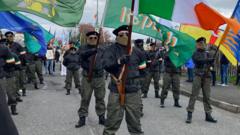
Hundreds of people lined the streets of Creggan this week to watch the annual Easter Monday parade. It wasn't a celebration for everyone. While the organizers claim they're honoring the 1916 Rising, the heavy police presence and the sight of masked men tell a different story. This isn't just about history. It’s about a small, stubborn movement that refuses to accept the peace process that most people in Northern Ireland moved on from decades ago.
If you look at the footage from Derry, you'll see the same patterns repeating. Young men in paramilitary-style dress. The rhythmic beat of the drums. The black berets. It looks like a time capsule from the 1970s, but it's happening right now in 2026. This isn't an accident. These parades are carefully staged to show that despite the Good Friday Agreement, despite the decommissioned weapons, a "dissident" element still exists. They want you to know they haven't gone away.
Why the Creggan Parade Matters More Than You Think
Most people outside of Derry or Belfast probably think these marches are just relics. They’re wrong. The Derry 1916 Commemoration Committee, which organizes the Creggan event, uses these parades to recruit and radicalize. It’s a branding exercise. They’re trying to link the legendary figures of the 1916 Easter Rising to modern-day criminal activity and small-scale insurgent groups like the New IRA.
The Police Service of Northern Ireland (PSNI) always watches these events with a mix of caution and frustration. You can't blame them. On one hand, they have to allow the right to protest and assemble. On the other, they’re watching people openly celebrate illegal organizations. It’s a tightrope. Every year, we see the same tension. Usually, it ends with a few arrests for wearing "paramilitary-style" clothing or for suspected membership in a proscribed organization. It's a cat-and-mouse game that costs the taxpayer a fortune in policing hours.
The Gap Between Heritage and Violence
I’ve talked to people who live in these neighborhoods. Many of them are tired. They’re tired of the sirens and the hovering helicopters every Easter. They want to remember the fallen of 1916 with dignity, not with petrol bombs or masked teenagers. There is a massive difference between the official Sinn Féin commemorations—which are peaceful and political—and these dissident marches.
Dissidents argue that the current government in the North is a "partitionist" sham. They don't recognize the legitimacy of the Stormont Assembly. To them, the war never ended. But here's the reality they won't tell you. They don't have the support of the public. They have no mandate. They’re a tiny minority holding onto a violent dream while the rest of the island looks toward a unified, peaceful future through democratic means.
The Role of Youth in Dissident Circles
One of the most disturbing sights at the Creggan parade is the kids. You see twelve-year-olds watching men in masks like they're some kind of heroes. That’s how the cycle continues. The dissidents offer a sense of identity and "struggle" to young people in areas where jobs are scarce and the cost of living is biting hard. It’s easier to blame "the Brits" or "the traitors in Stormont" than it is to fix systemic poverty.
The organizers are smart. They use the imagery of the past—the Proclamation of the Republic, the green flags, the Celtic crosses—to wrap their modern-day agenda in a cloak of respectability. If you're a teenager looking for purpose, that's a powerful drug. It's a trap.
Policing the Impossible
The PSNI used drones and land rovers to monitor the crowds this year. They have to. In past years, these parades have served as a cover for transferring materials or scouting police positions. It’s not just a walk down the street. It’s a tactical operation.
Critics say the heavy policing makes things worse. They argue it "proves" the dissidents' point that they live in a police state. Honestly, that's a weak argument. When you have people marching in military formation through a residential area while honoring groups that still plant bombs, the police have a duty to be there. The risk of doing nothing is far higher than the risk of looking "heavy-handed."
The Political Dead End of Dissident Republicanism
What do these groups actually want? They’ll say "a 32-county socialist republic." Sounds great on a poster. But they have no plan to get there. Violence failed for thirty years. Politics, however, is actually working. Sinn Féin is now the largest party in the North. The path to a border poll is clearer than it has ever been.
The dissidents hate this. They hate it because it proves they aren't needed. If a United Ireland happens through a vote, their entire reason for existing vanishes. They need the conflict. They thrive on the "us vs. them" mentality. Without the threat of the police or the British army, they’re just guys in tracksuits with outdated ideas.
The Impact on the Local Economy
Derry is trying to reinvent itself. It’s a city of culture, a hub for tech, and a beautiful tourist destination. Every time these headlines hit the international press, it hurts. Who wants to invest in a city where masked men are marching down the road?
The local businesses in the Cityside feel the pinch. When the Creggan gets locked down for a parade, foot traffic drops. People stay home. The dissidents claim to love their community, but their actions keep their own neighborhoods stuck in the past. It’s a self-defeating cycle of "resistance" that only results in more poverty and more policing.
Breaking the Cycle
We need to stop treating these parades as just "another news story" that happens every April. We need to call them what they are: an attempt to intimidate the local population and keep the embers of conflict burning.
Real change doesn't happen in a mask. It happens at the ballot box. It happens in community centers. It happens when we stop romanticizing the gun and start focusing on the future. If you want to honor the men and women of 1916, do it by building a country worth living in, not by marching in circles in a housing estate.
If you're following the developments in Northern Ireland, stay tuned to local community reports rather than just the big headlines. Look at the work being done by groups like the Holywell Trust or local youth clubs. That’s where the real progress is. The parades are just noise. The real work is quiet, difficult, and doesn't require a balaclava.