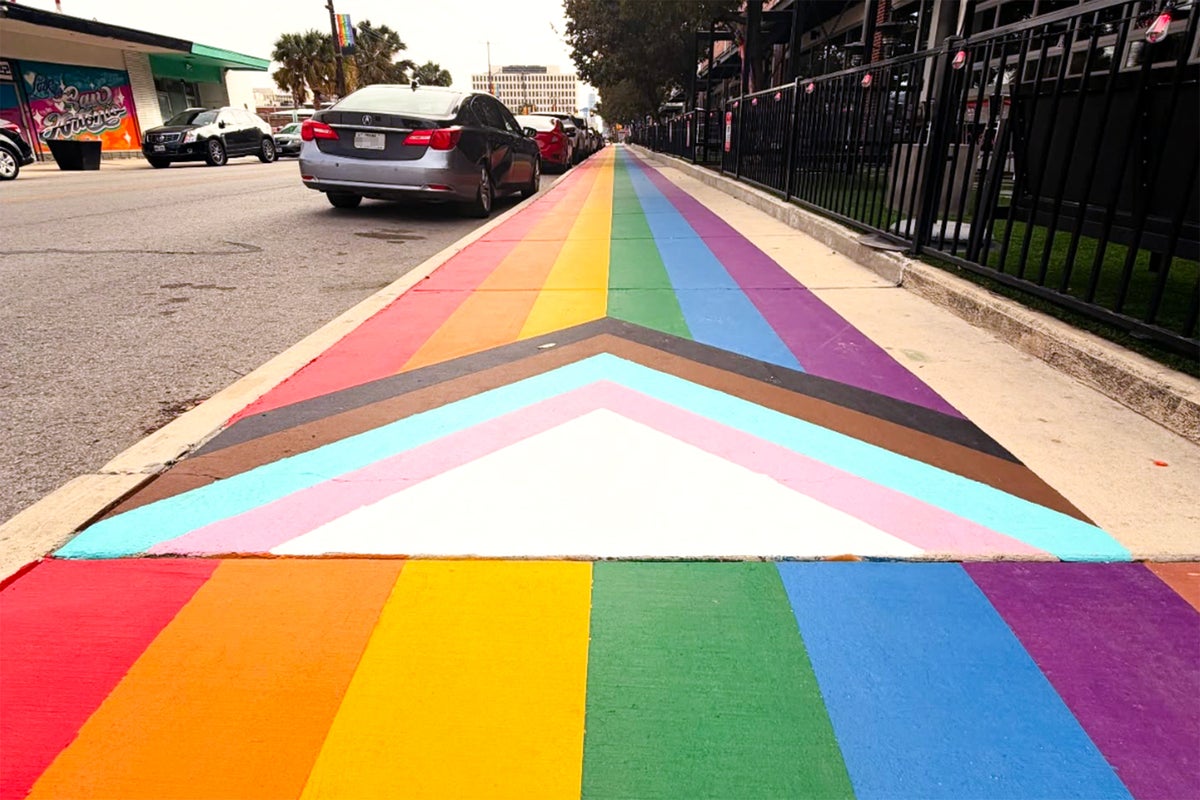
Municipal governance in Texas currently operates within a tightening vice of preemption, where state-level legislative mandates frequently collide with local-level cultural expressions. The recent removal and subsequent reinvention of the Pride crosswalk in San Antonio’s Main Avenue Strip serves as a primary case study in asymmetric regulatory warfare. When the Texas Department of Transportation (TxDOT) invoked federal safety manuals to scrub "non-standard" markings from state-maintained roads, they inadvertently triggered a shift from physical infrastructure to private-property intervention. This transition illustrates a critical law of urban semiotics: symbolic utility is not destroyed by regulation; it is merely displaced to less regulated jurisdictions.
The Triad of Regulatory Constraints
The removal of the rainbow crosswalks was not an arbitrary act of aesthetics but the result of a specific intersection between three regulatory layers. Understanding this hierarchy explains why the "restoration" of the symbol had to bypass the street surface entirely.
- The Manual on Uniform Traffic Control Devices (MUTCD): This federal standard, adopted by the State of Texas, dictates that crosswalks must consist of white longitudinal lines. Any deviation—such as the inclusion of colors between those lines—is classified as a distraction or a potential liability hazard. By framing the issue as a safety violation, state authorities neutralized political arguments with a technical mandate.
- State-Local Preemption: Main Avenue, while a local cultural hub, carries a state designation. This creates a jurisdictional overlap where the city manages the "vibe," but the state controls the asphalt. In Texas, the trend of "Death Star" bills and similar preemption tactics ensures that local ordinances regarding civil rights or public displays cannot supersede state-level administrative codes.
- The Public Forum Doctrine: Because the street is a traditional public forum, the government’s ability to regulate content is limited. However, when the government itself "speaks" through infrastructure, it maintains control. By reclaiming the crosswalk as strictly functional infrastructure rather than a canvas, TxDOT exercised its right to curate government speech.
The Displacement of Symbolic Capital
When the state erased the crosswalks, it created a vacuum of symbolic capital. In urban sociology, symbolic capital refers to the intangible value a community derives from recognized landmarks. The "workaround" adopted by San Antonio locals—installing a massive rainbow mural on the side of a privately owned building overlooking the intersection—functions as a strategic pivot in property rights.
The Private-Property Buffer
By moving the symbol from the horizontal plane (the road) to the vertical plane (a building facade), the community utilized the First Amendment protection of private expression. Unlike the street, which is subject to MUTCD safety standards, a private wall is subject only to local zoning and sign ordinances.
The logic follows a predictable cost-benefit path:
- Cost of Compliance: Maintaining a non-standard crosswalk involves recurring legal fees and the risk of losing state highway funding.
- Cost of Defiance: Painting a private wall involves a one-time material cost and zero risk of state-level preemption, provided the mural does not violate specific size or light-pollution ordinances.
This shift represents a tactical retreat from "contested public space" to "fortified private space."
Logistics of Permanent Visual Signalling
The restoration of the symbol via a mural provides a higher signal-to-noise ratio than the original crosswalk. Crosswalks are subject to tire wear, oil degradation, and visual obstruction by vehicles. A vertical mural, conversely, maintains a permanent line of sight for pedestrians and motorists alike, effectively decoupled from the "wear and tear" of infrastructure.
Furthermore, the mural serves as a Geographic Anchor. In urban planning, an anchor is a landmark that defines the character of a district. While a crosswalk is a transient space meant for movement, a mural turns a building into a destination. This creates a feedback loop:
- Increased visibility leads to higher foot traffic.
- Higher foot traffic bolsters the economic viability of the surrounding LGBTQ-owned businesses.
- Economic strength provides the capital necessary for further "workarounds" if other public symbols are challenged.
The Friction Coefficient of State Intervention
The state’s intervention in San Antonio highlights a fundamental flaw in top-down regulatory enforcement: the Friction Coefficient. When a state agency suppresses a local cultural marker, it generates social friction that often results in a more resilient and permanent replacement.
Consider the "Streisand Effect" applied to municipal code. By making the crosswalk a point of contention, TxDOT elevated a local amenity into a regional symbol of resistance. The data suggests that forced removal of symbols rarely leads to their disappearance; instead, it leads to their hardening. The new mural is not just a replacement; it is a statement of jurisdictional independence.
Structural Vulnerabilities in Local Symbolism
Despite the success of the San Antonio workaround, several bottlenecks remain for cities attempting to replicate this model.
- Reliance on Private Cooperation: If the owners of the "Strip" properties were not aligned with the community's goals, the symbol would remain erased. This creates a dependency on private landholders to act as curators of public identity.
- Zoning Law Volatility: While the state has limited power over private murals, city councils can be pressured to change zoning laws or historic preservation codes to restrict "expressive signage."
- Economic Barriers: Painting and maintaining large-scale public art is significantly more expensive for private citizens than it is for a city to include a tint in its annual paving budget.
Calculated Maneuvers for Municipal Autonomy
For local leaders and community organizers facing similar state-level restrictions, the San Antonio model suggests a three-step strategic framework:
- Audit the Jurisdiction: Identify which assets are state-controlled versus city-controlled. Focus symbolic investment exclusively on city-owned or private assets to avoid the MUTCD trap.
- Verticalize the Message: Move away from horizontal infrastructure (streets, sidewalks) which are heavily regulated for safety, and move toward vertical infrastructure (walls, banners, light-pole wraps) which enjoy broader legal protections.
- Establish Permanent Easements: Secure long-term agreements with private property owners to host community symbols. This prevents the "erasure" of symbols during property sales or shifts in political climate.
The tension between state uniformity and local identity is a permanent feature of the Texan political ecosystem. The San Antonio "workaround" is not a loophole; it is a sophisticated recalibration of how power is projected in the built environment. Future efforts to maintain cultural enclaves must move beyond the pavement and into the architectural fabric of the city itself, ensuring that symbols are protected by the sturdy shield of private property rights rather than the shifting sands of administrative code.