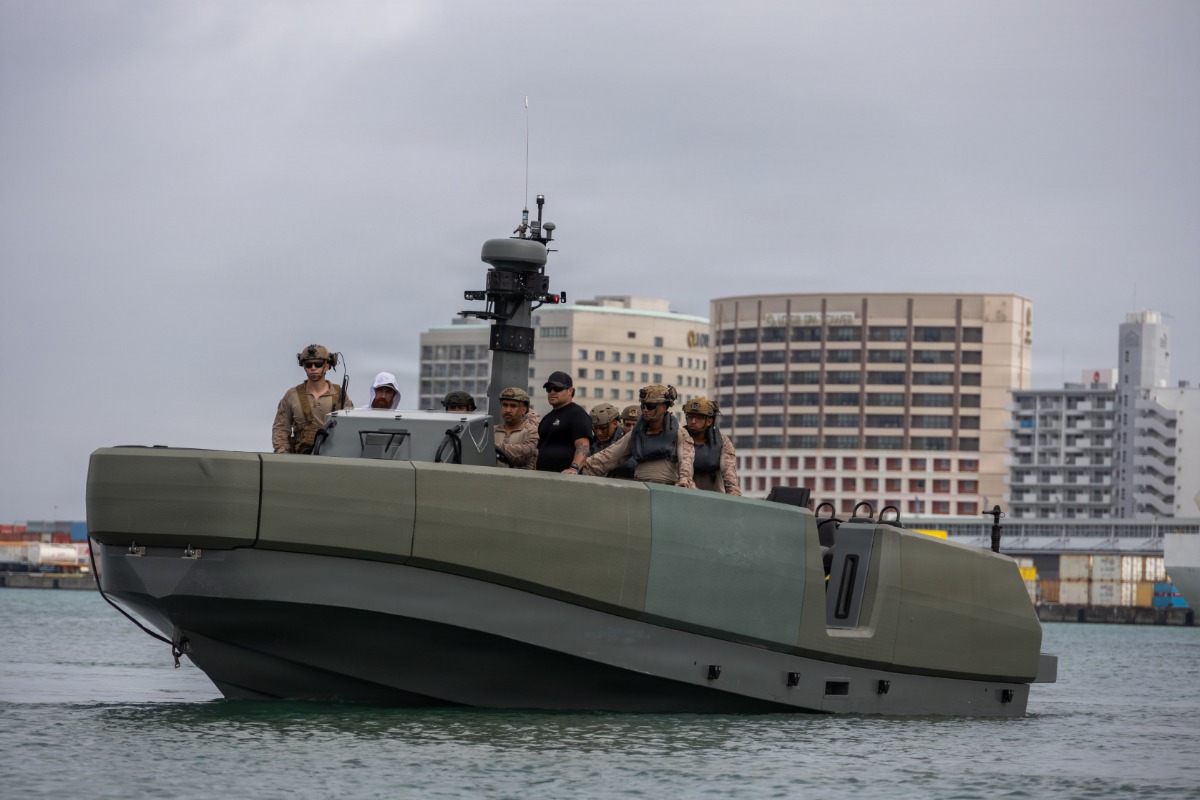
The defense establishment is currently swooning over the latest deployment of high-tech reconnaissance craft near Taiwan. The mainstream media line is predictable. Analysts are swooning over the deployment of small, fast watercraft, painting a picture of agile Marines darting through the waves to outmaneuver a massive naval power. They call it a triumph of distributed lethality.
They are wrong.
This hyper-fixation on tactical speedboats ignores the brutal reality of modern electronic warfare and anti-access/area-denial (A2/AD) networks. Shoving a handful of Marines onto a glorified jet ski with satellite uplinks does not shift the balance of power in the Taiwan Strait. It creates a target-rich environment for a near-peer adversary that has spent thirty years perfecting the art of littoral denial.
The Myth of the Low Profile
The prevailing consensus suggests that smaller equals invisible. The logic goes that by moving away from massive amphibious warships and toward smaller reconnaissance platforms, the military can slip under the radar.
This assumption belongs in the 1990s.
Modern littoral combat zones are saturated with synthetic aperture radar (SAR), high-altitude long-endurance drones, and persistent commercial satellite constellations. A low-riding hull does not hide you from thermographic imaging or high-repetition-rate laser scanners. When the water is monitored by multi-spectrum sensor grids, an agile recon boat stands out just as clearly as a destroyer.
Worse, small craft lack the space for serious electronic countermeasures. You cannot fit a multi-megawatt jamming suite onto a hull designed for rapid insertion. If you cannot jam the incoming missile, your survival relies entirely on not being seen. In a narrow strait backed by mainland radar installations, that is a mathematical impossibility.
The Logistics Delusion
Military planners love to discuss the concept of "expeditionary advanced base operations." The idea is to scatter small teams across remote islands to scout and relay targeting data.
Let us look at the actual physics of this strategy.
- Fuel Limitations: Small reconnaissance craft have limited internal fuel capacity. They require frequent refueling from either a mother ship or a hidden cache. Both options are incredibly vulnerable.
- Payload Constraints: You cannot carry heavy air-defense systems on a light reconnaissance vessel. If a drone spots the crew, they have no organic way to defend their airspace against sustained loitering munitions.
- Weather Vulnerability: The Taiwan Strait is notorious for treacherous sea states and seasonal typhoons. A hull that performs flawlessly in calm test waters will break crews down physically when subjected to sustained eight-foot swells.
I have watched acquisition programs burn through hundreds of millions of dollars trying to field "agile" hardware that fails the moment it encounters real-world maritime logistics. A platform that requires a pristine supply chain to maintain its stealth or operational readiness is not an asset. It is a liability that ties down rescue assets when things go south.
What the Defense Establishments Gets Wrong About Chinese Radar
Every debate about littoral operations assumes that enemy radar operates on a binary logic: either they see you, or they do not.
That is not how modern shore-based radar works. Organizations like the macro-defense research units have pointed out for years that the People's Liberation Army uses over-the-horizon backscatter radar networks alongside passive coherent location systems. These systems do not care about the radar cross-section of a composite hull. They detect the wake left by the boat moving through the water.
Imagine a scenario where a small recon team successfully navigates an island chain without emitting a single radio signal. Their hull is perfectly optimized to deflect X-band radar. Yet, their wake leaves a distinct thermal and physical signature that orbital sensors track in real time. The moment they sit still to transmit targeting data, a long-range precision strike vector is already calculating their coordinates.
The Right Strategy: True Dispersion
If the goal is to deter an amphibious invasion, the solution is not to send American Marines into the littoral zone on vulnerable boats to do the scouting themselves. The solution is to turn the target area into a completely autonomous minefield of sensors.
Instead of putting human lives on high-value, small-batch manned vessels, resources must pivot toward mass-produced, expendable underwater gliders and static seabed acoustic arrays. If an asset costs less than the missile used to destroy it, the economic calculus shifts back in your favor.
Putting personnel on the water in small craft gives the illusion of action while providing the adversary with easy tactical victories. Stop romanticizing the image of troops rushing through the surf on advanced speedboats. Start investing in underwater mass that can actually survive the first twenty-four hours of a peer-level conflict.


