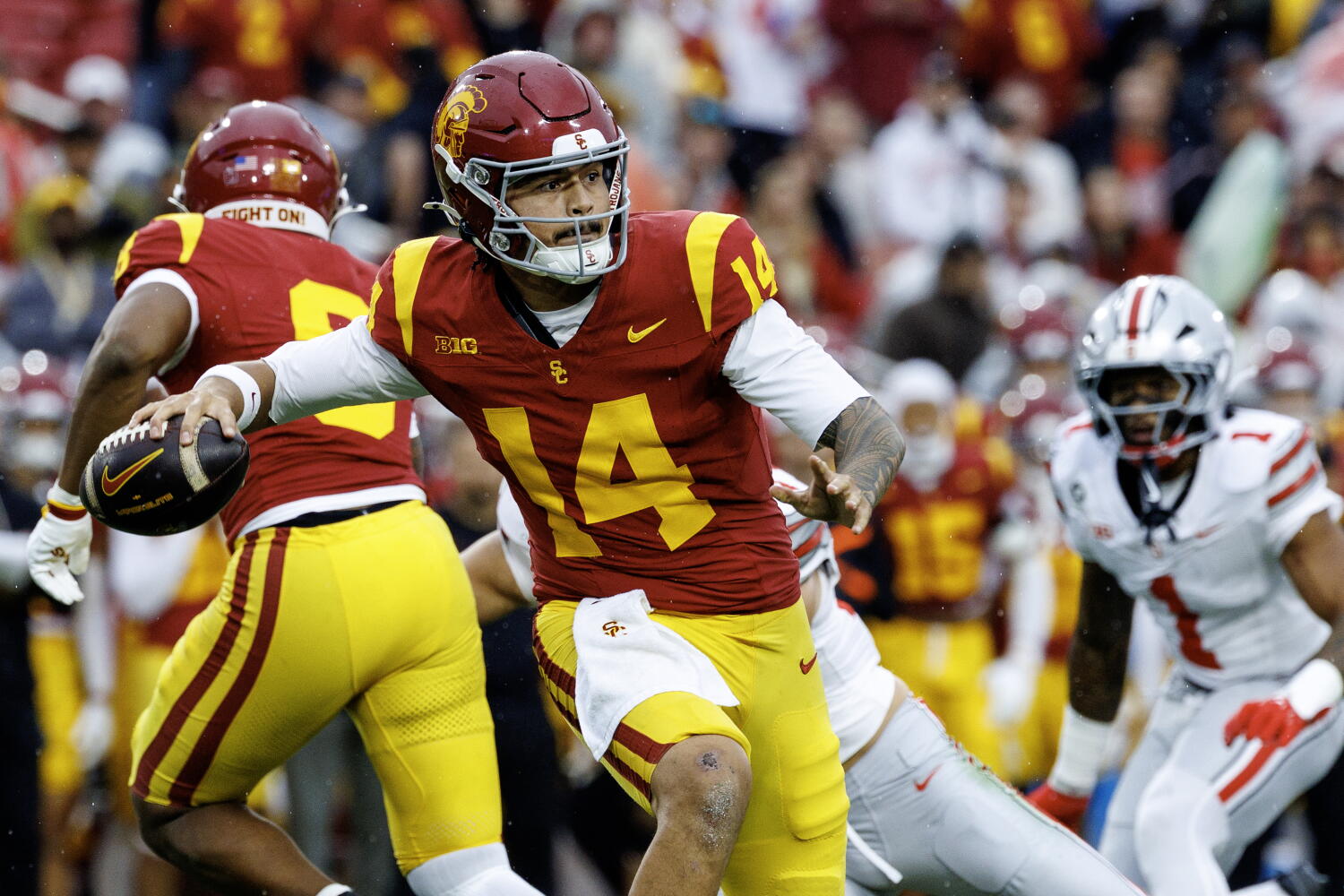
Walk into Memorial Stadium in Bloomington on a cold autumn Saturday, and you immediately realize why Big Ten road games break teams that aren't built for them. USC is walking into that exact buzzsaw against Indiana, carrying the heavy baggage of three straight seasons defined by fourth-quarter collapses, sloppy penalties, and road meltdowns. Everyone in Los Angeles wants to believe this roster has finally turned the corner. Honestly, until they prove they can survive a hostile Midwest environment without beating themselves, skepticism isn't just fair—it's mandatory.
The narrative coming out of Southern California this week is predictable. Coaches talk about maturity. Players mention learning from past mistakes in Ann Arbor, Minneapolis, and South Bend. You've heard this script before if you follow college football closely. Talk is cheap when you're practicing under sunny skies at Howard Jones Field, far away from 50,000 screaming Hoosier fans who smell blood in the water. Also making news lately: Luke Littler Beat Beau Greaves at the Grand Slam and Everyone Missed the Real Story.
The Anatomy of USC's Road Collapses
To understand what's at stake in Bloomington, you have to look at why USC keeps losing the exact same way away from the Coliseum. It's rarely a talent deficit. Blue-chip recruits still litter the two-deep depth chart, and Lincoln Riley's offensive scheme still stresses defensive coordinators across the country. The issue is mental fragility when things go sideways in the second half.
Look back at USC's recent history in high-pressure road spots. Whether it was blowing double-digit leads or letting inferior opponents hang around until a fluke turnover flipped the scoreboard, the pattern stays consistent. Pre-snap penalties kill promising drives on third-and-short. Defensive backs lose eye discipline on play-action fakes. Special teams units surrender hidden yardage at the worst possible moments. More insights regarding the matter are explored by ESPN.
When you travel two time zones east to play in the Big Ten, those tiny cracks turn into canyons. Indiana thrives on discipline, physicality at the line of scrimmage, and capitalizing on opponent errors. They won't beat themselves, which puts the entire burden on USC to play clean football for sixty minutes.
Why Third-Down Defense Dictates Everything
If you want to know by halftime whether USC has actually learned from past mistakes, watch how their defensive front handles third-and-medium. Under previous defensive regimes, the Trojans routinely got bullied up the middle when opposing offenses needed four yards to move the chains. Bringing in D'Anton Lynn to overhaul the defense brought undeniable schematic upgrades, better tackling angles, and actual gap integrity.
Yet scheme only carries you so far in November. When Indiana lines up in heavy personnel and tries to bleed the clock, USC's interior defensive linemen have to hold their ground without getting washed out of the lane. If the Hoosiers convert over 45 percent of their third downs, USC's high-powered offense will spend half the afternoon freezing on the sidelines.
Indiana Is Not the Pushover Old-School Fans Remember
A massive mistake casual Pac-12 nostalgic fans make is treating Indiana like a guaranteed win based on helmet logos from twenty years ago. That program doesn't exist anymore. Under Curt Cignetti's aggressive, no-nonsense culture shift, Indiana transformed into one of the most efficient, physical teams in the conference.
They play with a chip on their shoulder that directly contrasts with USC's Hollywood reputation. Indiana's offensive line fires off the ball low and angry. Their receivers block downfield like tight ends. Most importantly, their quarterback play relies on quick processing and taking what the defense gives rather than hunting for viral highlight throws.
For USC, this creates an uncomfortable stylistic clash. Lincoln Riley loves explosive plays and vertical spacing. Indiana wants to drag you into a phone booth, shorten the game to nine or ten possessions total, and dare you to stay patient. Patience has never been USC's strong suit.
What Actually Needs to Change for a USC Victory
Winning in Bloomington doesn't require USC to reinvent its identity. It requires executing boring, unglamorous football when the stadium gets loud. Here is what the coaching staff and players must execute to flip the script on their road reputation:
- Commit to the interior run game early. Abandoning the run after two stuffed carries in the first quarter is a classic Riley trap. Even if the yards per carry sit around 3.5 in the opening half, keeping Indiana's linebackers honest prevents them from dropping seven guys into passing lanes.
- Eliminate dead-ball fouls. False starts and illegal formations on the road are pure concentration failures. Quarterback cadence needs to be crisp, and the offensive tackles can't afford to jump early when the crowd noise spikes on third down.
- Win the middle eight minutes. The final four minutes of the second quarter and the first four minutes of the third quarter decide almost every tight Big Ten game. USC has a bad habit of letting opponents score right before the break and then going three-and-out to open the second half.
- Tackle in space without lunging. Indiana uses horizontal screens and quick slants to test defensive discipline. Missed tackles turn three-yard gains into back-breaking first downs.
The Quarterback Factor Under Pressure
Road environments expose quarterbacks faster than any other position on the field. At home, a quarterback can check out of bad plays, adjust protections at the line, and read coverage disguises in relative peace. In Bloomington, silent counts disrupt timing, and defensive ends tee off without worrying about hard counts drawing them offsides.
USC's quarterback doesn't need to throw for 400 yards to walk out of Indiana with a win. Honestly, trying to play hero ball against a disciplined zone defense is the fastest way to throw two momentum-killing interceptions. Taking checkdowns, throwing the ball away when the pocket collapses, and protecting the football in the red zone will matter infinitely more than highlight-reel deep balls.
The Bigger Picture for Lincoln Riley's Tenure
Let's be completely honest about what this game represents for the program's trajectory. You don't pay a head coach elite money and pour millions into NIL rosters just to beat up on bottom-tier opponents at home while folding every time you board a charter flight. College football's expanded playoff format leaves zero room for teams that can't win tough road games in November.
Every recruit watching from California, Texas, and Georgia is paying attention to whether USC looks tough or soft when adversity hits. Recruiting pitches about sunshine and draft picks lose their shine if the product on Saturday looks unprepared for physical conference play. Proving they learned from past mistakes isn't just about salvaging a single season's record—it's about validating that USC actually belongs among the Big Ten's heavyweights.
Watch the opening two drives of the game closely. Ignore the pregame hype, ignore the uniforms, and watch the body language at the line of scrimmage. If USC's offensive line is moving Indiana backward and the defense is rallying to the ball with bad intentions, you'll know the lessons finally stuck. If you see early flags, miscommunications in the secondary, and coaches screaming on the sideline before the first TV timeout, grab your remote—because you've already seen how this movie ends.