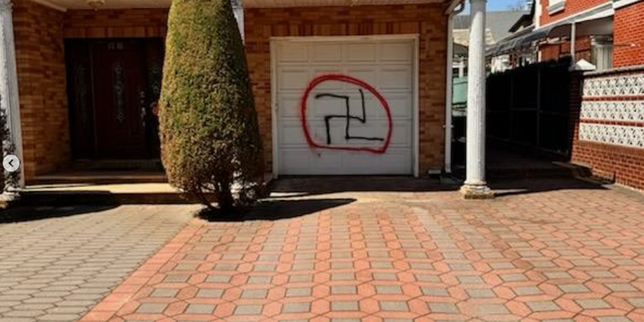
Spray paint on a synagogue isn’t just a crime; it’s a failure of our collective imagination. When a swastika appears on a wall in Brooklyn or Queens, the media machine pivots to a tired, decades-old script. They call it a "rising tide." They demand more "awareness." They treat the paint as the disease rather than a symptom of a much deeper, more uncomfortable structural rot.
Most reporting on these incidents stays surface-level. It’s lazy. It’s safe. It frames the act as a spontaneous eruption of hate from the margins of society. That’s a comforting lie. By focusing on the shock value of the symbol, we ignore the cold, hard mechanics of why these acts persist despite billions spent on security and education. We are fighting a 21st-century ideological war with 1950s sensibilities.
The Myth of the Lone Radical
The standard narrative suggests that a vandal is a lone wolf who stumbled upon some dark corner of the internet. This perspective is dangerously naive. Hate isn't a contagion you "catch" from a stray tweet; it’s a product of social fragmentation.
When we see antisemitic graffiti in New York, we are looking at the physical manifestation of a breakdown in local social contracts. Security experts often talk about "Target Hardening"—adding cameras, gates, and guards. I’ve seen organizations sink $500,000 into high-tech surveillance only to have a teenager with a $5 can of Krylon bypass it in three seconds. Cameras don’t stop hate; they just record it in 4K.
The "broken windows theory" suggests that visible signs of crime create an environment that encourages more crime. But in the digital age, the "window" isn’t just the side of a house; it’s the entire information ecosystem. By reacting with the exact same shock-and-awe media coverage every single time, we provide the vandal with a return on investment that no marketing agency could ever guarantee. We have turned hate into a high-yield currency.
Why Awareness Campaigns Are Failing
If "awareness" worked, antisemitism would have vanished in the 1990s. We have more museums, more mandatory curriculum hours, and more "tolerance" seminars than at any point in human history. Yet, the numbers don’t budge. Why? Because these programs often operate on the flawed premise that hate is a lack of information.
It isn't.
Hate is an identity. For the person holding the spray can, the swastika isn't a historical reference to 1940s Germany; it’s a shortcut to relevance. It’s the ultimate "f*** you" to a system they feel excluded from. When we respond with more "education" that feels like a lecture from a distant elite, we actually reinforce the vandal’s worldview. We validate their rebellion.
Instead of teaching "tolerance"—a weak, passive word that basically means "I’ll let you exist"—we should be looking at economic and social integration. You don't see this level of localized vandalism in neighborhoods where the social fabric is tight and communal stakes are high. Vandalism thrives in the "non-places" of our cities—the anonymous alleys and the gentrified blocks where neighbors don't know each other's names.
The Security Industrial Complex
There is a massive, unspoken industry that profits from these headlines. I’ve sat in rooms with security consultants who use the latest graffiti report to upsell panic-stricken boards on facial recognition software that doesn't actually work in the dark.
This is the "Security Industrial Complex." It thrives on the perception of an omnipresent threat. While physical security is necessary, it’s a tactical fix for a strategic disaster. If your strategy for protecting a synagogue relies entirely on the thickness of the glass, you’ve already lost the battle for the neighborhood.
We need to stop treating these incidents as isolated news cycles and start treating them as data points in a failed urban policy. New York is a city of layers. When one layer—the civic layer—erodes, the darker layers underneath start to show through.
The False Comfort of Legislation
Every time a synagogue is tagged, a politician stands in front of a microphone and promises "stricter hate crime laws."
Here is the brutal truth: laws don't deter people who feel they have nothing to lose. Increasing a prison sentence from two years to five years means nothing to a 19-year-old who doesn't believe he has a future anyway. Legislation is a reactive tool. It’s a way for the state to look busy without actually solving the underlying friction between different ethnic and religious groups.
We focus on the punishment of the act because it’s easier than addressing the geography of the hate. Look at where these incidents happen. They often occur at the "seams" of the city—the borders where different communities rub against each other without interacting. These are friction points. You don't solve friction with a gavel; you solve it with grease. In this case, the "grease" is genuine, boots-on-the-ground community brokerage that doesn't involve a camera crew.
Stop Making the Symbols Famous
The media’s obsession with showing the graffiti is a tactical error. We are told we must "witness" the hate to understand it. That’s nonsense. We know what it looks like. By broadcasting the image, the media acts as a force multiplier for the vandal.
Imagine a scenario where we treated graffiti like we treat "streakers" at a football game. The cameras turn away. The act is stripped of its audience. If a tree falls in the forest and no one posts it on X (formerly Twitter), does it even make a sound? By providing a global platform for a local act of cowardice, we are essentially subsidizing the next attack.
We need to move toward a model of "Rapid Remediation and Radio Silence." Scrub the wall before the morning commute. Don't give the local news a backdrop for their 6 PM stand-up. Deny the perpetrator the dopamine hit of seeing their "work" on the nightly news.
The Nuance of the Modern Hate Crime
The competitor's article paints a picture of a city under siege by a unified front of bigotry. The reality is more chaotic and less organized. Much of the "antisemitic" graffiti we see today is a messy, incoherent blend of various extremist ideologies, internet subcultures, and raw, undirected nihilism.
When you treat it as a monolithic, organized movement, you give it a dignity it doesn't deserve. You make it look like an army when it's actually a collection of losers. We need to stop inflating the status of these vandals. They aren't soldiers in a holy war; they are social failures who found a shortcut to the headlines.
The Hard Choice
The choice is simple, yet most people won't like it. We can continue the cycle:
- Incident occurs.
- Outrage follows.
- Politicians promise "never again."
- Security companies sell more gear.
- Awareness campaigns launch.
- Nothing changes.
Or, we can admit that our current approach is a performance. True safety doesn't come from a badge or a sensor. It comes from a community that is so tightly knit that a vandal feels like an outsider long before they ever pick up a spray can.
Stop asking for more police. Start asking why your neighbors are so alienated that they find meaning in a symbol of death. If you aren't looking at the isolation of the modern city, you aren't looking at the problem at all.
Pick up the paint, cover the symbol, and stop talking about it. Silence the spectacle. That is how you actually win.