Darkness falls early over Moscow's grand courtyards, casting long, geometric shadows against the thick yellow stone of the Senate Palace. Inside, past the heavy mahogany doors and the silent, watchful gaze of security details, the air smells faintly of old paper, floor wax, and intense, compressed anxiety.
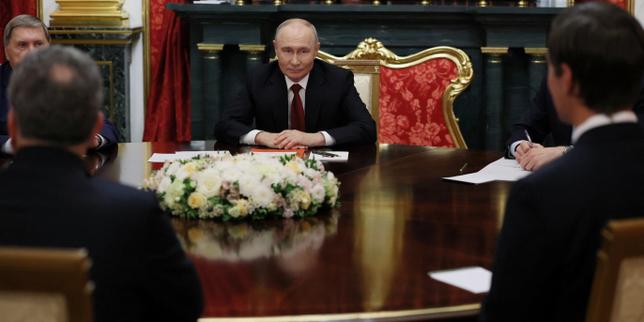
Vladimir Putin sits at the head of a massive, polished table. Across from him stand the emissaries of a distant American president—figures carrying not weapons, but proposals, fresh maps, and a fragile, high-stakes portfolio of ideas. The confrontation is entirely civil, yet the weight in the room could crush stone.
Consider what happens when absolute resolve meets relentless diplomacy.
The delegation, featuring special envoy Steve Witkoff and Jared Kushner, arrived in the Russian capital under a temporary, fragile canopy of silence. For three days, a rare pause in capital-targeted strikes was negotiated—a brief window where the drone hum over Kyiv and Moscow quieted just enough for men in suits to speak. Moscow officials called the atmosphere extremely frank. That diplomatic euphemism often translates to a room where nobody is blinking, and every sentence is measured against the lives of thousands.
"The situation we have to deal with today is certainly complex," Putin remarked softly as the cameras rolled for a brief, highly choreographed opening.
He offered polite nods and requested that warm regards be passed back across the ocean to Donald Trump. But beneath the diplomatic courtesies lay an unmovable wall. The Kremlin's foundational demands—insisting that Ukraine surrender entire eastern regions and abandon its western security alignment—remained precisely where they were planted years ago. To Moscow, these are not negotiable starting points; they are perceived geographic necessities. To Kyiv and its allies, they are an absolute non-starter, an invitation to national erasure.
Imagine standing in a trench somewhere in the freezing Donbas mud, listening to the distant concussions of artillery, while thousands of miles away, well-dressed planners debate the exact lines that will dictate whether you live under one flag or another. The abstraction of geopolitics vanishes instantly when translated into human cost. The human element here is staggering, measured in a relentless attrition of young lives every single day.
The American envoys came bearing what they hoped would break the ice of an eight-month diplomatic deep freeze. They outlined alternative routes to a settlement, paths meant to bypass the personal animosity and deep-seated hatred that Washington insiders whisper has choked formal communication. Yet, as foreign policy aide Yuri Ushakov calmly pointed out to reporters after hours of closed-door dialogue, Russia remains entirely confident in its ability to grind forward toward its maximalist military objectives. Confidence is a dangerous currency in war. It keeps armies marching long after common sense has fled the field.
The dialogue did not yield a miracle beneath the gilded chandeliers. Miracles are rarely born from administrative meetings between adversaries who have spent years trying to dismantle one another's economies and infrastructure. Instead, it produced a continuation of the dance. The American plane prepared to pivot south toward Kyiv, carrying the observations gathered under the heavy chandeliers of the Kremlin directly to the desk of Volodymyr Zelenskyy.
The maps remain marked with red ink. The capital cities hold their breath for forty-eight hours before the skies inevitably reopen. Peace, it turns out, is not an agreement signed in a single dramatic afternoon. It is a slow, agonizing extraction, fought inch by inch against the inertia of history and the unyielding pride of empires.