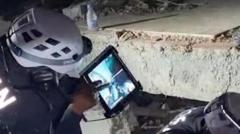
Six days in the dark under tons of pulverized concrete is a death sentence for almost any human. For a toddler, it defies every medical textbook on the planet. Yet early Tuesday morning, international search teams pulled a little boy named Klieber Moran out of the shattered ruins of the Los Corales Garden 1 building in La Guaira state, Venezuela.
It's the kind of survival story that makes you pause. It stops the breath of seasoned emergency workers who know exactly how grim the odds are. Klieber is the only survivor found alive on day six following the catastrophic twin earthquakes that ripped through northern Venezuela last Wednesday. The twin shocks, clocking in at magnitudes of 7.2 and 7.5, hit less than sixty seconds apart. They basically pancaked high-rises, hotels, and homes across the region, leaving an estimated 59,000 buildings damaged or outright destroyed.
While local politicians debate whether the boy is two or three years old—acting President Delcy Rodriguez says three, National Assembly President Jorge Rodriguez says two—the real story lies in how he survived and what his rescue reveals about the brutal realities of modern disaster response.
The Brutal Science of the Golden Hours
In urban search and rescue, we talk about the "Golden 72 Hours." During this initial three-day window, the chances of pulling living people from structural collapses are relatively high. After 72 hours, the survival curve doesn't just dip; it plummets off a cliff.
Humans can survive weeks without food, but water is the hard ceiling. Dehydration kills quickly, especially in tropical coastal regions like La Guaira, where temperatures spike and trapped victims sweat out precious fluids. For an infant or toddler, the timeline is compressed even further because their smaller bodies succumb to dehydration and heat stroke much faster than adults.
So how did Klieber Moran beat a six-day clock?
Structural engineers and disaster medicine experts point to a few specific conditions that have to align perfectly for a miracle like this to happen.
- The Void Space: When buildings collapse, they rarely flatten completely into solid blocks. Reinforced concrete beams often catch on furniture or adjacent walls, creating small triangular pockets called void spaces. Klieber was likely protected from the direct crushing impact by a structural void that kept the weight off his tiny frame.
- Reduced Metabolic Output: Children in terrifying situations sometimes drop into a state of shock or deep sleep that lowers their heart rate and metabolic demands. This preservation mode slows down the rate at which the body burns through its internal hydration reserves.
- Microclimates: Deep within a concrete pile, temperatures can occasionally remain cooler than the blistering air outside. If moisture from broken pipes or condensed humidity collects on the concrete, it can create a slightly damp microclimate that slows down fatal dehydration.
We saw a similar flash of survival earlier in the week when a mother, Dayana Patino, and her 18-day-old newborn were pulled from an eighth-floor apartment collapse after 32 hours. But 32 hours is vastly different from 144 hours. Moran’s rescue is an extreme anomaly.
How an International Response Network Actually Operates
Look past the dramatic headlines and you find a massive, chaotic logistical puzzle. Klieber Moran wasn't found by luck. He was located and extracted by a highly specialized heavy urban search and rescue team flying all the way from Jordan.
When a country gets hit by a double-punch disaster of this scale, its local infrastructure instantly collapses. Morgues in Caracas are currently overwhelmed, and the official death toll of over 1,700 is widely considered a massive undercount by experts on the ground. When local emergency lines go dead, the international community has to step in.
Right now, there are over 800 international volunteers and dozens of designated foreign search teams operating in Venezuela. They come from Jordan, Mexico, El Salvador, Switzerland, and Colombia.
But throwing bodies at a pile of rubble doesn't work. True rescue capability requires a highly coordinated system managed under strict international protocols, typically structured through networks like the International Search and Rescue Advisory Group.
Teams like the Jordanian unit utilize specialized acoustic listening devices that can pick up the faint scratching or heartbeat of a victim trapped deep beneath concrete. They use fiber-optic cameras slid into tiny gaps in the debris to look for signs of life before they even think about starting up heavy excavation equipment. One wrong move with a bulldozer can shift the weight of a collapsed ceiling and crush a survivor instantly.
The Massive Crisis Looming Behind the Good News
It's easy to get swept up in the emotion of a single child being saved. The video of a toddler being carried to a Caracas health center provides a brief moment of hope in a dark week. But don't let the miracle blind you to the scale of the ongoing humanitarian disaster.
The United Nations children's agency, UNICEF, just landed a 47-metric-ton shipment of emergency supplies in the country. This includes emergency health kits, water purification gear, and obstetric supplies for safe births in the field. They are targeting a horrifying statistic: UNICEF estimates that 680,000 children across Venezuela are now in urgent need of humanitarian assistance.
The immediate search for life is ending. Hopes of finding more survivors under the rubble are practically zero at this stage. The operation is shifting from search and rescue to a massive recovery and stabilization phase.
With 46,000 people still reported missing or unaccounted for, the country is facing an unprecedented displacement crisis. Families are sleeping in the streets, afraid of the powerful aftershocks that continue to shake the region, including a massive tremor that terrified residents just days ago.
Surviving the Aftermath
If you're watching this tragedy unfold and wondering what happens next, the priority list for humanitarian agencies on the ground has completely flipped. The immediate rescue phase is over. The focus is now entirely on preventing the secondary wave of mortality—deaths caused by contaminated water, disease outbreaks, lack of chronic medical care, and exposure.
For international donors and aid organizations, the next moves require a hard pivot toward long-term water, sanitation, and hygiene infrastructure. When tens of thousands of people are displaced into makeshift camps, waterborne illnesses like cholera can easily kill more children than the initial earthquake ever did.
The survival of Klieber Moran proves that life can endure against impossible odds. But keeping the remaining hundreds of thousands of displaced children alive will require a sustained, unsexy logistical effort that lasts long after the rescue cameras pack up and leave Caracas.