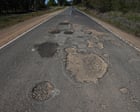
Roads aren't supposed to kill you. They are built to connect towns, move freight, and get you home safely. But across regional Victoria, crumbling asphalt has turned everyday commutes into high-stakes hazards. When a 71-year-old motorcyclist lost his life after striking a severe pothole on the Western Highway near Trawalla, west of Ballarat, it wasn't just a tragic accident. It was the breaking point for a community that has been screaming about deteriorating infrastructure for years.
If you ride a bike or drive a truck through regional Victoria, you already know the truth. Potholes aren't minor inconveniences anymore. They are gaping craters hidden behind blind curves, masked by rain, and left unpatched for months. The tragic death of the Ballarat motorcyclist has forced the state government back onto the defensive, reigniting a furious debate over funding, maintenance neglect, and who is actually responsible when infrastructure fails completely. Learn more on a connected topic: this related article.
The Cost of Neglected Asphalt
Potholes don't appear overnight. They start as hairline cracks, widen under heavy freight traffic, fill with water, and blow apart under the weight of passing vehicles. But when local councils and state authorities take months to respond to community reports, those small failures turn lethal.
Months before the fatal crash on the Western Highway, drivers and motorcycle riders had flooded reporting hotlines with warnings about that exact stretch of bitumen. Hundreds of complaints sat in queues while the holes expanded. When maintenance finally happens, it's often a reactive shovel of cold mix rather than a proper structural rebuild. That band-aid approach fails the moment heavy rain hits. Further reporting by Associated Press highlights comparable perspectives on this issue.
For cars, a deep pothole bends a rim or blows a tire. It ruins your day and costs a few hundred dollars at the mechanic. For a motorcyclist, hitting that same crater at highway speeds is catastrophic. You don't just lose a tire; you lose traction, stability, and control in a fraction of a second.
Why Regional Highways are Failing
Victoria’s regional road network spans thousands of kilometers, and much of it is buckling under pressure. Freight demands have skyrocketed, pushing heavier trucks across aging rural corridors that were never engineered to carry this kind of constant pounding.
At the same time, maintenance budgets have failed to keep pace with inflation and material costs. Governments love cutting ribbons on new urban rail projects and flashy city tunnels, but regional roads quietly starve for cash. Patchwork repairs become the default strategy because they look cheaper on paper.
Yet, deferred maintenance always costs more in the end. When an entire foundation fails, fixing it requires a complete reconstruction, not just a surface skim. Riders and regional residents are paying the ultimate price for this short-term budgeting mindset.
The Real Danger for Two Wheels
Cars have four contact patches and a steel cage. Motorcycles have two contact patches the size of a credit card. That physics reality changes everything about how road defects impact riders.
When you're leaning into a bend on a regional highway at one hundred kilometers per hour, your margin for error is razor-thin. If your front wheel drops into an unpatched crater, the handlebars violently snap, washing out the front end before your brain even registers what happened.
Riders across Victoria have adopted defensive habits out of sheer survival. They scan the tarmac meters ahead, weave within lanes to dodge craters, and share hazard locations on community apps. But you cannot dodge your way through an entire state network of decaying infrastructure. Personal vigilance has its limits when the road surface itself becomes an obstacle course.
Pushing Past Temporary Fixes
The political fallout from the Western Highway tragedy has been swift, with opposition figures and road safety advocates demanding immediate, sweeping funding injections. Labor ministers face intense scrutiny over whether twelve years of governance has left regional roads fundamentally underfunded.
Temporary patch jobs won't cut it anymore. What's needed is a complete overhaul of how road maintenance is prioritized and funded. Authorities need to transition from reactive complaint systems to proactive, data-driven resurfacing schedules. When hundreds of road users flag a dangerous section of highway, it shouldn't take a fatality to trigger an urgent response.
Accountability matters too. Local councils and state bodies need clear performance benchmarks for repairing reported hazards within days, not months. Until funding matches the physical reality of heavy freight and climate stress on our highways, anyone heading out on two wheels is taking an unnecessary gamble every single time they turn the ignition key.