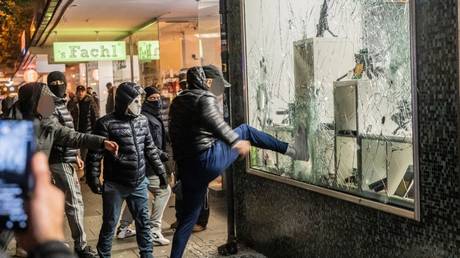
Viral clips of smashed storefronts and looted shops across Germany look terrifying on a six-inch screen. They also miss the actual story by a wide margin.
When sensational headlines scream about "Gen Z protests" tearing up German cities, they flatten a massive, complicated mess of youth frustration, opportunistic looting, and political polarization into a single tidy label. You've probably seen the footage making the rounds on social media. Young people in hoodies darting out of shattered retail windows, sirens wailing in the background, police lines holding back crowds in major urban centers. It makes for incredible clickbait. It's also a terrible way to understand what's actually happening on the ground in Germany right now.
Let's be honest about how modern street unrest works. There's a massive difference between organized youth political demonstrations and the small pockets of opportunistic rioters who hijack the chaos once the sun goes down.
Why Germany's Streets Are Boiling Over Right Now
If you haven't been paying close attention to European domestic politics lately, the sudden explosion of street anger in Germany might seem like it came out of nowhere. It didn't. Young Germans are dealing with a compounding pile of economic and social pressures that have been building for years.
Inflation hit everyday essentials hard. Rent in cities like Berlin, Munich, Frankfurt, and Hamburg has spiraled out of reach for students and entry-level workers. According to data from the German Federal Statistical Office (Destatis), young adults in Germany face disproportionately high housing cost burdens compared to older generations who locked in regulated leases decades ago. You can't tell a twenty-two-year-old working a minimum-wage gig that everything is fine when half their paycheck vanishes into a cramped shared apartment before they even buy groceries.
Then there's the political friction. Debates over mandatory military service proposals, climate policy rollbacks, and severe cuts to youth and social programs have pushed thousands of students into the streets. Most of these demonstrations start peacefully during the day. Kids show up with cardboard signs, chant slogans, and march along pre-approved routes.
Nighttime changes the math.
Once the main crowd disperses, a totally different demographic steps into the vacuum. Police unions and municipal officials in cities like Berlin and Frankfurt have repeatedly pointed out that the people smashing glass and grabbing merchandise rarely care about the daytime political demands. They're looking for adrenaline, TikTok clout, or free sneakers. Lumping a peaceful university student protesting tuition or climate policy into the same bucket as someone throwing a paving stone through a jewelry store window isn't just lazy journalism—it's flat-out wrong.
The Anatomy of a Viral Riot Clip
Have you ever noticed how ten different accounts on X or TikTok will share the exact same fifteen-second video from five different angles, making a single street corner look like an entire city is burning down?
That's the illusion of modern crisis coverage.
When you watch raw footage of rioters ransacking shops during youth protests in Germany, your brain naturally fills in the blanks. You assume the chaos stretches for miles. In reality, German riot police—the Bereitschaftspolizei—are notoriously aggressive about containment. They use kettling tactics, water cannons, and rapid-arrest squads to box unrest into a few specific blocks.
Here's what actually happens behind the scenes of those viral clips:
- The Spark. A standoff builds between a small, militant bloc and a police perimeter, usually after bottles or pyrotechnics get thrown.
- The Splinter. As police push the crowd back, smaller groups break off down side streets where patrol presence is thinner.
- The Smash-and-Grab. A handful of individuals target high-visibility storefronts—electronics shops, designer clothing boutiques, convenience stores—knowing they have roughly ninety seconds before armored vans arrive.
- The Broadcast. Dozens of bystanders film the looting on their phones, uploading the clips instantly with sensational captions designed to farm engagement.
By morning, international outlets run headlines framing the entire night as a generational uprising. Meanwhile, 99% of the city woke up, grabbed a coffee, and went to work without seeing a single broken window.
What Most People Get Wrong About Gen Z Protesters in Germany
There's a lazy narrative floating around right now that Gen Z is uniquely violent or uniquely entitled. Both takes are garbage.
If you look at the history of German street politics, today's unrest is honestly pretty mild compared to what happened in the late 1960s, the 1980s squatter battles in Berlin's Kreuzberg district, or the 2017 G20 riots in Hamburg. Germany has a long, deeply ingrained culture of intense street protest. What's different today isn't the level of violence—it's the speed of the camera phones and the algorithms rewarding the worst behavior.
Another massive misconception is that German Gen Z is a political monolith. They aren't. Not even close.
Walk through any major youth rally in Germany and you'll find wild ideological splits. You have climate activists from groups like Fridays for Future who strictly preach non-violence and civil disobedience. You have anti-capitalist youth blocs who view property destruction as a legitimate political tactic. And on the complete opposite end of the spectrum, recent German state elections have shown a sharp surge in young voters backing far-right populist movements, driven by anger over immigration, economic stagnation, and cultural backlash.
Calling all of this "Gen Z protests" tells you nothing. It's like describing a massive traffic jam by only mentioning the color of three cars.
How Opportunists Hijack Legitimate Demonstrations
Anyone who has ever covered urban protests or worked in public safety knows the exact moment a demonstration goes sideways. It's rarely an accident.
Organized troublemakers—often referred to in German media as Chaoten or violent fringe elements—actively monitor social media channels for upcoming youth protests. They know police resources will be stretched thin managing thousands of peaceful marchers. They show up dressed in black, wearing masks, carrying hammers or fireworks, and wait for dusk.
The store owners caught in the middle take the heaviest hit. Small independent retailers in downtown districts already operate on razor-thin margins. When rioters smash a plate-glass window and empty the cash register, insurance payouts take months, deductibles eat up profit, and the neighborhood feels less safe for regular shoppers.
Meanwhile, the legitimate organizers of the daytime protests end up taking all the blame. Politicians immediately pivot from addressing the actual grievances—like housing shortages, education funding, or pension reform—to demanding harsher policing and blanket protest bans. The looters get their viral videos, the politicians get an easy talking point, and the young people actually trying to fix their future get ignored.
The Role of Social Media Algorithms in Fueling Unrest
We need to talk about how platforms like TikTok, Instagram, and Telegram act as accelerants during street unrest.
Years ago, organizing a spontaneous flash mob or coordinating a loot-and-run required word of mouth or clunky web forums. Today, live streams act like real-time radar. When a crowd clashes with police at a specific subway station in Berlin or Cologne, thousands of local teens see it on their feeds within minutes. Some show up out of pure curiosity. Others show up to film content for their own channels. A smaller fraction shows up looking to join the fray.
The German Federal Criminal Police Office (BKA) has noted in multiple public assessments how digital mobilization compresses the timeline of civil unrest. Flashpoints form faster, disperse quicker, and pop up three neighborhoods away before commanders can redeploy officers.
Worse, the algorithms heavily favor outrage. A video of five hundred students holding a peaceful teach-in gets maybe two hundred views. A thirty-second clip of three guys kicking down a storefront door gets two million views, gets picked up by international news aggregators, and becomes the defining image of an entire generation.
How to Read Breaking Protest News Without Getting Played
When chaotic footage of riots and youth protests floods your feed, you don't have to fall for the engagement bait. A few quick habits will tell you immediately whether you're looking at a genuine systemic breakdown or a localized viral panic.
Check the perimeter of the video. Look past the person smashing the window and watch what's happening twenty feet away. Are thousands of people marching in unison, or are fifteen kids filming two guys while regular pedestrians stand on the sidewalk watching? That background context reveals everything.
Look for local German reporting rather than international aggregators. Outlets like Tagesschau, Der Spiegel, or local city papers like the Berliner Zeitung will give you hard numbers—how many people attended the daytime march, how many arrests police actually made, and how many officers or civilians were injured. If a protest drew 15,000 people and police made 22 arrests, you aren't looking at a violent revolution. You're looking at a tiny criminal fringe.
Pay attention to the timeline. Peaceful political marches almost always happen in the afternoon with permits and speakers. Looting and street clashes almost always happen after 9:00 PM once the organizers have packed up their sound systems and gone home.
Separating the real economic anger of young Germans from the opportunistic vandalism of a few dozen looters isn't complicated once you stop letting fifteen-second clips do your thinking for you. Watch the full picture, verify the arrest and attendance numbers through local German news desks, and recognize viral street footage for what it usually is—a loud, narrow snapshot of a much bigger story.