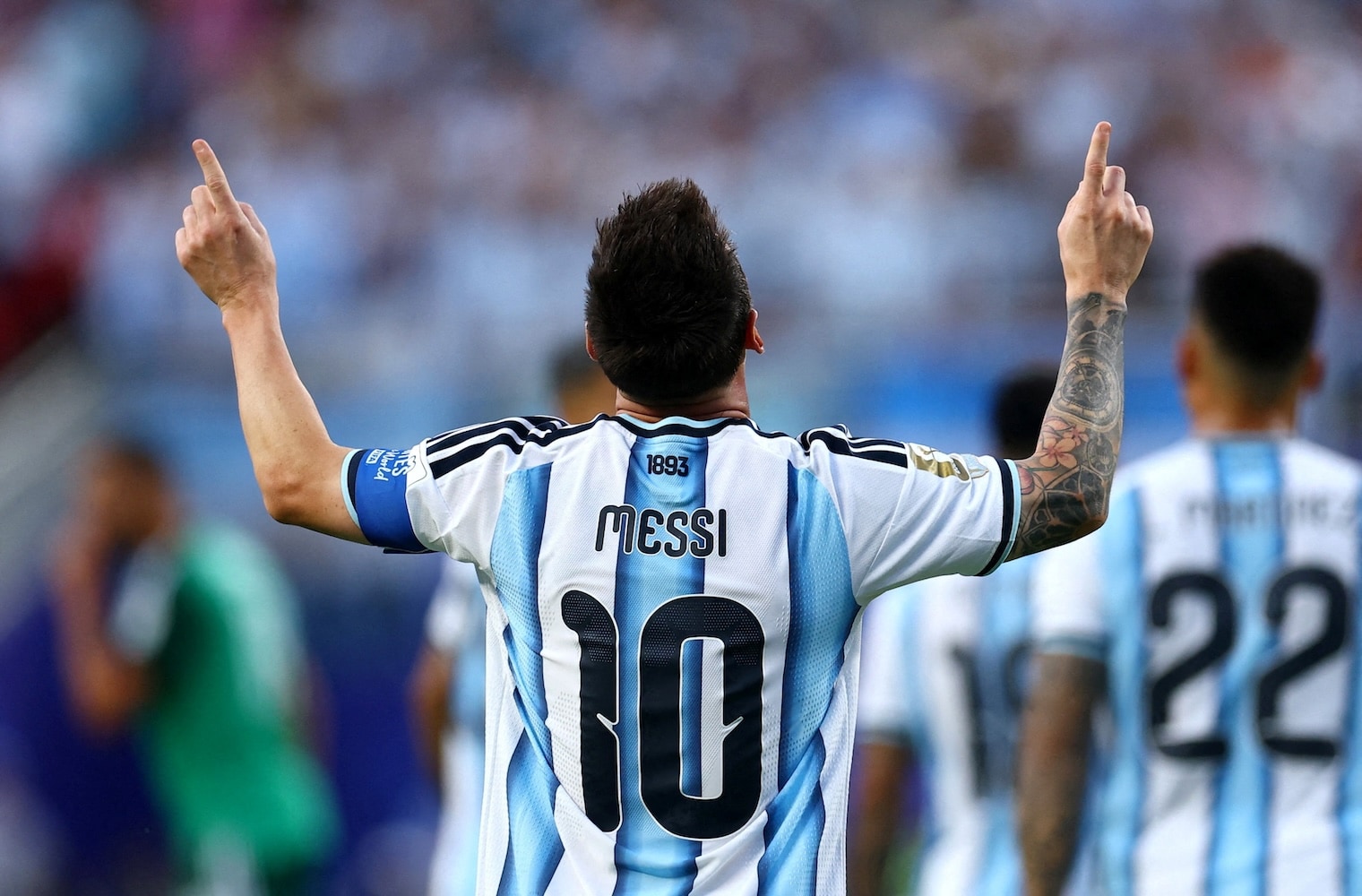
The raw summation of goals scored in the FIFA World Cup is a flawed metric for evaluating striking efficiency and historical dominance. Lionel Messi matching Miroslav Klose at 16 career World Cup goals—achieved via a hat-trick against Algeria at Kansas City Stadium—provides a superficial equilibrium. Evaluating these two outputs requires a structural breakdown of conversion mechanisms, team tactical architecture, and the contrasting timelines of their international careers.
Comparing Klose and Messi purely on cumulative volume ignores the fundamentally different strategic roles each player occupied. Klose operated as a hyper-specialized finishing node within a highly structured German attacking system. Messi functions as both the primary creative engine and the ultimate compounding finisher for Argentina. To understand how these two paths converged at 16 goals, we must analyze the structural mechanics of their production.
The Specialization Model vs. The System Engine
The divergence between Klose and Messi is best understood through the lens of offensive allocation. Klose was an apex executioner whose output was maximized by elite structural service. His 16 goals were achieved across 24 appearances spanning four tournaments (2002–2014). The operational parameters of Klose’s production reveal a highly localized efficiency:
- Spatial Confinement: The vast majority of Klose's World Cup goals originated inside the penalty box, heavily reliant on one-touch finishes, elite aerial positioning, and high-percentage rebounds.
- Systemic Consistency: Klose benefited from a German national team framework that consistently prioritized high-volume crossing, vertical efficiency, and positional discipline under Rudi Völler, Jürgen Klinsmann, and Joachim Löw.
- Positional Isolation: Klose was insulated from deep build-up responsibilities, meaning his physical energy was preserved strictly for final-third penetration and pressing.
Messi’s progression to 16 goals operates on an entirely different tactical axis. Achieving this milestone required 27 appearances across six World Cup editions (2006–2026), reflecting an evolution from a teenage winger to an aging, deep-lying playmaker.
The structural bottleneck for Messi has always been his dual responsibility. He must drop into the middle third to progress the ball while simultaneously arriving in the penalty area to finish the sequence. The 38-year-old’s hat-trick against Algeria illustrated this multi-tiered operational profile:
- Distance Variability: His first goal against Algeria was an explicit display of long-range shot-generation, scored from outside the penalty area following a quick free-kick sequence with Rodrigo De Paul. This matched Rivellino's historical benchmark of five World Cup goals from outside the box.
- Opportunistic Rebound Absorption: His second goal came from close-range positioning, capitalizing on a loose ball after an Alexis Mac Allister attempt.
- Self-Generated Transition: The third goal was initiated by Messi himself, using a diagonal dribbling sequence to manipulate the defensive block before executing a curling finish.
Longevity Mechanics and the Aging Curve
The temporal distribution of Messi’s goals challenges standard athletic degradation models. Standard sports science indicates that a forward's physical peak occurs between ages 24 and 29. Klose followed a relatively traditional trajectory, scoring five goals in 2002, five in 2006, four in 2010, and two in 2014. His output scaled downward as his physical mobility decreased, adapting into a pure poacher role.
Messi has inverted this curve through spatial optimization and role preservation. He scored his first World Cup goal in 2006 against Serbia and Montenegro at 18 years and 358 days old. Exactly 20 years later, at 38 years and 357 days old, he registered his first World Cup hat-trick.
This creates a distinct statistical phenomenon: Messi is simultaneously the youngest and the oldest goalscorer in Argentina's World Cup history.
[Messi's World Cup Scoring Distribution by Age Profile]
Early Career (Ages 18–27 | 2006, 2010, 2014): 5 Goals
Late Career  (Ages 31–38 | 2018, 2022, 2026): 11 Goals
The underlying driver of this late-career surge—scoring 10 World Cup goals after turning 35—is tactical insulation. Lionel Scaloni’s tactical framework minimizes Messi’s defensive workloads and off-ball running. By deploying high-energy midfielders like De Paul and Mac Allister to cover defensive vacuums, Argentina preserves Messi’s anaerobic capacity for high-leverage attacking actions.
This preservation strategy directly allowed Messi to achieve his 200th international cap against Algeria while maintaining elite efficiency, becoming only the third male player in history to cross the 200-cap threshold.
The Impending Longevity Bottleneck: Mbappé's Velocity
While Messi’s ascent to 16 goals cements his historical standing alongside Klose, the structural duration of his record is highly vulnerable to a younger demographic. The primary threat is not Klose's historical baseline, but the sheer velocity of Kylian Mbappé's scoring trajectory.
Hours before Messi's hat-trick in Kansas City, Mbappé recorded a brace in France's 3-1 victory over Senegal. This pushed the French forward to 14 career World Cup goals, tying him with Gerd Müller.
The statistical disparity between Messi, Klose, and Mbappé highlights an inevitable generational displacement:
- Miroslav Klose: 16 goals / 24 appearances (Concluded career at age 36)
- Lionel Messi: 16 goals / 27 appearances (Active at age 38)
- Kylian Mbappé: 14 goals / 15 appearances (Active at age 27)
Mbappé’s conversion velocity sits at 0.93 goals per match, contrasted against Klose’s 0.67 and Messi’s 0.59. Furthermore, the 2026 tournament expansion to a 48-team format introduces an additional knockout round. This structural change expands the maximum games played from seven to eight, introducing lower-ranked opponents in the group stages and inflating the available goal-pool for elite modern forwards.
Strategic Forecast for the Argentine Attack
Messi's substitution in the 79th minute against Algeria reveals the managing staff's clear operational priority: workload mitigation over individual record chasing. With a grueling tournament schedule amplified by North American summer travel, Argentina cannot afford to over-leverage their captain’s physical reserves in settled matches.
The tactical blueprint for the remainder of Argentina's campaign must rely on early-sequence capitalization. Scaloni will continue to utilize Messi as a central focal point who drifts horizontally to overload half-spaces.
However, against structurally disciplined low-blocks later in the tournament, the reliance on Messi to execute all three phases of an attacking sequence—initiation, progression, and conversion—will hit a ceiling. The coaching staff must transition localized finishing duties to secondary forwards to prevent defensive units from choking Messi's central operating corridors.
The race for the standalone historical record is fundamentally a race against physical attrition. Messi possesses the technical variance to surpass Klose in the upcoming group fixtures, but the long-term custody of the record belongs to the volume-heavy environment of the expanded modern tournament.