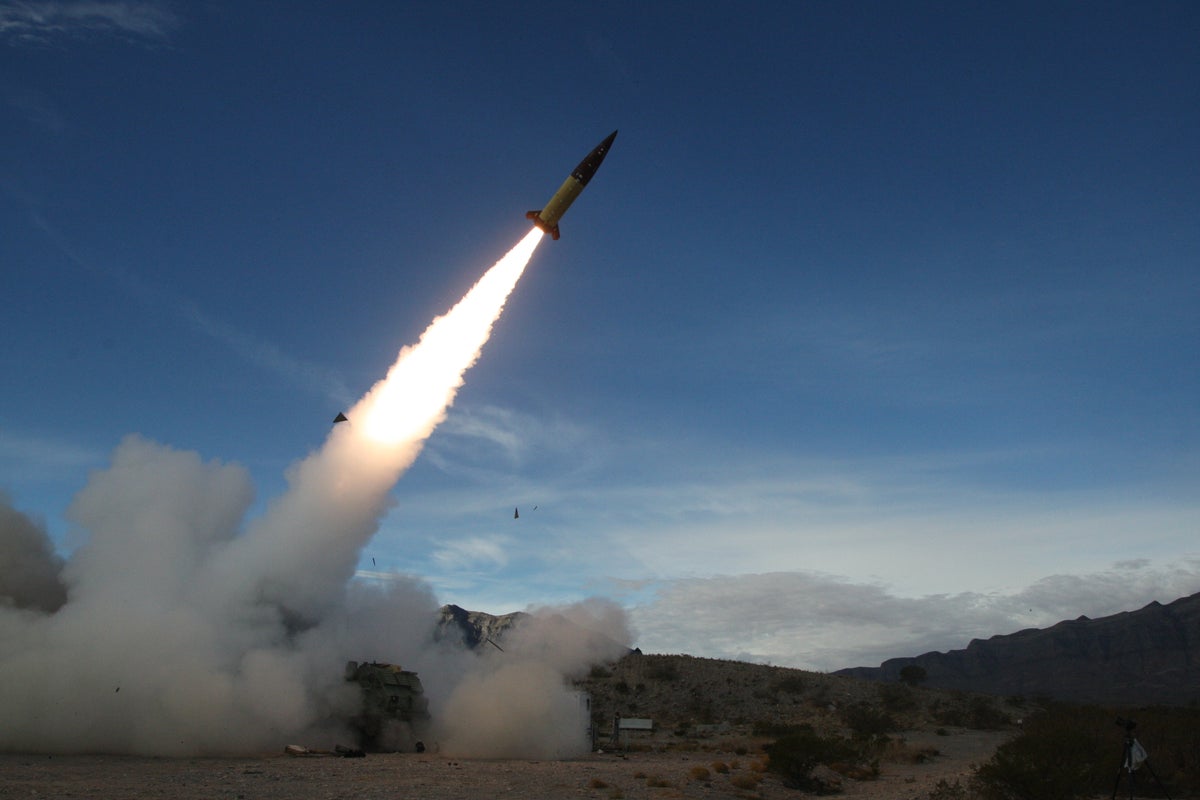
The headlines are screaming that the Pentagon has shot its wad. The lazy consensus echoing across every defense blog and cable news panel claims the United States has run out of nearly all its long-range missiles, leaving the White House stark naked in any confrontation with Iran. It is a neat, terrifying narrative. It also happens to be fundamentally illiterate when it comes to how modern industrial logistics, defense economics, and actual combat power operate.
I have spent decades watching defense analysts mistake factory delivery schedules for strategic bankruptcy. They look at a depleted stockpile count in a quarterly report, panic, and declare the cupboard bare. They assume war is a video game where you dump your entire magazine into the boss fight and then stand around waiting to reload. If you found value in this article, you should check out: this related article.
That is not how great powers fight. More importantly, that is not how Iran or any rational adversary calculates American capability.
Let us dismantle the panic. For another look on this story, refer to the recent coverage from Reuters.
The Fallacy of the Static Inventory
The core error in the mainstream panic is the belief that a nation's military strength is defined by what is sitting in a bunker today. This static view of power ignores the most terrifying asset the American military-industrial apparatus possesses: surge capacity and deep reserve substitution.
When pundits wring their hands over low counts of specific tactical precision munitions, they are usually looking at a narrow slice of high-end inventory, such as specific variants of Tomahawk cruise missiles or long-range interceptors. They treat these numbers as fixed. If we fire five hundred, and we only have eight hundred left, the doomsayers start measuring for the coffin.
This ignores the reality of asymmetric cost trades. If you are launching a multi-million-dollar interceptor at a cheap, mass-produced loitering munition, you are playing a losing economic game. But the Pentagon does not fight symmetrical attrition wars anymore. The inventory crunch is not a sign of exhaustion; it is a pricing and production friction point.
I have watched defense contractors drag their feet on line expansions during peacetime because multi-year procurement predictability is notoriously broken. But the moment a crisis hits, cash moves mountains. The industrial base does not work like a retail store that runs out of milk. It works like an assembly line that shifts from a single-shift crawl to a round-the-clock monster the second Congress opens the spigots and relaxes regulatory chokeholds.
Iran Does Not Care About Your Spreadsheet
The underlying fear driving these exhaustion narratives is that Iran will call our bluff because our missile bins look empty on paper. This assumes Tehran makes strategic decisions based on public think-tank PDF reports.
They do not.
Iran knows that an American President does not need a warehouse full of Tomahawks parked in the Persian Gulf to turn Iranian critical infrastructure into a parking lot. Long-range strike capability is not limited to surface-launched cruise missiles or expensive stealth fighters. We live in an era of distributed lethality. Submarines, long-range bombers operating from continental bases with global refuelers, and allied integrated air defenses completely rewrite the geometry of the theater.
If you think a shortage of one specific missile category leaves a superpower short of options, you are suffering from tactical myopia. Air power is not about the delivery vehicle; it is about the payload, the sensor network, and the targeting data. America holds a monopoly on global intelligence, surveillance, and reconnaissance. We know where the targets sleep, eat, and breathe. Whether the delivery mechanism is a hypersonic glide vehicle, an upgraded gravity bomb, or a repurposed anti-ship missile is an engineering detail, not a strategic ceiling.
The Cost of the Counter-Argument
To be fair, let us look at the downside of my own argument. Am I saying the supply chain is healthy? Absolutely not.
The defense acquisition process is bloated, bureaucratic, and painfully slow. We have outsourced critical propellant manufacturing and specialized chemical processing to a handful of fragile subcontractors. If a protracted, multi-theater industrial war breaks out tomorrow against peer competitors, the current manufacturing footprint would strain to keep up with high-intensity consumption rates. That is a legitimate vulnerability.
But confusing a peacetime industrial bottleneck with a total lack of strategic options is intellectual laziness. The US military is not short of options; it is short of imagination among commentators who think war is measured entirely by inventory spreadsheets.
Stop Counting Missiles and Start Watching Capabilities
If you want to understand how a confrontation with Iran or any other regional actor actually plays out, stop looking at how many missiles are stacked in a Utah depot. Look at the architecture of regional deterrence. Look at electronic warfare capacity, cyber disruption assets, and the ability to systematically blind an adversary without firing a single kinetic round.
The narrative that Washington is out of ammo is designed to generate clicks, panic politicians into rubber-stamping bloated, unearned budget increases for the wrong programs, and project weakness where structural dominance actually exists.
Next time you read a breathless breakdown about empty missile silos, remember who benefits from the panic. It is never the strategist trying to win a war; it is the merchant selling the replacement.
We are not running out of options. We are just refusing to use the right ones.