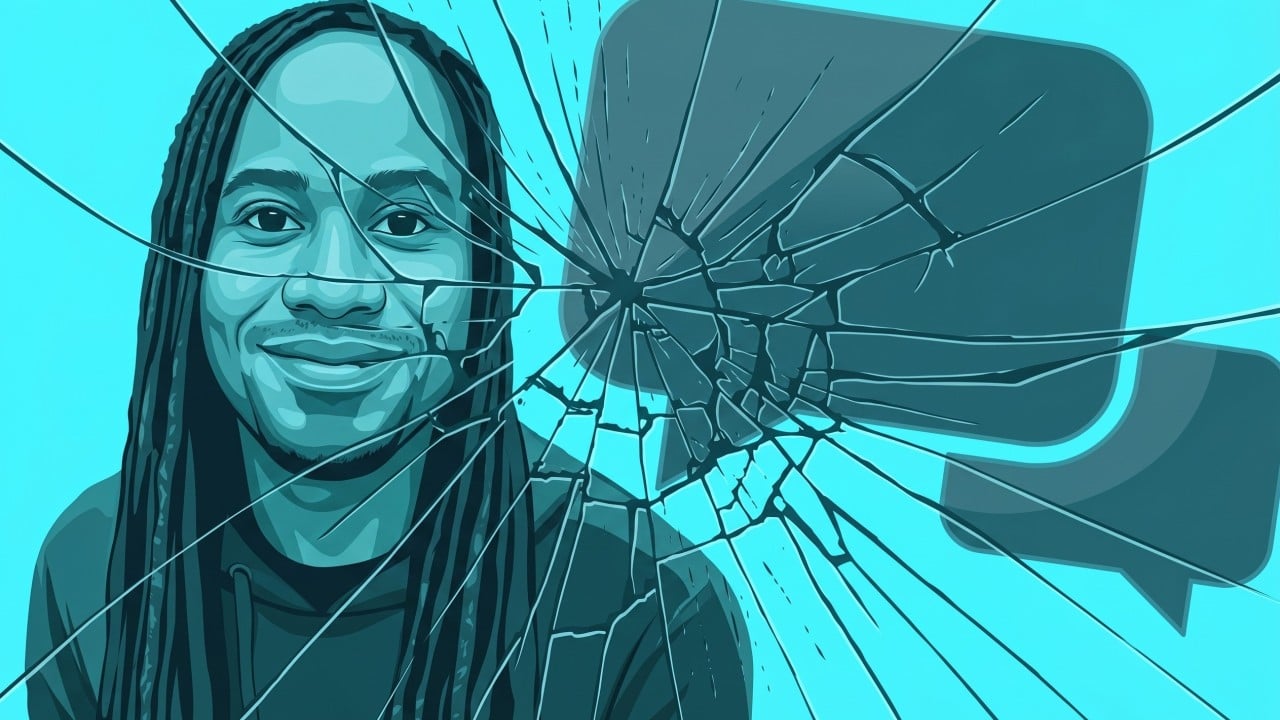
The air inside a Cambridge lecture hall smells of old paper, cold stone, and centuries of unearned certainty. When you walk across those uneven floorboards, your boots make a sound that feels entirely too loud, as if you are disturbing a conversation that started three hundred years before you were born and intended to go on just as long without your interruption.
Jason Arday knew that sound intimately.
He also knew what it meant to be the person everyone else looked at twice, not because they admired his mind, but because they were trying to calculate how he had managed to get inside the room.
When the news broke of his passing, the internet did what it always does when a person who breaks the mold is broken by the world. It turned him into a talking point. Pundits carved his life up into convenient ideological chunks, arguing fiercely over whether his ascent proved the system was finally opening its heavy oak doors or whether his struggles proved those doors were only ever propped open for show. They debated the word woke like it was a shield or a weapon, stripping away the actual human being who had spent decades staring at blank pages, fighting a neurological condition that kept him from speaking until he was eleven, and working night shifts in supermarkets just to keep the lights on while he taught himself sociology.
They missed the point entirely. Because the tragedy of Jason Arday is not a partisan football. It is the crushing, quiet toll of what happens when we demand that exceptional people perform miracles just to be granted a baseline of dignity.
Let us be honest about what a professorship at a place like Cambridge actually represents. To the public imagination, it is Hogwarts with better funding. It is an ivory tower where brilliant minds sit by crackling fires and ponder the cosmos undisturbed. But for someone who arrives at that summit from the outside—someone who did not inherit a lineage of degrees or a network of dining club acquaintances—it is something entirely different. It is an arena.
Imagine walking into a room where every single tradition is designed to remind you that your presence is an anomaly. Every portrait on the wall tells a silent story about who belongs and who merely visits. Every casual hallway conversation functions as an unspoken test of cultural fluency. You are not just doing the job you were hired to do—researching, teaching, writing, mentoring. You are carrying an invisible mountain of symbolic weight. You are proof. You are the exception that proves the rule. And if you stumble, an army of skeptics is waiting in the wings to declare that the experiment failed.
That is not an opportunity. That is a crucible.
I remember sitting in a faculty lounge years ago, listening to a senior academic marvel at a younger colleague from a working-class background. The tone was benevolent, dripping with a sickening kind of institutional pride. "We gave him a chance," the professor said, swirling amber liquid in a heavy glass. "And look how well he adapted."
Adapted. As if he had moved to a foreign country and learned to tolerate the local cuisine. Nobody ever talks about what it costs to adapt to a world that was engineered to exclude you. Nobody measures the cortisol spikes, the fractured sleep, the relentless, gnawing paranoia that comes from knowing you are always one misplaced footnote away from being invalidated.
We romanticize resilience because it lets us off the hook. When we call someone inspirational, we are often quietly absolving ourselves of the responsibility to build a fairer world. We are saying, Look how strong she is for climbing that cliff of broken glass, which completely distracts from the fact that someone deliberately strewed the cliff with broken glass in the first place.
Jason Arday did not just climb. He sprinted. He taught himself to read and write late in life, guided by a fierce mother who refused to accept the low expectations mapped out for him by a system that loved to label struggling children as hopeless. He earned degrees while working grueling hours. He published. He shouted from the margins until the center had no choice but to turn its head and listen.
And when he finally secured a professorship at Cambridge—becoming one of the youngest Black professors in the history of the institution—the headlines celebrated his triumph as a victory for modern equity.
Then came the silence. Then came the exhaustion. Then came the end.
We need to talk about the myth of the breakthrough. We live in a culture obsessed with the singular narrative of redemption, the cinematic moment where the underdog beats the odds and claims their rightful prize. Hollywood loves it. Cable news loves it. It reassures us that the machinery works, that justice is just a delayed reaction, that merit ultimately rises to the top like cream in a bottle.
It is a comforting lie.
The truth is that systemic exclusion does not stop being toxic just because a few extraordinary individuals manage to survive it. In fact, survival is often mistaken for thriving. We look at a Black man holding an endowed chair at a medieval university and we clap our hands, convinced that racism has been defeated because one brilliant mind outmaneuvered it. We fail to ask what the environment demanded of that mind to make it fit. We fail to notice the invisible fractures spreading beneath the polished surface.
Consider what happens when an institution brings in an outsider to diversify its ranks without fundamentally changing its culture. It is like transplanting a delicate orchid into frozen tundra and expecting it to flourish simply because you put a plaque next to it. The burden of translation falls entirely on the newcomer. They must translate their lived experience into academic language that validates the comfort of the comfortable. They must moderate their anger, temper their grief, and smile through the microaggressions that drift down like ash from the rafters.
If they complain, they are difficult. If they keep their heads down, they are complicit. If they break under the strain, they are fragile.
There is no winning move in a game where the board was built to exclude you from the start.
We must stop treating tragedies like this as isolated anomalies. When brilliant scholars burn out, when pioneers collapse beneath the sheer gravitational pull of institutional isolation, it is a structural failure. It is the result of a system that extracts brilliance from the margins while refusing to offer genuine shelter.
Jason Arday deserved better than to be a symbol in a culture war. He deserved a career that felt sustainable, human, and ordinary. He deserved the right to have a bad day without it turning into a referendum on his demographic. He deserved to be remembered not as a tragic martyr of progress, but as a brilliant sociologist, a devoted teacher, and a human being who gave far more to the world than the world was ever willing to protect.
The next time an institution celebrates a historic first, let us look past the press release. Let us look at the room, the walls, the expectations, and the quiet loneliness of the chair at the head of the table.
Until we change the air in the room, every victory will remain a ghost story.