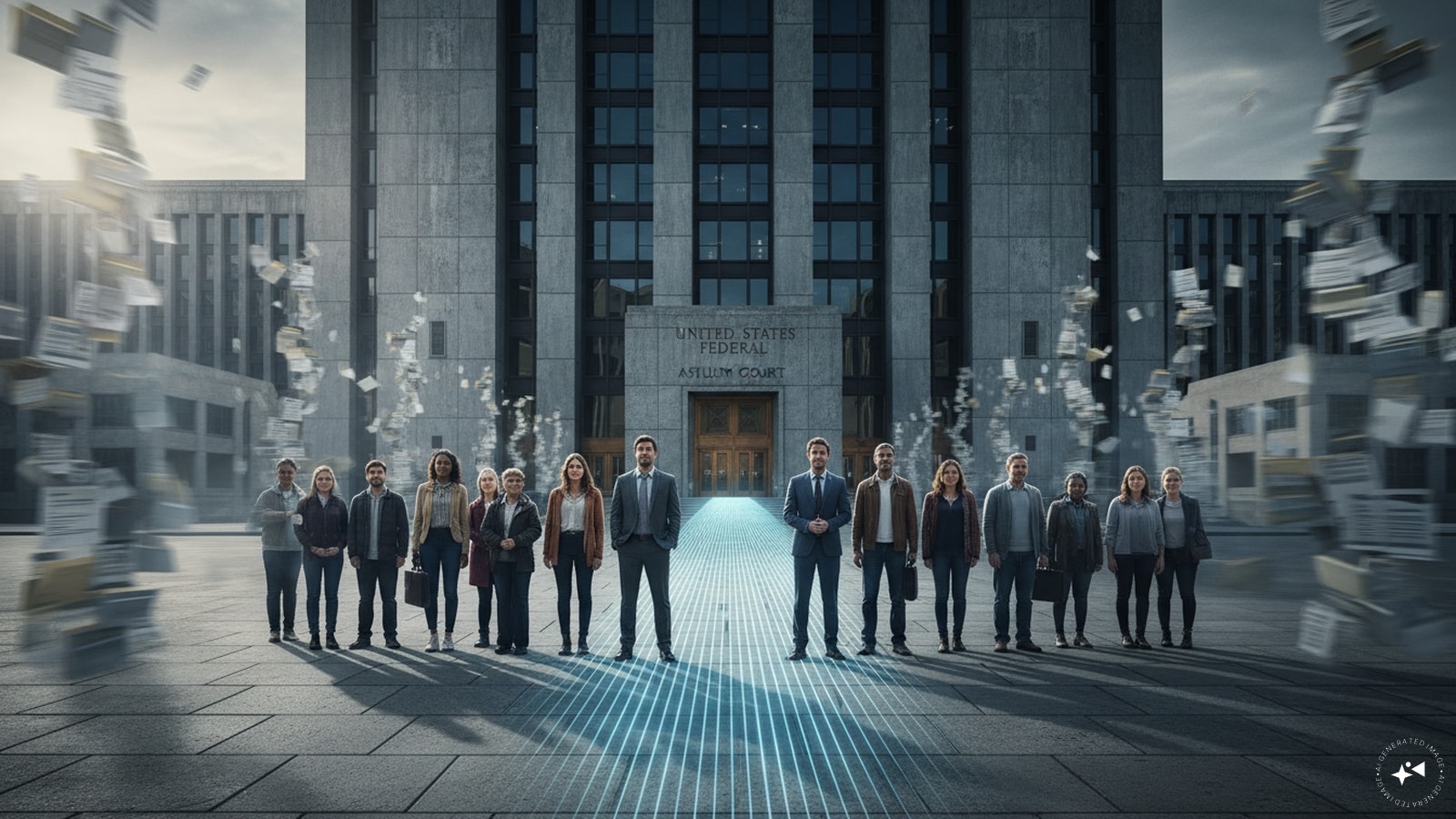
The morning air in the waiting room smells of old paper, floor wax, and collective exhaustion. A clock on the wall ticks with a mechanical indifference, measuring out lives in increments of sixty seconds. Beneath that clock sits Elena. She is not a statistic yet. Right now, she is a person holding a worn manila folder, staring at a date printed in bold ink.
That date represents a collision between human desperation and bureaucratic machinery.
We talk about immigration as a policy puzzle. We argue over borders, lines on maps, and percentages in quarterly reports. But zoom in close enough, and the vast geopolitical abstraction dissolves into the texture of a cheap plastic chair, the dry throat of a mother who left her home with two suitcases, and the quiet panic of a deadline rushing forward like a freight train.
To understand the new asylum rules introduced to fast-track cases and clear an overwhelming national backlog, you cannot just look at the flowcharts. You have to feel the friction.
The Architecture of the Wait
For years, the system moved at the speed of glacial drift. Millions of pending cases choked the immigration courts. Imagine a highway designed for fifty cars suddenly forced to swallow a continuous parade of semi-trucks. Traffic does not just slow down; it freezes solid. Years passed. People built lives in the waiting. They rented apartments, enrolled their children in local schools, found jobs in restaurants and warehouses, and integrated into communities—all while the sword of uncertainty hung suspended above their heads.
That indefinite limbo bred a unique psychological torment. To live in a state of suspended animation is to exist nowhere. You are physically present, but your future is entirely theoretical.
Then came the pivot. The Department of Justice and the Department of Homeland Security rolled out a streamlined framework designed to cut through the bureaucratic sludge. The core mechanism is simple in theory: shift initial asylum interviews away from overburdened immigration judges and place them into the hands of specialized asylum officers within U.S. Citizenship and Immigration Services. If an officer finds a credible fear, the case moves directly to a fast-tracked adjudication track rather than sitting in the multi-year court queue.
Efficiency. Speed. Relief from the backlog.
On paper, it sounds like a clean engineering solution to a clogged pipe. But human lives do not bend smoothly to engineering fixes.
Inside the Fast Lane
Speed has a price. When you accelerate a process, you compress the time available for error correction.
Consider what happens next in a fast-tracked proceeding. Under the old model, an applicant might have years to gather documentation, secure legal representation, and translate testimonies of trauma, political persecution, or violence. Lawyers could build robust dossiers. Witnesses abroad could be reached.
Now, the timeline snaps tight.
Elena received her notice under the new accelerated guidelines. The window to prepare her complete legal defense shrank from years to mere weeks. Suddenly, the abstract concept of a judicial backlog transforms into a frantic search for a pro bono attorney who is already drowning in cases. It becomes midnight phone calls across twelve time zones, trying to secure police reports or medical records from a country you had to flee in secret.
The system wants velocity. The individual needs depth. Trauma does not package itself neatly into a thirty-day window. Human memory, fractured by fear and displacement, takes time to unspool safely. When rushed, the narrative of survival can sound hesitant, disjointed, or confused—traits that an overworked bureaucracy can easily mistake for inconsistency.
This is the hidden cost of clearance rates. Every percentage point gained in reducing the backlog represents a compression of someone's margin for error.
The Human Equation
Critics of fast-tracking point to the risk of due process erosion. When cases move at breakneck speed, access to counsel plummets. Legal representation is not a luxury item in an immigration hearing; it is the difference between translation and misunderstanding, between structured legal argument and a confused monologue. Statistics consistently show that asylum seekers with legal representation are vastly more likely to successfully navigate their claims than those forced to represent themselves against trained government attorneys.
Yet, defenders of the new rules argue that the status quo was a humanitarian crisis in its own right. Leaving people in a multi-year purgatory, where they cannot legally work for extended periods or live with security, is its own form of cruelty. A fast 'no' is sometimes viewed by administrators as preferable to a grueling, decade-long 'maybe' that ends in disruption after deep roots have already been planted.
We are caught between two bad options: a slow system that collapses under its own weight, or a fast system that risks sacrificing thoroughness for speed.
Elena does not care about the policy debates. She cares about whether the officer listening to her story will understand why her voice shakes when she describes the night her storefront was firebombed. She cares about whether her children will still be able to sleep in the same beds next month.
The second hand on the waiting room clock sweeps downward. Another minute gone.
The backlog will change. The numbers on the government dashboards will shift, moving up or down based on throughput metrics and staffing allocations. Success will be claimed in press releases, and bottlenecks will be analyzed in policy briefs.
But down here, in the quiet hum of the fluorescent lights, the architecture of human lives continues to be built and unbuilt, one interview at a time, racing against a clock that never slows down.