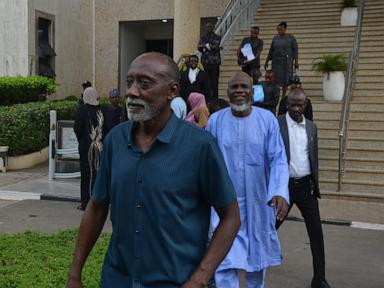
The morning air in Abuja does not move; it sits heavy, thick with the scent of exhaust and the quiet, vibrating anxiety of a city that has seen too many transitions written in blood. Inside the Federal High Court, the silence is different. It is a clinical, cold silence, punctuated only by the rhythmic shuffle of legal robes and the metallic click of handcuffs.
Ten men stand in a line. Their faces are a map of the current Nigerian psyche—exhausted, defiant, and deeply uncertain. These are not just names on a docket. They are the human faces of a charge that carries the ultimate price: treason.
To the casual observer scrolling through a news feed, the headline is a blur of legal jargon. Charges of "treason," "terrorism," and "inciting mutiny" sound like relics from a history book or the plot of a high-stakes political thriller. But for the men standing in the dock, and for the nation watching through the iron bars of social media, these words are physical. They are the difference between a life lived in the sun and a life ended in the shadow of a state executioner.
The Anatomy of a Whisper
The prosecution’s case rests on a terrifying premise. They allege that these individuals didn't just disagree with the government; they sought to dismantle it. The state claims there was a coordinated effort to use the "End Bad Governance" protests as a smokescreen for something far more predatory.
[Image of a courtroom in session]
Think of a nation’s stability like a glass sculpture. It looks solid, permanent, and imposing. But the state argues that these men were looking for the hairline fractures. The charges suggest they collaborated with a foreign national—a British citizen named Andrew Wynne—to distribute "seditious" materials and stoke the fires of an uprising.
But here is where the narrative splits.
If you sit in the gallery and listen to the defense, you hear a story of desperation. You hear about citizens who looked at the price of a bag of rice, looked at their empty pockets, and decided that silence was no longer an option. The defense paints a picture of activists, not terrorists. They describe men who used their voices because they had nothing else left to lose.
The tension in the courtroom isn't just about guilt or innocence. It’s about the definition of dissent. When does a protest stop being a democratic right and start being a threat to the existence of the Republic?
The Missing Architect
At the center of this storm is a ghost. Andrew Wynne, the man the Nigerian government labels as the mastermind, is nowhere to be found in the courtroom. He is an absence that speaks louder than the presence of the ten men in the dock.
The police have declared him wanted. They claim he operated under the alias "Andrew Povich," weaving a web of influence from a bookshop in the capital. It sounds like a spy novel, but the consequences are grounded in the harshest reality. The state alleges that Wynne provided the intellectual and financial fuel for a fire intended to consume the presidency.
Consider the logistical nightmare of a coup in the digital age. It isn't just about seizing the radio station anymore. It’s about seizing the narrative. The charges mention the "intent to intimidate the President," a phrase that feels strangely intimate. It suggests that the halls of power are not as thick as they seem.
The defendants, however, plead not guilty. Their plea is a soft sound in a large room, but it carries the weight of a mountain. One of them, a 70-year-old man, looks less like a revolutionary and more like a grandfather caught in a storm he cannot control. His presence is a visual argument against the state’s narrative of a high-octane terrorist cell.
The Invisible Stakes
Why does this matter to the person sitting in a Lagos traffic jam or a farm in Kaduna?
Because the law is a mirror. When the state invokes the Terrorism Prevention and Prohibition Act, it is exercising its most potent power. It is saying that the security of the whole outweighs the liberty of the few. But if that power is used to silence legitimate frustration, the mirror cracks.
Nigeria is a country built on a delicate balance of ethnicities, religions, and economic classes. The "End Bad Governance" protests were a rare moment of cross-sectoral unity. People were angry because they were hungry. They were loud because they were ignored.
The government’s response—this trial—is a message. It is a signal that there is a line in the sand. If you cross it, you are no longer a citizen with a grievance; you are an enemy of the state.
The prosecutors talk about "mutiny." They talk about "levying war." These are heavy, ancient words. They conjure images of bayonets and barricades. Yet, the evidence presented often boils down to social media posts and printed flyers. We are living in an era where a hashtag can be classified as a weapon of war.
A Long Night in the Cell
Justice Emeka Nwite, the presiding judge, ordered the defendants to be remanded in prison. This is the part of the story the cameras don't see.
The transition from the bright lights of the courtroom to the grey walls of Kuje or Suleja prison is a violent one. The legal arguments end. The philosophical debates about democracy vanish. There is only the thin mattress, the smell of damp concrete, and the long, slow crawl of time toward the next hearing.
For the families of the accused, the world has stopped. They stand outside the court, clutching photographs and wiping away tears that the law has no interest in. They are the collateral damage of a political struggle that is being fought over their heads.
One wife of a defendant stood near the gates, her voice a mere thread of sound. She didn't talk about treason. She talked about who would pay the school fees now that her husband was behind bars. She talked about the heart medication he forgot to take on the morning of his arrest.
These are the details that the charge sheets omit.
The Shadow of the Flag
During the protests, a strange thing happened. In several northern cities, protesters were seen waving the Russian flag. To the government, this was the smoking gun—proof of foreign interference and a desire for a military takeover.
To a historian, it was a cry for help directed at the wrong savior. To the men in the dock, it is now an albatross around their necks.
The state argues that the waving of a foreign flag is a symbolic surrender of Nigerian sovereignty. It is the visual representation of the treason they are trying to prove. But the defense argues that a flag is just a piece of cloth, a desperate signal from people who feel their own flag has failed to protect them.
The courtroom becomes a theater where the history of Nigeria is being litigated. Are we a nation that can handle the messiness of a loud, angry democracy? Or are we a nation that must use the iron fist to keep the peace?
The Trial of a Generation
This isn't just a trial of ten men. It is a trial of the Nigerian state’s ability to distinguish between a riot and a revolution.
If the state proves its case, it will have uncovered a plot that could have plunged the most populous nation in Africa into chaos. If it fails, it will have spent its credibility on a campaign to criminalize poverty and protest.
The legal process will be slow. It will be filled with technicalities, bail applications, and the droning voices of experts. But beneath the surface, the pulse of the country is quickening.
Every Nigerian knows what it feels like to be on the edge of a breakthrough or a breakdown. We live in the "in-between." We are the masters of the "manage." But the men in the dock represent the moment when the "manage" was no longer enough.
The gavel will eventually fall. Whether it brings justice or merely an end to the noise remains to be seen.
As the sun sets over the Zuma Rock, casting a long, jagged shadow toward the city, the ten men are driven away in a green van. The dust kicks up behind them, obscuring the view. The protesters are gone. The cameras are packed away. The lawyers are back in their offices, leafing through thick volumes of precedent.
But the question remains, hanging in the humid air like a threat. In a land where the cost of living has become a death sentence, who is truly committing treason: the man who demands a better life, or the system that makes him a criminal for asking?
The cells are cold tonight. The silence in Abuja is not peace; it is a held breath.