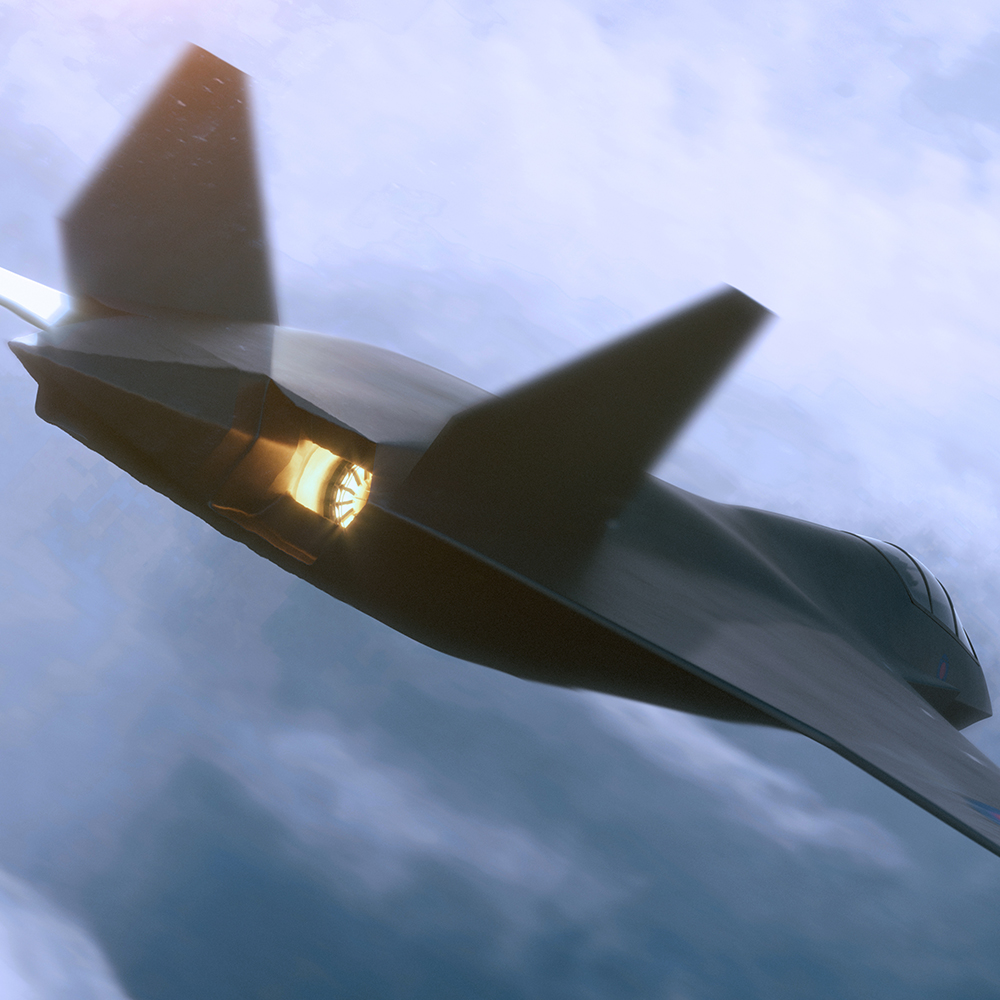
The floor of a military hangar does not feel like the birthplace of the future. It feels like a cathedral made of corrugated steel, smelling faintly of aviation fuel, ozone, and cold grease. In the center of this cavernous space sits a shape hidden beneath a heavy gray tarp. It is silent. It has no pulse. Yet, the billions of pounds recently injected into defense budgets mean this silent shape is about to change the geopolitics of the next half-century.
Most people read the headlines about increased defense spending and see abstract numbers. They see rows of zeros on a spreadsheet, a political talking point debated by suits in television studios. They miss the human hands that turn those numbers into titanium and software. They miss the engineering teams staring at glowing monitors at three in the morning, trying to solve a problem that has never existed before: how to build a combat jet that thinks faster than the person flying it.
Consider a hypothetical engineer named Sarah. She has spent seven years designing a single component of the wing assembly for BAE Systems' next-generation fighter. If Sarah does her job perfectly, nobody will ever know her name. If she fails, a pilot miles above an ocean loses control. The funding boost isn't just a political victory for defense contractors. For people like Sarah, it is the difference between a project that dies on a whiteboard and a machine that screams into the stratosphere.
The reality of modern aerial warfare is terrifyingly simple. The old metrics of speed and armor are obsolete. Today, the sky belongs to whoever can process data the fastest. The next-generation combat jet is less of an airplane and more of a flying supercomputer wrapped in a stealth hull. It is designed to coordinate fleets of uncrewed drones, sift through petabytes of electronic noise, and make decisions in fractions of a millisecond.
But building something that complex requires more than just ingenuity. It requires a staggering, almost incomprehensible amount of capital.
When governments pledge billions to defense, the public often reacts with a mix of resignation and skepticism. Why spend so much on machines designed for conflicts we hope will never happen? It is a fair question. The answer lies in the concept of deterrence, a psychological game where the ultimate measure of success is a weapon that never has to fire a single shot in anger. The money is spent to buy stability, to ensure that the balance of power remains predictable in an unpredictable world.
Walk through the design facilities where this aircraft is taking shape, and the tension is palpable. The atmosphere is a strange mix of university lab and military outpost. Young programmers, recruited straight from top-tier universities, sit next to veterans who worked on the Tornado and the Typhoon. There is a generational clash of ideas happening here. The older generation understands the brutal physics of flight—the raw, unforgiving forces that rip metal apart at Mach 2. The younger generation understands the fluid, chaotic world of artificial intelligence and cyber warfare.
The newly secured funding acts as the bridge between these two worlds. It allows the team to build physical prototypes instead of relying purely on digital simulations. There is a profound difference between seeing a wing stress-test on a screen and watching a hydraulic press bend a real carbon-fiber spar until it groans.
The stakes extend far beyond the hangar doors. Every major defense project supports a massive network of suppliers—small machine shops, specialized software houses, and material science labs scattered across the country. A sudden influx of capital ripples through these communities, keeping high-skilled manufacturing alive in towns that the modern tech economy usually overlooks. It is an economic ecosystem disguised as a military program.
Yet, a cloud of uncertainty always hangs over projects of this scale. Technology moves faster than bureaucracy. A system designed today might be entirely obsolete by the time the aircraft enters active service a decade from now. Engineers are essentially trying to predict the future, guessing what kinds of threats will emerge in the 2030s and 2040s. It is an exercise in managed anxiety. They are building a platform that must be infinitely adaptable, capable of being rewritten and upgraded on the fly.
The tarp in the hangar remains still, but the energy around it is shifting. The blueprints are turning into hardware. The software is learning how to fly. As the funding secures the immediate future of the program, the abstract debates of policymakers fade into the background, replaced by the immediate, practical reality of manufacturing.
The next time you look up and hear the distant, tearing roar of a jet engine cutting through the clouds, remember that you aren't just hearing physics at work. You are hearing the culmination of millions of hours of human labor, billions of pieces of data, and a collective gamble that peace can be maintained through the sheer, overwhelming sophistication of our machines.