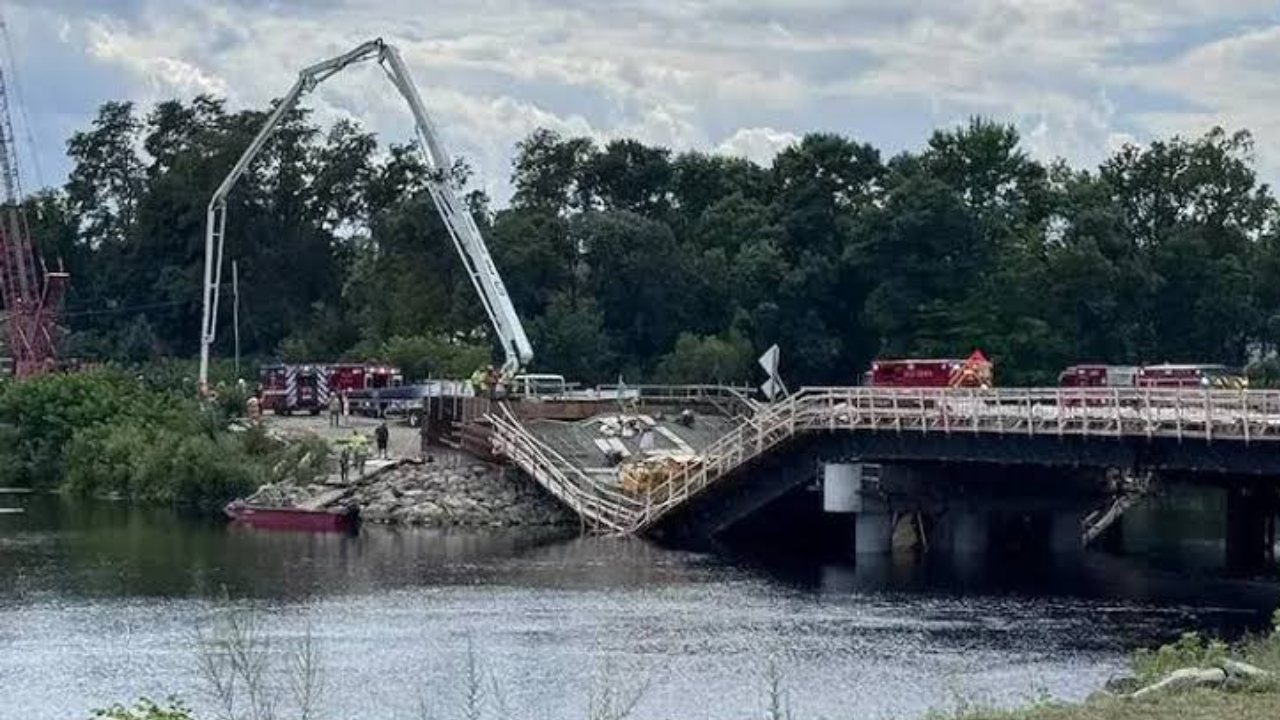
Civil engineering projects are supposed to look routine until they suddenly aren't. When a newly constructed section of the Llewellyn Estes Bridge in Old Town, Maine, buckled and partially collapsed on August 13, it caught the entire construction community off guard. Crews were actively pouring wet concrete for the bridge deck over the Stillwater River when the structure gave way, injuring three workers and turning a standard infrastructure replacement into a high-stakes forensic investigation.
Months later, the real work of untangling the engineering failure is happening on-site as crews methodically dismantle the ruined spans. If you want to understand how modern bridge construction fails under live loads, this incident serves as a rare, sobering case study.
The Anatomy of a Concrete Deck Pour Failure
Pouring a bridge deck is high-stress work. Wet concrete is punishingly heavy. As pumps push tons of fluid material across formwork, every single component of the temporary and permanent support system experiences maximum design loads.
In the Old Town project, which is designed to replace aging infrastructure carrying Stillwater Avenue across the river, the August 13 failure happened mid-pour. Early findings released by the Maine Department of Transportation point toward a localized structural trigger. Investigators suggest an outer structural beam may have failed first, setting off a chain reaction that compromised adjacent beams and brought down the fresh deck section.
Three workers sustained injuries during the collapse—including one broken ankle and two others treated for minor conditions. It could have been much worse. Because the bridge was still entirely under construction and closed to public traffic, civilian vehicles were kept out of harm's way.
Dismantling the Damage Before the Rebuild
You can't engineer a fix until you clear the wreckage. Transport officials and contractors spent weeks mapping out a controlled demolition plan. Heavy machinery and rigging crews moved in to lift the broken, concrete-laden steel and structural elements out of the Stillwater River.
Clearing the site isn't just about cleaning up. It's an essential forensic step. Engineers need to inspect the stress points, fracture faces, and connection points of the fallen girders. Federal agencies, including the Federal Highway Administration and OSHA, have collaborated with state inspectors to analyze computer models and material samples. Until every twisted beam is pulled apart and tested, nobody can sign off on a revised construction schedule.
Impact on Local Traffic and Infrastructure Timelines
Major infrastructure failures always ripple outward. Local drivers have had to deal with detours routed along Bennoch Road, North Main Street, and College Avenue while heavy recovery work takes place. Fortunately, state safety teams checked adjacent temporary bridges in the immediate aftermath and confirmed they remained stable and safe for public use.
The bigger question is project momentum. Replacing regional river crossings requires tight coordination between state funding, contractor timelines, and material suppliers. With the unexpected delay of clearing a collapsed span, the Llewellyn Estes Bridge project timeline remains fluid. Maine transport officials have promised transparent updates once the forensic teardown yields definitive answers.
Construction setbacks like this remind us that infrastructure renewal is inherently risky. Safety protocols and rigorous post-failure analysis protect crews today and prevent similar structural failures tomorrow.
The video above covers the engineering investigation and ongoing teardown of the damaged Stillwater River spans.