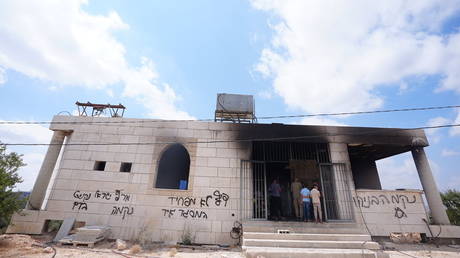
The headlines write themselves. Smoke rises, a building burns, and the digital outrage machine grinds into gear. You have seen the reports about mosques torched in the West Bank. The immediate reaction is a pre-programmed moral hierarchy: victims are assigned, villains are cast, and the cycle of geopolitical grievance spins onward.
If you consume this as a morality play, you are being played. Meanwhile, you can explore other events here: Why Seven PLAN Vessels Near Taiwan Change the Game Right Now.
The standard media framing relies on the assumption that these incidents are random bursts of radicalized violence. This is the lazy consensus. It ignores the mechanics of asymmetric conflict. When you view these events purely through a lens of arson and communal friction, you miss the tactical reality: the degradation of symbolic infrastructure is almost never about the structure itself. It is about accelerating the friction that makes normal governance impossible.
The Illusion of Random Violence
The popular narrative paints these acts as inexplicable outbursts from fringe elements. That is a comforting fiction. In high-stakes territorial disputes, nothing is random. The arson of a mosque or any other local landmark serves as a psychological trigger. It is a signal meant to force a reaction from leadership on both sides. To understand the complete picture, we recommend the excellent analysis by The Guardian.
When a structure burns, it creates a vacuum. That vacuum must be filled with either silence or retribution. By baiting this reaction, the actors involved—regardless of which flag they carry—ensure that the conflict remains centered on emotional grievances rather than the tangible, boring, and difficult work of regional stability.
I have spent enough time in conflict zones to know the smell of a staged crisis. When you look at the geography of these incidents, you see a pattern of selection that favors maximum visibility over tactical gain. This isn't about destroying a place of worship; it is about destroying the possibility of coexistence by providing concrete proof that it has already failed.
Why You Are Asking the Wrong Questions
Most coverage asks: "Who did this?" and "How can we stop the cycle?" These questions are useless. They assume the cycle is a bug in the system. It is the system.
The more relevant question is: "Who benefits when the news cycle turns away from policy and toward flames?"
The stakeholders in this conflict have become masters of the performative outrage loop. By forcing the international community to fixate on individual acts of vandalism, the parties involved successfully dodge accountability for broader, more systemic failures. It is a classic misdirection. As long as the world is debating who lit the match, nobody is talking about land use, administrative law, or the actual economic mechanics that keep the region in a state of suspended animation.
The Strategic Value of Friction
Let's conduct a thought experiment. Imagine a scenario where the headlines regarding these incidents vanish overnight. Suppose every news outlet decided to stop reporting on isolated acts of arson and instead focused exclusively on the glacial movement of building permits and civil court rulings in the region.
The temperature of the conflict would plummet within a week.
Violence of this sort relies on the oxygen of public attention. Without the amplified signal of a trending social media topic or a top-tier news banner, the strategic utility of burning a mosque drops to zero. It becomes merely a crime, not a geopolitical event. Yet, the media refuses to pivot. They crave the spectacle because the spectacle sells. They need the outrage because an engaged audience is a monetizable one.
The Industry Blind Spot
There is a profound lack of intellectual honesty in current reporting. Journalists rarely acknowledge that by framing these events as purely religious or ethnic clashes, they are doing the work of the agitators. They are providing the exact response the perpetrators seek.
If you want to understand the reality, you have to stop looking at the fire and start looking at the maps. The tension in the West Bank is rarely about theology. It is about the physical realities of borders, electricity grids, and water rights. These issues are complex, dry, and resistant to pithy tweets. Arson is easy. It is visceral. It fits into a 280-character box. It is the preferred language of those who want to keep the conflict perpetually hot so that the deeper, structural questions never get answered.
The Real Cost of the Narrative
When we accept the standard framing, we effectively subsidize the status quo. We validate the idea that this conflict is an eternal, inevitable grind between two sides who just can't stop hurting each other.
That is a lie. It is a managed conflict. It is managed by people who know exactly how to manipulate your perception of justice. The burning of a building is a symptom of a deeper paralysis, but it is not the disease. The disease is the lack of a functional, long-term framework that makes such acts irrelevant rather than incendiary.
You are being asked to pick a side in a fight that is designed to prevent you from seeing the boardroom. Every time you share a headline about a torched building without digging into the underlying administrative failures that made the environment ripe for such extremism, you are helping the people who want this to continue.
Stop looking at the flames and start following the money and the policy decisions that lead to the tension. The fire is just a distraction. Real change only happens when you stop responding to the signals they send and start interrogating the silence they are trying to hide.
The next time you see the outrage cycle spin up over a local tragedy, ask yourself who gains the most from your anger. It isn't the people on the ground. It is the architects of the perpetual crisis. They don't want peace; they want to keep you focused on the smoke so you never notice who is holding the torch.